Results by title
97 books match the query 'Geopolitics' and 7 start with s

Savage Ecology
War and Geopolitics at the End of the WorldJairus Victor Grove
Duke University Press, 2019
Jairus Victor Grove contends that we live in a world made by war. In Savage Ecology he offers an ecological theory of geopolitics that argues that contemporary global crises are better understood when considered within the larger history of international politics. Infusing international relations with the theoretical interventions of fields ranging from new materialism to political theory, Grove shows how political violence is the principal force behind climate change, mass extinction, slavery, genocide, extractive capitalism, and other catastrophes. Grove analyzes a variety of subjects—from improvised explosive devices and drones to artificial intelligence and brain science—to outline how geopolitics is the violent pursuit of a way of living that comes at the expense of others. Pointing out that much of the damage being done to the earth and its inhabitants stems from colonialism, Grove suggests that the Anthropocene may be better described by the term Eurocene. The key to changing the planet's trajectory, Grove proposes, begins by acknowledging both the earth-shaping force of geopolitical violence and the demands apocalypses make for fashioning new ways of living.
[more]
Scripts of Blackness
Race, Cultural Nationalism, and U.S. Colonialism in Puerto RicoIsar P. Godreau
University of Illinois Press, 2015
The geopolitical influence of the United States informs the processes of racialization in Puerto Rico, including the construction of black places. In Scripts of Blackness, Isar P. Godreau explores how Puerto Rican national discourses about race--created to overcome U.S. colonial power--simultaneously privilege whiteness, typecast blackness, and silence charges of racism.
Based on an ethnographic study of the barrio of San Antón in the city of Ponce, Scripts of Blackness examines institutional and local representations of blackness as developing from a power-laden process that is inherently selective and political, not neutral or natural. Godreau traces the presumed benevolence or triviality of slavery in Puerto Rico, the favoring of a Spanish colonial whiteness (under a hispanophile discourse), and the insistence on a harmonious race mixture as discourses that thrive on a presumed contrast with the United States that also characterize Puerto Rico as morally superior. In so doing, she outlines the debates, social hierarchies, and colonial discourses that inform the racialization of San Antón and its residents as black.
Mining ethnographic materials and anthropological and historical research, Scripts of Blackness provides powerful insights into the critical political, economic, and historical context behind the strategic deployment of blackness, whiteness, and racial mixture.
[more]
Securitizing Youth
Young People’s Roles in the Global Peace and Security AgendaMarisa O. Ensor
Rutgers University Press, 2021
Securitizing Youth offers new insights on young people’s engagement in a wide range of contexts related to the peace and security field. It presents empirical findings on the challenges and opportunities faced by young women and men in their efforts to build more peaceful, inclusive, and environmentally secure societies. The chapters included in this edited volume examine the diversity and complexity of young people’s engagement for peace and security in different countries across the globe and in different types and phases of conflict and violence, including both conflict-affected and relatively peaceful societies. Chapter contributors, young peacebuilders, and seasoned scholars and practitioners alike propose ways to support youth’s agency and facilitate their meaningful participation in decision-making. The chapters are organized around five broad thematic issues that correspond to the 5 Pillars of Action identified by UN Security Council Resolution 2250. Lessons learned are intended to inform the global youth, peace, and security agenda so that it better responds to on-the-ground realities, hence promoting more sustainable and inclusive approaches to long-lasting peace.
[more]
Somatic States
On Cartography, Geobodies, Bodily IntegrityFranck Billé
Duke University Press, 2025
In Somatic States, Franck Billé examines the conceptual link between the nation-state and the body, particularly the visceral and affective attachment to the state and the symbolic significance of its borders. Billé argues that corporeal analogies to the nation-state are not simply poetic or allegorical but reflect a genuine association of the individual body with the national outline—an identification greatly facilitated by the emergence of the national map. Billé charts the evolution of cartographic practices and the role that political maps have played in transforming notions of territorial sovereignty. He shows how states routinely and effectively mobilize corporeal narratives, such as framing territorial loss through metaphors of dismemberment and mutilation. Despite the current complexity of geopolitics and neoliberalism, Billé demonstrates that corporeality and bodily metaphors remain viscerally powerful because they offer a seemingly simple way to apprehend the abstract nature of the nation-state.
[more]
Soviet Occupation of Romania, Hungary, and Austria 1944/45–1948/49
László Borhi
Central European University Press, 2015
This book compares the various aspects – political, military economic – of Soviet occupation in Austria, Hungary and Romania. Using documents found in Austrian, Hungarian, Romanian and Russian archives the authors argue that the nature of Soviet foreign policy has been misunderstood. Existing literature has focused on the Soviet foreign policy from a political perspective; when and why Stalin made the decision to introduce Bolshevik political systems in the Soviet sphere of influence. This book will show that the Soviet conquest of East-Central Europe had an imperial dimension as well and allowed the Soviet Union to use the territory it occupied as military and economic space. The final dimension of the book details the tragically human experiences of Soviet occupation: atrocities, rape, plundering and deportations.
[more]
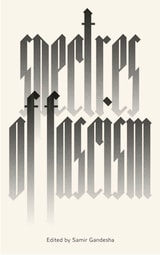
Spectres of Fascism
Historical, Theoretical and International PerspectivesSamir Gandesha
Pluto Press, 2020
Concerns over the rise of fascism have been preoccupied with the Trump presidency and the Brexit vote in the UK, yet, globally, we are witnessing a turn towards anti-democratic and illiberal forces. From the tragic denouement of the Egyptian Revolution to the consolidation of the so-called Gujarat Model in India under the leadership of Prime Minister Narendra Modi and the consolidation of the power of Turkish President Recep Tayyip Erdogan, to the recent election of Jair Bolsonaro in Brazil, fascist ideology, aesthetics and fascist personalities appear across the globe. Spectres of Fascism makes a significant contribution to the unfolding discussion on whether what we are witnessing today is best understood as a return to classic twentieth-century ‘fascism,’ or some species of what has been called ‘post-fascism.’ Applying a uniquely global perspective, it combines analyses of historical contexts, theoretical approaches and contemporary geopolitics.
[more]
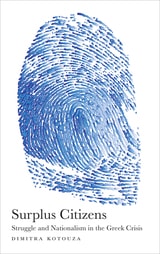
Surplus Citizens
Struggle and Nationalism in the Greek CrisisDimitra Kotouza
Pluto Press, 2018
The crisis in Greece has elicited the full spectrum of responses - from optimism for a left parliamentary politics inspired by Syriza's electoral victory, to pessimism about the intransigence of the EU and calls for the reinstatement of full national sovereignty in Europe. In Surplus Citizens, Dimitra Kotouza questions the terms of the debate by demonstrating how the national framing of social contestation posed obstacles to transformative collective action, but also how this framing has been challenged. Analysing the increasing superfluousness of subordinate classes in Greece as part of a global phenomenon with racialised and gendered dimensions, the book interrogates the strengths, contradictions and limits of collective action and identity in the crisis, from the movement of the squares and neighbourhood assemblies, to new forms of labour activism, environmental struggles, immigrant protests, anti-fascism and pro-refugee activism. Arguing against the strategic fixation on unified identities and pointing instead to the transformative potential of internal dispute within movements, Surplus Citizens highlights the relevance of a discussion of Greece to collective action beyond it, as we continue to traverse a global financial crisis that has provoked conflicts over nationalism, immigration and the rise of neo-fascism.
[more]