Results by title
64 books match the query 'Georgia' and 7 start with s

Scarlett's Women
Gone With the Wind and Its Female FansTaylor, Helen
Rutgers University Press, 1989

Scarlett's Women
Gone With the Wind and Its Female FansTaylor, Helen
Rutgers University Press, 1969

Silent Alarm
On the Edge with a Deaf EMTSteven L. Schrader
Gallaudet University Press, 1995
For 15 years, Steven Schrader worked as a firefighter and an Emergency Medical Technician (EMT) in Atlanta, Georgia. There, he faced the day-to-day stress created by having to deal with nonstop human catastrophe, one moment administering to terribly hurt accident victims, the next talking down a suicidal person from a rooftop. Added to these difficulties were his own personal struggles, not the least being the bias he experienced because of his severe hearing loss. Silent Alarm presents his no-frills, stunning account of survival in a profession with a notoriously high burn-out rate, and the good that he did as a topnotch EMT.
Schrader makes palpable the constant tension of being the first summoned to life-or-death situations, and he also outlines the grim reality of being an EMT in dangerous parts of the community. “Always wear a bulletproof vest; keep a weapon (out of sight of the supervisors, of course); never, never stand in front of a door when knocking,” are just a few of his rules for the street.
Despite these cautions, time and again he and his partners plunged into danger to save children, elderly citizens, indigents, criminals, and any other persons they found at risk. His hearing loss occasionally hindered him, and sometimes saved him, but, mostly, as it should, it became part of the background to the astonishing compassion in the stories he tells.
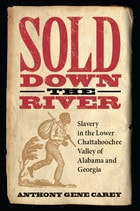
Sold Down the River
Slavery in the Lower Chattahoochee Valley of Alabama and GeorgiaAnthony Gene Carey
University of Alabama Press, 2023
Examines a small part of slavery’s North American domain, the lower Chattahoochee River Valley between Alabama and Georgia
In the New World, the buying and selling of slaves and of the commodities that they produced generated immense wealth, which reshaped existing societies and helped build new ones. From small beginnings, slavery in North America expanded until it furnished the foundation for two extraordinarily rich and powerful slave societies, the United States of America and then the Confederate States of America. The expansion and concentration of slavery into what became the Confederacy in 1861 was arguably the most momentous development after nationhood itself in the early history of the American republic.
This book examines a relatively small part of slavery’s North American domain, the lower Chattahoochee river Valley between Alabama and Georgia. Although geographically at the heart of Dixie, the valley was among the youngest parts of the Old South; only thirty-seven years separate the founding of Columbus, Georgia, and the collapse of the Confederacy. In those years, the area was overrun by a slave society characterized by astonishing demographic, territorial, and economic expansion. Valley counties of Georgia and Alabama became places where everything had its price, and where property rights in enslaved persons formed the basis of economic activity. Sold Down the River examines a microcosm of slavery as it was experienced in an archetypical southern locale through its effect on individual people, as much as can be determined from primary sources.
Published in cooperation with the Historic Chattahoochee Commission and the Troup County Historical Society.
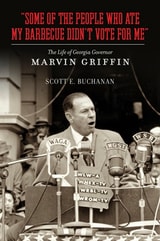
Some of the People Who Ate My Barbecue Didn't Vote for Me
The Life of Georgia Governor Marvin GriffinScott E. Buchanan
Vanderbilt University Press, 2011
.
In "Some of the People Who Ate My Barbecue Didn't Vote for Me," Scott Buchanan portrays Marvin Griffin as a Yellow Dog Democrat struggling against inevitable change. Griffin was viewed by many as a charismatic voice of resistance in the Georgia and the South in the wake of Brown v. Board of Education. He combined a staunch segregationist approach with economically progressive policies, assisting in Georgia's transformation from an agrarian economy to a more industrialized one.
Ironically, it was these efforts and the larger shift in politics that doomed Griffin's career, ensuring his administration would last only one term. In many ways, Griffin stands as a clear dividing line between the Old South and the New.
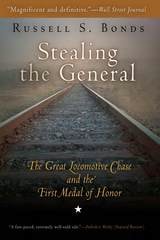
Stealing the General
The Great Locomotive Chase and the First Medal of HonorRussell S. Bonds
Westholme Publishing, 2007
Selected by Civil War Interactive as One of the Top Civil War Books of All Time
On April 12, 1862—one year to the day after Confederate guns opened on Fort Sumter and started the Civil War—a tall, mysterious smuggler and self-appointed Union spy named James J. Andrews and nineteen infantry volunteers infiltrated north Georgia and stole a steam engine called the General. Racing northward at speeds approaching sixty miles an hour, cutting telegraph lines and destroying track along the way, Andrews planned to open East Tennessee to the Union army, cutting off men and matériel from the Confederate forces in Virginia. If they succeeded, Andrews and his raiders could change the course of the war. But the General's young conductor, William A. Fuller, chased the stolen train first on foot, then by handcar, and finally aboard another engine, the Texas. He pursued the General until, running out of wood and water, Andrews and his men abandoned the doomed locomotive, ending the adventure that would soon be famous as The Great Locomotive Chase. But the ordeal of the soldiers involved was just beginning. In the days that followed, the "engine thieves" were hunted down and captured. Eight were tried and executed as spies, including Andrews. Eight others made a daring escape to freedom, including two assisted by a network of slaves and Union sympathizers. For their actions, before a personal audience with President Abraham Lincoln, six of the raiders became the first men in American history to be awarded the Medal of Honor—the nation's highest decoration for gallantry.
Americans north and south, both at the time and ever since, have been astounded and fascinated by this daring raid. But until now, there has not been a complete history of the entire episode and the fates of all those involved. Based on eyewitness accounts, as well as correspondence, diaries, military records, newspaper reports, deposition testimony and other primary sources, Stealing the General: The Great Locomotive Chase and the First Medal of Honor by Russell S. Bonds is a blend of meticulous research and compelling narrative that is now considered to be the definitive history of "the boldest adventure of the war."
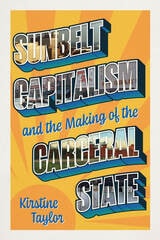
Sunbelt Capitalism and the Making of the Carceral State
Kirstine Taylor
University of Chicago Press, 2025
The story of how the American South became the most incarcerated region in the world’s most incarcerated nation.
Sunbelt Capitalism and the Making of the Carceral State examines the evolution of southern criminal punishment from Jim Crow to the dawn of mass incarceration, charting this definitive era of carceral transformation and expansion in the southern United States. The demise of the county chain gang, the professionalization of police, and the construction of large-scale prisons were among the sweeping changes that forever altered the southern landscape and bolstered the region’s capacity to punish. What prompted this southern revolution in criminal punishment?
Kirstine Taylor argues that the crisis in the cotton fields and the arrival of Sunbelt capitalism in the south’s rising metropolises prompted lawmakers to build expansive, modern criminal punishment systems in response to Brown v. Board of Education and the Black freedom movements of the 1960s and ‘70s. Taking us inside industry-hunting expeditions, school desegregation battles, the sit-in movement, prisoners’ labor unions, and policy commissions, Taylor tells the story of how a modernizing south became the most incarcerated region in the globe’s most incarcerated nation.