Results by title
212 books match the query 'German' and 12 start with s
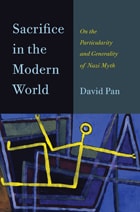
Sacrifice in the Modern World
On the Particularity and Generality of Nazi MythDavid Pan
Northwestern University Press, 2012
A landmark book, David Pan’s Sacrifice in the Modern World seeks to explain the continuing emphasis, in modern times, on sacrifice. Pan specifically turns to the culture of sacrifice—ritualized and sanctified death—in Nazi Germany, showing how that regime co-opted an existing discussion of sacrifice and infused it with its own mythology. Pan suggests that sacrifice is a key value in every society but that there is a preponderance of association of sacrifice with Nazi culture and therefore a largely pejorative treatment of sacrifice.
Surveying the arguments of philosopher Alfred Baeumler and other symptomatic Nazi texts, Pan shows how the Nazis’ reactionary intellectual culture unraveled much of the Enlightenment project. In so doing, he is able to offer a compelling new perspective on basic theoretical concepts in the work of Kant, Nietzsche, Adorno, Bataille, Girard, and others. He posits that it is only by clearing our way through the Nazis’ misuse of sacrifice that we can understand the durability of sacrificial structures that—following several of the theorists he discusses— establish the fundamental values by which we live our lives.
Rather than condemning the Nazi appeal to sacrifice itself, this book looks at the particular ways in which sacrifice was distributed and structured within that society. All cultures must grapple with the existential violence of the human condition, and they frequently do so through aesthetic treatments of sacrifice, rooted in myths and traditions. Pan argues that our task is not to eradicate these traditions but to engage them by carefully evaluating the commitments and values that they imply.
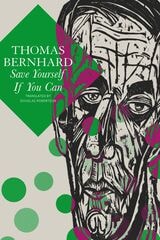
Save Yourself If You Can
Six PlaysThomas Bernhard
Seagull Books, 2023
Save Yourself if You Can is a collection of six plays that span the entirety of Thomas Bernhard’s career as a dramatist. The plays collected in this long-awaited addition to Bernhard’s oeuvre in English—The Ignoramus and the Madman, The Celebrities, Immanuel Kant, The Goal Attained, Simply Complicated, and Elizabeth II—traverse somber lyricism and misanthropy to biting satire and glorious slapstick. They explore themes that will be familiar to longtime readers of Bernhardt, but here they are presented in a subtly different register, attuned to the needs of the stage.
Seasonal Time Change
Selected PoemsMichael Krüger
Seagull Books, 2015
Bearing witness to Krüger’s interactions with renowned poets and artists through his time as director of Hanser publishing house, proximity and relationships are ongoing themes in this volume. Together, the poems remind us of our own mortality and of the finiteness of nature, but also our need for celebration even—perhaps especially—in times of darkness.
Sebastian Dreaming
Georg Trakl
Seagull Books, 2016
A century later, the book appears for the first time in English. While a number of its poems have been included in other collections, translator James Reidel argues that this particular book deserves to stand on its own and be read as one piece, as Trakl intended. Only by doing this can we begin to see Trakl in his proper time and place, as an early modern poet whose words nonetheless continue to exert a powerful hold on us while we make our way through a new, uncharted century.
Selective Affinities
Literature and New Critical TheoryRita Felski
University of Chicago Press, 2026
Rita Felski’s new work brings literary studies into conversation with more affirmative and democratic forms of critical theory.
Literary critics associate the phrase “Frankfurt School” with early twentieth-century thinkers like Adorno or Benjamin, but contemporary German critical theory remains largely unknown. In this new book, Rita Felski draws on the work of a group of important philosophers and social theorists to offer fresh readings of literary texts by Robert Walser, Didier Eribon, Zadie Smith, Magda Szabo, John Williams, and Dionne Brand.
Through five key concepts derived from her reading of German theory—disclosure, recognition, self-realization, lifeworld, and resonance—Felski asks how these literary texts articulate the relationship between intellectuals and others. Contrary to critical theories that discount everyday experience, new German thought reveals the ethical, existential, and political richness of such experience. Through this framework, Felski shows that literature, theory, and experience are not opposed but mutually constitutive.
Sex Changes with Kleist
Katrin Pahl
Northwestern University Press, 2019
Focusing on the theatricality of Kleist’s interventions in the performance of gender, sexuality, and emotion and examining how his dramatic texts unhinge major tenets of classical European theater, Sex Changes with Kleist is vital reading for anyone interested in queer studies, feminist studies, performance studies, literary studies, or emotion studies. This book changes our understanding of Kleist and breathes new life into queer thought.

Shining Sheep
PoemsUlrike Almut Sandig
Seagull Books, 2024
In the beginning, was the light, or was it the Lumières? In Ulrike Almut Sandig’s latest volume of poetry, it is only a leap from the creation of the world to the symphony of the Berlin metropolis. And there is a question holding out off the coast of Lampedusa: Can shining sheep be used as night storage for the dark hours, when we are overwhelmed with fears of God, of a gym teacher with a whistle, of mothers with eyes as black as coal? In devastating sequences, Sandig charts the reality of an abused child, victims of contemporary war, or a fourteenth-century Madonna. Full of humor, musicality, lightness, and rage, Shining Sheep is not just visual poetry—it has loops in your ear and filmic explosions of imagery for all your senses.
Sociability and Its Enemies
German Political Theory After 1945Jakob Norberg
Northwestern University Press, 2014

Society and its Outsiders in the Novels of Jakob Wassermann
Katharina Volckmer
University of London Press, 2016

Squandered Advice
Ilse Aichinger
Seagull Books, 2022
Austrian writer Ilse Aichinger (1921–2016) was a member of the Gruppe 47 writers’ group, which sought to renew German-language literature after World War II. From a wide-ranging literary career that encompassed all genres, Squandered Advice was Aichinger’s sole poetry collection. The book gathers poems written over several decades, yet Aichinger’s poetic voice remains remarkably consistent, frequently addressing us or a third party, often in the imperative, with many poems written in the form of a question. Even though they use free verse throughout, the poems are still tightly structured, often around sounds or repetition, using spare language. Phrases are often fragmentary, torn off, and juxtaposed as if in a collage. Isolated and haunting, the images are at times everyday, at other times surreal, suggesting dreams or memories. The tone ranges from reassuring and gentle to disjointed and disturbing, but the volume was carefully composed by the author into an integral whole, not chronological but following its own poetic logic. This new translation makes Aichinger’s critically acclaimed book, which has inspired poets in the German-speaking world for decades, available to English-language readers for the first time.
Storm Still
Peter Handke
Seagull Books, 2018
In Storm Still, Handke’s most recent work, he returns to the land of his birth, the Austrian province of Carinthia. There on the Jaunfeld, the plain at the center of Austria’s Slovenian settlement, the dead and the living of a family meet and talk. Composed as a series of monologues, Storm Still chronicles both the battle of the Slovene minority against Nazism and their love of the land. Presenting a panorama that extends back to the author’s bitter roots in the region, Storm Still blends penetrating prose and poetic drama to explore Handke’s personal history, taking up themes from his earlier books and revisiting some of their characters. In this book, the times of conflict and peace, war and prewar, and even the seasons themselves shift and overlap. And the fate of an orchard comes to stand for the fate of a people.
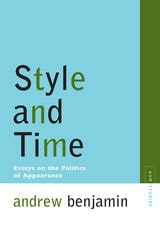
Style and Time
Essays on the Politics of AppearanceAndrew Benjamin
Northwestern University Press, 2006
Nothing less than a rethinking of the conditions of Western art as it relates to politics, architecture, and time, this study of Walter Benjamin's modernity in temporal and spatial terms is a provocative and original work of philosophy in its own right—a work that suggests that the time has come to revise existing paradigms.