Results by title
67 books match the query 'Global Warming & Climate Change' and 8 start with s
Savage Ecology
War and Geopolitics at the End of the WorldJairus Victor Grove
Duke University Press, 2019
Sea Level Rise
A Slow Tsunami on America's ShoresOrrin H. Pilkey and Keith C. Pilkey
Duke University Press, 2019
Sea Level
A HistoryWilko Graf von Hardenberg
University of Chicago Press, 2024
News reports warn of rising sea levels spurred by climate change. Waters inch ever higher, disrupting delicate ecosystems and threatening island and coastal communities. The baseline for these measurements—sea level—may seem unremarkable, a long-familiar zero point for altitude. But as Wilko Graf von Hardenberg reveals, the history of defining and measuring sea level is intertwined with national ambitions, commercial concerns, and shifting relationships between people and the ocean.
Sea Level provides a detailed and innovative account of how mean sea level was first defined, how it became the prime reference point for surveying and cartography, and how it emerged as a powerful mark of humanity’s impact on the earth. With Hardenberg as our guide, we traverse the muddy spaces of Venice and Amsterdam, the coasts of the Baltic Sea, the Panama and Suez canals, and the Himalayan foothills. Born out of Enlightenment studies of physics and quantification, sea level became key to state-sponsored public works, colonial expansion, Cold War development of satellite technologies, and recognizing the climate crisis. Mean sea level, Hardenberg reveals, is not a natural occurrence—it has always been contingent, the product of people, places, politics, and evolving technologies. As global warming transforms the globe, Hardenberg reminds us that a holistic understanding of the ocean and its changes requires a multiplicity of reference points.
A fascinating story that revises our assumptions about land and ocean alike, Sea Level calls for a more nuanced understanding of this baseline, one that allows for new methods and interpretations as we navigate an era of unstable seas.
Solvable
How We Healed the Earth, and How We Can Do It AgainSusan Solomon
University of Chicago Press, 2024
We solved planet-threatening problems before, Susan Solomon argues, and we can do it again. Solomon knows firsthand what those solutions entail. She first gained international fame as the leader of an expedition to Antarctica in 1986, making discoveries that were key to healing the damaged ozone layer. She saw a path—from scientific and public awareness to political engagement, international agreement, industry involvement, and effective action. Solomon, an atmospheric scientist and award-winning author, connects this career-defining triumph to the inside stories of other past environmental victories—against ozone depletion, smog, pesticides, and lead—to extract the essential elements of what makes change possible.
The path to success begins when an environmental problem becomes both personal and perceptible to the general public. Lawmakers, diplomats, industries, and international agencies respond to popular momentum, and effective change takes place in tandem with consumer pressure when legislation and regulation yield practical solutions. Healing the planet is a long game won not by fear and panic but by the union of public, political, and regulatory pressure.
Solvable is a book for anyone who has ever despaired about the climate crisis. As Solomon reminds us, doom and gloom get us nowhere, and idealism will only take us so far. The heroes in these stories range from angry mothers to gang members turned social activists, to upset Long Island birdwatchers to iconoclastic scientists (often women) to brilliant legislative craftsmen. Solomon’s authoritative point of view is an inspiration, a reality check, a road map, and a much-needed dose of realism. The problems facing our planet are Solvable. Solomon shows us how.
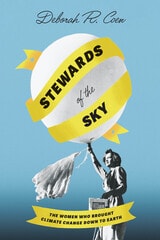
Stewards of the Sky
The Women Who Brought Climate Change Down to EarthDeborah R. Coen
University of Chicago Press, 0
The forgotten history of grassroots climate science, built by women.
For over two centuries, scientists have struggled to predict how people will respond to the vagaries of weather and climate. Today, governments, insurance companies, and investment firms continue to forecast what climate change will mean for local communities, setting adaptation goals from the top down. But hidden in the archives is another approach to this problem that is democratic, collaborative, and grows from the bottom up.
In Stewards of the Sky, historian Deborah R. Coen uncovers the stories of women who documented the humble drivers of change that unfold at the scale of everyday life, modeling the stewardship of the atmosphere as an equitably shared resource—a commons. These naturalists revealed how insects and plants work together to survive unusual weather, how air powers the cycle of life and death, and how people with disabilities cope with pollution. Coen spotlights Geneviève Thiroux d’Arconville, Anna Kingsford, Rosa Luxemburg, and Margaret Collins, as well as the contemporary figures Susan Cutter, Diana Liverman, and Maria Lemos, scientists and activists who resisted their colleagues’ efforts to replace traditional forms of collective security with predictive sciences that would make risk profitable. In contrast, Coen’s antiheroines demonstrated the value of humility and respect for the interpersonal and cross-species relationships that make research possible. Their work shows that surviving climate change is not a zero-sum game, that mutual aid is critical, and that antiheroic science can help build alliances that respect different ways of knowing the world.
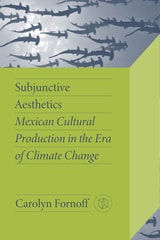
Subjunctive Aesthetics
Mexican Cultural Production in the Era of Climate ChangeCarolyn Fornoff
Vanderbilt University Press, 2024
Honorable Mention, LASA Environment Best Book Prize, Latin American Studies Association–Environment Section, 2025
During the twenty-first century, Mexico has escalated extractive concessions at the same time that it has positioned itself as an international leader in the fight against climate change. Cultural production emergent from this contradiction frames this impasse as a crisis of imagination. Subjunctive Aesthetics studies how contemporary writers, filmmakers, and visual artists grapple with the threat that climate change and extractivist policies pose to Mexico's present and future. It explores how artists rise to the challenge of envisioning alternative forms of territoriality (ways of being in relation to the environment) through strategies ranging from rewriting to counterfactual speculation.
Whereas ecocritical studies have often focused on art's evidentiary role—its ability to visualize and prove the urgency of environmental damage—author Carolyn Fornoff argues that what unites the artists under consideration is their use of more hypothetical, uncertain representational modes, or "subjunctive aesthetics." In English, the subjunctive is a grammatical mode that articulates the imagined, desired, and possible. In the Spanish language, it is even more widely used to express doubts, denials, value judgments, and emotions. Each chapter of Subjunctive Aesthetics takes up one of these modalities to examine how Mexican artists, writers, and filmmakers activate approaches to the planet not just as it is, but as it could be or should be.
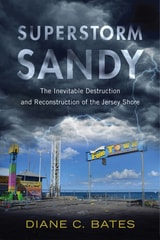
Superstorm Sandy
The Inevitable Destruction and Reconstruction of the Jersey ShoreBates, Diane C
Rutgers University Press, 2015
Diane C. Bates offers a wide-ranging look at the Jersey Shore both before and after Sandy, examining the many factors—such as cultural attachment, tourism revenues, and governmental regulation—that combined to create a highly vulnerable coastal region. She explains why the Shore is so important to New Jerseyans, acting as a key cultural touchstone in a state that lacks a central city or even a sports team to build a shared identity among the state’s residents. She analyzes post-Sandy narratives about the Jersey Shore that trumpeted the dominance of human ingenuity over nature (such as the state’s “Stronger than the Storm” advertising campaign) or proclaimed a therapeutic community (“Jersey Strong”)—narratives rooted in emotion and iconography, waylaying any thought of the near-certainty of future storms. The book also examines local business owners, politicians, real estate developers, and residents who have vested interests in the region, explaining why the Shore was developed intensively prior to Sandy, and why restoration became an imperative in the post-storm period.
Engagingly written and insightful, Superstorm Sandy highlights the elements that compounded the disaster on the Shore, providing a framework for understanding such catastrophes and preventing them in the future.

Surviving Climate Change
The Struggle to Avert Global CatastropheEdited by David Cromwell and Mark Levene
Pluto Press, 2007
Governments and business keep reassuring the public they are going to fix the problem. This book brings together some leading activists who disagree. They expose the inertia, denial, deception -- even threats to our civil liberties -- which comprise mainstream responses from civil and military policy makers, and from opinion formers in the media, corporations and academia.
An epochal change is called for in the way we all engage with the climate crisis. Key to that change is Aubrey Meyer's proposed Contraction and Convergence framework for limiting global carbon emissions. This book, which also includes contributions by Mayer Hillman and George Marshall, is a powerful and vital guide to how mass mobilisation can avert the looming catastrophe.