Results by title
383 books match the query 'Globalization' and 20 start with s
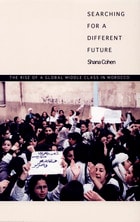
Searching for a Different Future
The Rise of a Global Middle Class in MoroccoShana Cohen
Duke University Press, 2004
Cohen delves into the rupture that has occurred between the middle class, the individual, and the nation in Morocco and elsewhere around the world. Combining institutional economic analysis with cultural theory and ethnographic observation including interviews with seventy young adults in Casablanca and Rabat, she reveals how young, urban, educated Moroccans conceive of their material, social, and political conditions. She finds that, for the most part, they perceive improvement in their economic and social welfare apart from the types of civic participation commonly connected with nationalism and national identity. In answering classic sociological questions about how the evolution of capitalism influences identity, Cohen sheds new light on the measurable social and economic consequences of globalization and on its less tangible effects on individuals’ perception of their place in society and prospects in life.

Season of Rains
Africa in the WorldStephen Ellis
University of Chicago Press, 2012
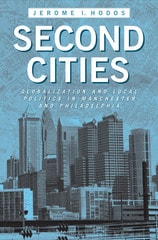
Second Cities
Globalization and Local Politics in Manchester and PhiladelphiaAuthored by Jerome I. Hodos
Temple University Press, 2013
Manchester, England, and Philadelphia, Pennsylvania, are what sociologist Jerome Hodos calls second cities—viable alternatives to well-known global cities such as London and New York. In Second Cities, Hodos considers how Manchester and Philadelphia have confronted problems of globalization over the past two centuries.
This thought-provoking, comparative look at these cities examines their histories, economies, migration patterns, cultural innovations, transportation planning, and self-identities. Hodos demonstrates not just how the two cities are positioned in global flows of capital, goods, people, and ideas but also how each has used what he calls “municipal foreign policy” to preserve and rejuvenate its position over time. The second city offers an illustrative lens through which to view other urban centers, from Atlanta to Bangalore, Seattle, and Turin.
Hodos’s description and analysis of urban development over a broad time frame offer lessons for policy makers, scholars, and community leaders concerned with the impact of globalization on their own cities.

Secularism as Misdirection
Critical Thought from the Global SouthNivedita Menon
Duke University Press, 2024

Secure the Base
Making Africa Visible in the GlobeNgugi wa Thiong’o
Seagull Books, 2016
Ngũgĩ's fiction has been met with wide acclaim, but his nonfiction work, while equally brilliant, is more difficult to find. Secure the Base changes this by bringing together for the first time essays spanning nearly three decades. Originating as disparate lectures and texts, this complete volume will remind readers anew of Ngũgĩ's power and importance. Written in a personal and accessible style, the book covers a range of issues, including the role of the intellectual, the place of Asia in Africa, labor and political struggles in an era of rampant capitalism, and the legacies of slavery and prospects for peace. At a time when Africa looms large in our discussions of globalization, Secure the Base is mandatory reading.

Seeing Like a Smuggler
Borders from BelowMahmoud Keshavarz and Shahram Khosravi
Pluto Press, 2022
Stories of smuggling as acts of resistance and decolonization.
'This conceptually vivid book refreshes our vision' - Ruth Wilson Gilmore
The word smuggler often unleashes a simplified, negative image painted by the media and the authorities. Such state-centric perspectives hide many social, political, and economic relations generated by smuggling. This book looks at the practice through the eyes of the smugglers, revealing how their work can be productive, subversive, and deeply sociopolitical.
By tracing the illegalized movement of people and goods across borders, Seeing Like a Smuggler shows smuggling as a contradiction within the nation-state system, and in a dialectical relation with the national order of things. It raises questions about how smuggling engages and unsettles the ethics, materialities, visualities, histories, and the colonial power relations that form borders and bordering.
Covering a wide spectrum of approaches from personal reflections and ethnographies to historical accounts, cultural analysis, and visual essays, the book spans the globe from Colombia to Ethiopia, Singapore to Guatemala, Afghanistan to Zimbabwe, and from Kurdistan to Bangladesh, to show how people deal with global inequalities and the restrictions of poverty and immobility.
Service Economies
Militarism, Sex Work, and Migrant Labor in South KoreaJin-kyung Lee
University of Minnesota Press, 2010
Making surprising and revelatory connections, Jin-kyung Lee analyzes South Korean military labor in the Vietnam War, domestic female sex workers, South Korean prostitution for U.S. troops, and immigrant/migrant labor from Asia in contemporary South Korea. Foregrounding gender, sexuality, and race, Lee reimagines the South Korean economic "miracle" as a global and regional articulation of industrial, military, and sexual proletarianization.
Lee not only addresses these under-studied labors individually but also integrates and unites them to reveal an alternative narrative of a changing South Korean working class whose heterogeneity is manifested in its objectification. Delving into literary and popular cultural sources as well as sociological work, Lee locates South Korean development in its military and economic interactions with the United States and other Asian nation-states, offering a unique perspective on how these practices have shaped and impacted U.S.-South Korea relations.
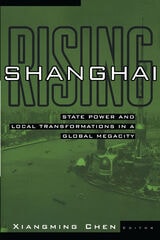
Shanghai Rising
State Power and Local Transformations in a Global MegacityXiangming Chen
University of Minnesota Press, 2009
Analyzing a Chinese city’s dazzling rise to global megacity status
Until around 1990, Shanghai was China’s premier but sluggish industrial center. Now at the beginning of the twenty-first century, the joint impact of global forces and state power has turned Shanghai into a dynamic megacity. Shanghai’s remarkable growth in economy, infrastructure, and global presence has prompted questions about the Shanghai “miracle.” This collection places the city’s unprecedented rise in a rare comparative examination of U.S. cities, as well as with Asian megacities Singapore and Hong Kong, providing a nuanced account of how Shanghai’s politics, economy, society, and space have been transformed by macro- and micro-level forces.
Contributors: Stephen W. K. Chiu, Chinese U of Hong Kong; K. C. Ho, National U of Singapore; John D. Kasarda, U of North Carolina; Hanlong Lu, Shanghai Academy of Social Sciences; Tai-lok Lui, Chinese U of Hong Kong; Ann R. Markusen, U of Minnesota; Anthony M. Orum, U of Illinois, Chicago; Yuan Ren, Fudan U Shanghai; Saskia Sassen, Columbia U; Jiaming Sun, Texas A&M U, Commerce; Fulong Wu, Cardiff U; Pingkang Yu, George Washington U; Tingwei Zhang, U of Illinois, Chicago; Zhenhua Zhou, Development Research Center, Shanghai Municipal Government.
Shipwreck Modernity
Ecologies of Globalization, 1550–1719Steve Mentz
University of Minnesota Press, 2015
Shipwreck Modernity engages early modern representations of maritime disaster in order to describe the global experience of ecological crisis. In the wet chaos of catastrophe, sailors sought temporary security as their worlds were turned upside down. Similarly, writers, poets, and other thinkers searched for stability amid the cultural shifts that resulted from global expansion. The ancient master plot of shipwreck provided a literary language for their dislocation and uncertainty.
Steve Mentz identifies three paradigms that expose the cultural meanings of shipwreck in historical and imaginative texts from the mid-sixteenth through the early eighteenth centuries: wet globalization, blue ecology, and shipwreck modernity. The years during which the English nation and its emerging colonies began to define themselves through oceangoing expansion were also a time when maritime disaster occupied sailors, poets, playwrights, sermon makers, and many others. Through coming to terms with shipwreck, these figures adapted to disruptive change.
Traces of shipwreck ecology appear in canonical literature from Shakespeare to Donne to Defoe and also in sermons, tales of survival, amateur poetry, and the diaries of seventeenth-century English sailors. The isolated islands of Bermuda and the perils of divine anger hold central places. Modern sailor-poets including Herman Melville serve as valuable touchstones in the effort to parse the reality and understandings of global shipwreck.
Offering the first ecocritical account of early modern shipwreck narratives, Shipwreck Modernity reveals the surprisingly modern truths to be found in these early stories of ecological collapse.

Shoveling Smoke
Advertising and Globalization in Contemporary IndiaWilliam Mazzarella
Duke University Press, 2003
An examination of the complex cultural politics of mass consumerism in a globalized marketplace, Shoveling Smoke is a pathbreaking and detailed ethnography of the contemporary Indian advertising industry. It is also a critical and innovative intervention into current theoretical debates on the intersection of consumerist globalization, aesthetic politics, and visual culture. William Mazzarella traces the rise in India during the 1980s of mass consumption as a self-consciously sensuous challenge to the austerities of state-led developmentalism. He shows how the decisive opening of Indian markets to foreign brands in the 1990s refigured established models of the relationship between the local and the global and, ironically, turned advertising professionals into custodians of cultural integrity.
Small Places, Large Issues
An Introduction to Social and Cultural AnthropologyThomas Hylland Eriksen
Pluto Press, 2015
Smart Governance
Governing the Global Knowledge SocietyHelmut Willke
Campus Verlag, 2007
In the wake of globalization, national governments are becoming increasingly interdependent, and knowledge is arguably becoming the most valuable form of capital. Helmut Willke’s Smart Governance offers a new perspective on global governance from the vantage point of a global knowledge society.
Employing a case study of the global financial system and an analysis of several governance regimes, Willke contends that markets, legal systems, and morality must evolve to cope with uncertainty, build capacities, and achieve resilience. Smart Governance will change the way economists, historians, and political scientists view international cooperation.
Social Movements in the World-System
The Politics of Crisis and TransformationJackie Smith
Russell Sage Foundation, 2012
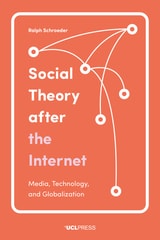
Social Theory After the Internet
Media, Technology, and GlobalizationRalph Schroeder
University College London, 2018
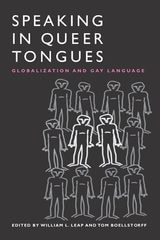
Speaking in Queer Tongues
GLOBALIZATION AND GAY LANGUAGEEdited by William L. Leap and Tom Boellstorff
University of Illinois Press, 2003
Western constructions of gay culture are now circulating widely beyond the boundaries of Western nations due to influences as diverse as Internet communication, global dissemination of entertainment and other media, increased travel and tourism, migration, displacement, and transnational citizenship. The authority claimed by these constructions, and by the linguistic codes embedded in them, is causing them to have a profound impact on public and private expressions of homosexuality in locations as diverse as sub-Saharan Africa, New Zealand, Indonesia and Israel.
Examining a wide range of global cultures, Speaking in Queer Tongues presents essays on topics that include old versus new sexual vocabularies, the rhetoric of gay-oriented magazines and news media, verbal and nonverbalized sexual imagery in poetry and popular culture, and the linguistic consequences of the globalized gay rights movement.
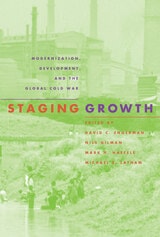
Staging Growth
Modernization, Development, and the Global Cold WarDavid C. Engerman
University of Massachusetts Press, 2003
Beginning in the 1950s, the theory of modernization emerged as the dominant paradigm of economic, social, and political development within the American foreign policy establishment. Purporting to explain the stages through which all nations pass on the road to industrial modernity, it provided a rationale for a broad range of cultural and political projects aimed at fostering Third World growth while simultaneously combating communism.
But modernization theory was more than simply an expression of Cold War ideology. As the essays in this volume show, the ideal of modernization proliferated throughout the postcolonial world and across ideological lines in places as diverse as East Asia, Southern Africa, and South Asia. Indeed, it was embraced by all who shared the American enthusiasm for the increased production and higher standards of living promised by industrialization—enemies and allies alike.
Situating modernization theory historically, Staging Growth avoids conventional chronologies and categories of analysis, particularly the traditional focus on conflicts between major powers. The contributors employ a variety of approaches—from economic and intellectual history to cultural criticism and biography—to shed fresh light on the global forces that shaped the Cold War and its legacies. Most of the pieces are comparative, exploring how different countries and cultures have grappled with the implications of modern development. At the same time, all of the essays address similar fundamental questions. Is modernization the same thing as Westernization? Is the idea of modernization universally valid? Do countries follow similar trajectories as they undertake development? Does modernization bring about globalization?
In addition to the editors and Akira Iriye, contributors include Michael Adas, Laura Belmonte, Gregg Andrew Brazinsky, Christina Klein, J. Victor Koschmann, and Michael R. Mahoney.
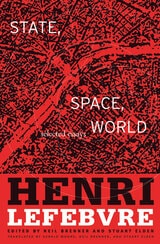
State, Space, World
Selected EssaysHenri Lefebvre
University of Minnesota Press, 2009
State, Space, World collects a series of Lefebvre’s key writings on the state from this period. Making available in English for the first time the as-yet-unexplored political aspect of Lefebvre’s work, it contains essays on philosophy, political theory, state formation, spatial planning, and globalization, as well as provocative reflections on the possibilities and limits of grassroots democracy under advanced capitalism.
State, Space, World is an essential complement to The Production of Space, The Urban Revolution, and The Critique of Everyday Life. Lefebvre’s original and prescient analyses that emerge in this volume are urgently relevant to contemporary debates on globalization and neoliberal capitalism.
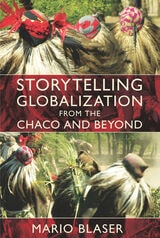
Storytelling Globalization from the Chaco and Beyond
Mario Blaser
Duke University Press, 2010
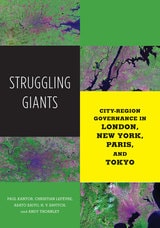
Struggling Giants
City-Region Governance in London, New York, Paris, and TokyoPaul Kantor
University of Minnesota Press, 2012
Throughout the past thirty years a small number of city-regions have achieved unprecedented global status in the world economy while undergoing radical changes. Struggling Giants examines the transformation of four of the most significant metropolises: London, New York, Paris, and Tokyo. This volume analyzes the thorniest issues these sprawling city-regions have faced, including ameliorating social problems through public policies, the effect of globalization on local governance, and the relationships between local, regional, and national institutions.
Three critical themes frame Struggling Giants. The first is the continuing struggle for governability in the midst of regional governmental fragmentation. The second theme is how the city-regions fight to manage powerful political biases. Policy-making is often selective, the authors find, and governments are more responsive to economic exigencies than to social or environmental needs. Finally, these city-regions are shown to be strong economic leaders in part because they are able to change—although the authors reveal that pragmatism and piecemeal policy solutions can still prevail.