Results by title
149 books match the query 'Group identity' and 4 start with s
Sexuality and the Politics of Ethos in the Writing Classroom
Zan Meyer Goncalves
Southern Illinois University Press, 2005
Applying the complexities of literacy development and personal ethos to the teaching of composition, Zan Meyer Goncalves challenges writing teachers to consider ethos as a series of identity performances shaped by the often-inequitable social contexts of their classrooms and communities. Using the rhetorical experiences of students who identify as lesbian, gay, bisexual, and/or transgender, she proposes a new way of thinking about ethos that addresses the challenges of social justice, identity, and transfer issues in the classroom.
Goncalves offers an innovative approach to teaching identity performance theory bound by social contexts. She applies this new approach to theories of specificity and intersectionality, illustrating how teachers can help students redefine the relationship between their social identities and their writing. She also addresses bringing social activism and identity politics into the classroom, helping writers make transfers across rhetorical contexts and linking students' interests to public conversations.
Theoretical and practical, Sexuality and the Politics of Ethos in the Writing Classroom provides teachers of first-year and advanced composition studies with useful, detailed assignments based in specific identity performance. Goncalves offers techniques to subvert oppressive language practices, while encouraging students to recognize themselves as writers, citizens, and active participants in their own educations and communities.
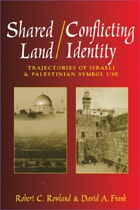
Shared Land/Conflicting Identity
Trajectories of Israeli & Palestinian Symbol UseRobert C. Rowland
Michigan State University Press, 2002
Shared Land/Conflicting Identity: Trajectories of Israeli and Palestinian Symbol Use argues that rhetoric, ideology, and myth have played key roles in influencing the development of the 100-year conflict between first the Zionist settlers and the current Israeli people and the Palestinian residents in what is now Israel. The Israeli-Palestinian conflict is usually treated as an issue of land and water. While these elements are the core of the conflict, they are heavily influenced by the symbols used by both peoples to describe, understand, and persuade each other. The authors argue that symbolic practices deeply influenced the Oslo Accords, and that the breakthrough in the peace process that led to Oslo could not have occurred without a breakthrough in communication styles.
Rowland and Frank develop four crucial ideas on social development: the roles of rhetoric, ideology, and myth; the influence of symbolic factors; specific symbolic factors that played a key role in peace negotiations; and the identification and value of criteria for evaluating symbolic practices in any society.
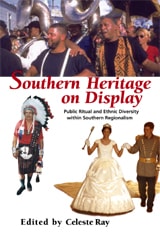
Southern Heritage on Display
Public Ritual and Ethnic Diversity within Southern RegionalismEdited by Celeste Ray
University of Alabama Press, 2002
W. J. Cash's 1941 observation that “there are many Souths and many cultural traditions among them” is certainly validated by this book. Although the Civil War and its “lost cause” tradition continues to serve as a cultural root paradigm in celebrations, both uniting and dividing loyalties, southerners also embrace a panoply of public rituals—parades, cook-offs, kinship homecomings, church assemblies, music spectacles, and material culture exhibitions—that affirm other identities. From the Appalachian uplands to the Mississippi Delta, from Kentucky bluegrass to Carolina piedmont, southerners celebrate in festivals that showcase their diverse cultural backgrounds and their mythic beliefs about themselves.
The ten essays of this cohesive, interdisciplinary collection present event-centered research from various fields of study—anthropology, geography, history, and literature—to establish a rich, complex picture of the stereotypically “Solid South.” Topics include the Mardi Gras Indian song cycle as a means of expressing African-American identity in New Orleans; powwow performances and Native American traditions in southeast North Carolina; religious healings in southern Appalachian communities; Mexican Independence Day festivals in central Florida; and, in eastern Tennessee, bonding ceremonies of melungeons who share Indian, Scots Irish, Mediterranean, and African ancestry. Seen together, these public heritage displays reveal a rich “creole” of cultures that have always been a part of southern life and that continue to affirm a flourishing regionalism.
This book will be valuable to students and scholars of cultural anthropology, American studies, and southern history; academic and public libraries; and general readers interested in the American South. It contributes a vibrant, colorful layer of understanding to the continuously emerging picture of complexity in this region historically depicted by simple stereotypes.

Strange Affinities
The Gender and Sexual Politics of Comparative RacializationGrace Kyungwon Hong and Roderick A. Ferguson, eds.
Duke University Press, 2011
Contributors
Victor Bascara
Lisa Marie Cacho
M. Bianet Castellanos
Martha Chew Sánchez
Roderick A. Ferguson
Grace Kyungwon Hong
Helen H. Jun
Kara Keeling
Sanda Mayzaw Lwin
Jodi Melamed
Chandan Reddy
Ruby C. Tapia
Cynthia Tolentino