Results by title
133 books match the query 'Guatemala' and 11 start with s
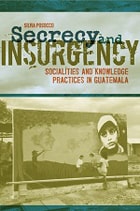
Secrecy and Insurgency
Socialities and Knowledge Practices in GuatemalaSilvia Posocco
University of Alabama Press, 2014
Drawing on a broad field of contemporary theory, Silvia Posocco’s Secrecy and Insurgency presents a vivid ethnographic account of secrecy as both sociality and a set of knowledge practices. Informed by multi-sited anthropological fieldwork among displaced communities with experiences of militancy in the guerrilla organization Fuerzas Armadas Rebeldes, the book traces the contours of dispersed and intermittent guerrilla social relations, unraveling the gendered dimensions of guerrilla socialities and subjectivities in a local context marked by violence and rapid social change.
The chapters chart shifting regimes of governance in the northern departamento of Petén; the inception of violence and insurgency; guerrilla practices of naming and secret relations; moral orders based on sameness and sharing; and forms of relatedness, embodiment, and subjectivity among the combatants. The volume develops new critical idioms for grappling with partiality, perspective, and incompleteness in ethnography and contributes to new thinking on the anthropology of Guatemala.
Secrecy and Insurgency will be of interest to social and cultural anthropologists, human geographers, and scholars in Latin American studies, human rights, women’s studies, and gender studies.
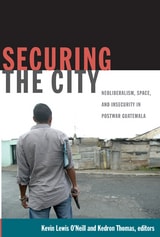
Securing the City
Neoliberalism, Space, and Insecurity in Postwar GuatemalaKevin Lewis O Neill and Kedron Thomas, eds.
Duke University Press, 2011
Contributors. Peter Benson, Manuela Camus, Avery Dickins de Girón, Edward F. Fischer, Deborah Levenson, Thomas Offit, Kevin Lewis O’Neill, Kedron Thomas, Rodrigo José Véliz

Seeing and Being Seen
The Q'eqchi' Maya of Livingston, Guatemala, and BeyondBy Hilary E. Kahn
University of Texas Press, 2006
The practice of morality and the formation of identity among an indigenous Latin American culture are framed in a pioneering ethnography of sight that attempts to reverse the trend of anthropological fieldwork and theory overshadowing one another.
In this vital and richly detailed work, methodology and theory are treated as complementary partners as the author explores the dynamic Mayan customs of the Q'eqchi' people living in the cultural crossroads of Livingston, Guatemala. Here, Q'eqchi', Ladino, and Garifuna (Caribbean-coast Afro-Indians) societies interact among themselves and with others ranging from government officials to capitalists to contemporary tourists.
The fieldwork explores the politics of sight and incorporates a video camera operated by multiple people—the author and the Q'eqchi' people themselves—to watch unobtrusively the traditions, rituals, and everyday actions that exemplify the long-standing moral concepts guiding the Q'eqchi' in their relationships and tribulations. Sharing the camera lens, as well as the lens of ethnographic authority, allows the author to slip into the world of the Q'eqchi' and capture their moral, social, political, economic, and spiritual constructs shaped by history, ancestry, external forces, and time itself.
A comprehensive history of the Q'eqchi' illustrates how these former plantation laborers migrated to lands far from their Mayan ancestral homes to co-exist as one of several competing cultures, and what impact this had on maintaining continuity in their identities, moral codes of conduct, and perception of the changing outside world.
With the innovative use of visual methods and theories, the author's reflexive, sensory-oriented ethnographic approach makes this a study that itself becomes a reflection of the complex set of social structures embodied in its subject.
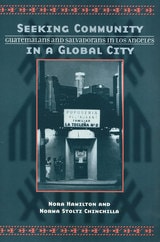
Seeking Community In Global City
Guatemalans & Salvadorans In Los AngelesNora Hamilton
Temple University Press, 2001
Based on twenty years of work with the Los Angeles Central American community and filled with facts, figures, and personal narratives, Seeking Community in a Global City presents this saga from many perspectives. The authors examine the forces in Central America that sent thousands of people streaming across international borders. They discuss economic, political, and demographic changes in the Los Angeles region and the difficulties the new immigrants faced in negotiating a new, urban environment. They look at family roles, networking, work strategies, and inter-ethnic relations. But they also consider policy issues and alliances, changing expectations, shifting priorities, and the reciprocal effect of the migrants and the city on each other.
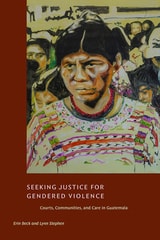
Seeking Justice for Gendered Violence
Courts, Communities, and Care in GuatemalaErin Beck and Lynn Stephen
Duke University Press, 2026
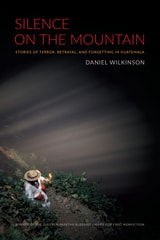
Silence on the Mountain
Stories of Terror, Betrayal, and Forgetting in GuatemalaDaniel Wilkinson
Duke University Press, 2004
Decades of terror-inspired fear have led the Guatemalans to adopt a survival strategy of silence so complete that it verges on collective amnesia. The author’s great triumph is that he finds a way for people to tell their stories, and it is through these stories—dramatic, intimate, heartbreaking—that we are shown the anatomy of a thwarted revolution that has relevance not only to Guatemala but also to countless places around the world where terror has been used as a political tool.

Silent Looms
Women and Production in a Guatemalan TownBy Tracy Bachrach Ehlers
University of Texas Press, 2000
Based on new fieldwork in 1997, Tracy Bachrach Ehlers has updated her classic study of the effects of economic development on the women weavers of San Pedro Sacatepéquez. Revisiting many of the women she interviewed in the 1970s and 1980s and revising her earlier hopeful assessment of women's entrepreneurial opportunities, Ehlers convincingly demonstrates that development and commercial growth in the region have benefited men at the expense of women.
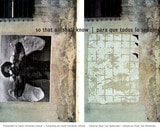
So That All Shall Know/Para que todos lo sepan
Photographs by Daniel Hernández-Salazar [Fotografías por Daniel Hernández-Salazar]Edited by/editado por Oscar Iván Maldonado
University of Texas Press, 2007
How does an artist respond to the horrors of war and the genocide of his or her people? Can art play a role in the fight for justice? These are key questions for understanding the work of Guatemalan photographer Daniel Hernández-Salazar. Since the 1980s, Hernández-Salazar has created both documentary and aesthetic works that confront the state-sponsored terrorism and mass killings of Guatemala's long civil war (1962-1996). His photographic polyptych (4-panel image) "Clarification" became the icon for the Recovery of Historical Memory project of the Archbishopric of Guatemala, as well as a rallying symbol for Guatemalans. Broadening his crusade for justice in the twenty-first century, Hernández-Salazar is now also using the shouting angel of his polyptych (entitled "So That All Shall Know") to challenge the forgetting and/or erasure of painful history in many parts of the world, including Mexico, Japan, the United States, Canada, and Argentina.
So That All Shall Know is a powerful, comprehensive overview of the work of Daniel Hernández-Salazar on recent Guatemalan history. Portfolios of images present his early photojournalistic work documenting the Guatemalan genocide; his Eros + Thanatos series that responds aesthetically to the destruction of war; and his Street Angel project, which uses his image "So That All Shall Know" to protest against injustice and historical forgetting around the world. Accompanying the images are bilingual English-Spanish essays by four scholars who discuss the development of Hernández-Salazar's art in the context of contemporary photography, the social and political conditions that inspire his work, and the broader questions that arise when artists engage in social struggle.
Introduced by Nobel Peace Laureate Rigoberta Menchú Tum, So That All Shall Know is a moving testament to the horrors of genocide and the power of art to give voice to the silenced and presence to the disappeared.

Songs that Make the Road Dance
Courtship and Fertility Music of the Tz'utujil MayaBy Linda O'Brien-Rothe
University of Texas Press, 2015
An important and previously unexplored body of esoteric ritual songs of the Tz’utujil Maya of Santiago Atitlán, Guatemala, the “Songs of the Old Ones” are a central vehicle for the transmission of cultural norms of behavior and beliefs within this group of highland Maya. Ethnomusicologist Linda O’Brien-Rothe began collecting these songs in 1966, and she has amassed the largest, and perhaps the only significant, collection that documents this nearly lost element of highland Maya ritual life.
This book presents a representative selection of the more than ninety songs in O’Brien-Rothe’s collection, including musical transcriptions and over two thousand lines presented in Tz’utujil and English translation. (Audio files of the songs can be downloaded from the UT Press website.) Using the words of the “songmen” who perform them, O’Brien-Rothe explores how the songs are intended to move the “Old Ones”—the ancestors or Nawals—to favor the people and cause the earth to labor and bring forth corn. She discusses how the songs give new insights into the complex meaning of dance in Maya cosmology, as well as how they employ poetic devices and designs that place them within the tradition of K’iche’an literature, of which they are an oral form. O’Brien-Rothe identifies continuities between the songs and the K’iche’an origin myth, the Popol Vuh, while also tracing their composition to the late sixteenth and early seventeenth centuries by their similarities with the early chaconas that were played on the Spanish guitarra española, which survives in Santiago Atitlán as a five-string guitar.

Specters of War
The Battle of Mourning in Postconflict Central AmericaIgnacio Sarmiento
University of Arizona Press, 2025
Specters of War explores mourning practices in postwar Central America, particularly in El Salvador and Guatemala. Ignacio Sarmiento delves into the intricate dynamics of grieving through an interdisciplinary lens, analyzing expressions of mourning in literature, theater, and sites of memory. At the heart of this analysis is the contention over who has the right to mourn, how mourning is performed, and who is included in this process. Sarmiento reveals mourning not as a private affair but as a battleground where different societal factions vie for the possibility of grieving the dead.
Through meticulous research and theoretical nuance, Specters of War sheds light on the politics of mourning in postconflict societies. Sarmiento argues that mourning is not merely a personal experience but a deeply political act intertwined with power struggles and societal divisions. From victims of state terrorism to military elites, various groups engage in a complex dance of grief, revealing the fraught nature of public mourning in postwar Central America. By examining cultural artifacts and memorialization projects, Sarmiento uncovers the multifaceted nature of mourning and its implications for memory, justice, and reconciliation.
This groundbreaking work is essential reading for scholars, students, and professionals interested in Central American history and culture, as well as post-authoritarian societies. Specters of War promises to deepen our understanding of postwar Central America and the legacy of loss in shaping collective identities and narratives of the past.
Supplement to the Handbook of Middle American Indians, Volume 2
LinguisticsVictoria Reifler Bricker, general editor
University of Texas Press, 1984
The sixteen-volume Handbook of Middle American Indians, completed in 1976, has been acclaimed the world over as the single most valuable resource ever produced for those involved in the study of Mesoamerica. When it was determined in 1978 that the Handbook should be updated periodically, well-known cultural anthropologist Victoria Reifler Bricker was selected to be general editor.
This second volume of the Supplement is devoted to Mesoamerican languages. It differs in both scope and content from its forerunner, Volume 5 of the Handbook of Middle American Indians: Linguistics, which presents a general survey of Middle American linguistics and descriptions of Classical Nahuatl, Yucatec, Quiche, Popoluca, Zapotec, Mazatec, Pame, and Chontal de Oaxaca.
The aim of the present volume is to provide detailed sketches of five additional languages: Mixe, Chichimeco Jonaz, Choltí, Tarascan, and Huastec. All the grammatical sketches deal with the phonology, morphology, and syntax of the languages treated; most cover discourse as well. Taken together, these new essays represent a substantial enrichment of the earlier Handbook volume on linguistics. Alone, the Supplement stands as an invaluable reference guide for all who are interested in learning about these important and heretofore poorly treated languages of Middle America.