Results by title
278 books match the query 'Guide' and 12 start with s
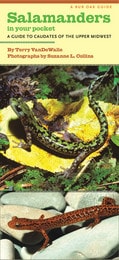
Salamanders in Your Pocket
A Guide to Caudates of the Upper MidwestTerry L. VanDeWalle and Suzanne L. Collins
University of Iowa Press, 2013
Common mudpuppies and lesser sirens spend their entire lives in water, never losing the gills that they developed as larvae; the lungless four-toed salamander distracts predators by detaching its tail; the eastern newt discourages predators by secreting poisonous chemicals from its skin; the flat-bodied hellbender, which can reach twenty-nine inches in length, breathes by absorbing oxygen through the folds of its skin. These, plus the well-named slimy, zigzag, tiger, and other salamanders in this guide, are now threatened by loss of habitat, pollution, and a deadly fungus.
Terry VanDeWalle provides a complete description of each species as well as distinguishing characteristics for twenty-one subspecies, from the striking orange and yellow spots of the spotted salamander to the lichenlike patches of the green salamander to the prominent rounded head of the mole salamander. He also includes information about the salamanders’ range and habitat preferences, from twilight zones of limestone caves and crevices to seepages and spring-fed bogs. His comparisons of similar species and his comprehensive key are most helpful for identifying individuals in the field. Superb photographs by Suzanne Collins make this new guide the perfect companion for outdoor expeditions in all kinds of moist environments.

Say Can You Deny Me
A Guide to Surviving Music by Women from the 16th through the 18th CenturiesBarbara Garvey Jackson
University of Arkansas Press, 1994

Sites of Insight
A Guide to Colorado Sacred PlacesJames Lough
University Press of Colorado, 2003
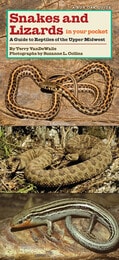
Snakes and Lizards in Your Pocket
A Guide to Reptiles of the Upper MidwestTerry VanDeWalle
University of Iowa Press, 2010
From the rare and docile massasauga, which relies on camouflage to remain unnoticed, to the more familiar bullsnake, which defends itself by hissing loudly and vibrating its tail from an S-shaped striking position, to the eastern racer, often seen crawling at more than three miles an hour during daytime, snakes are beautiful animals with habits both fascinating and beneficial to humans. Their relatives the lizards, most of which are more easily seen and identified, exhibit similarly fascinating behavior. This colorful addition to our series of laminated guides informs both amateur and professional herpetologists about twenty-seven species of snakes and six species of lizards in the Upper Midwest states of Minnesota, Wisconsin, Illinois, Indiana, Michigan, Ohio, South Dakota, North Dakota, Kansas, Nebraska, Iowa, and Missouri.
Terry VanDeWalle provides a complete description of each species, both adult and young, as well as distinguishing characteristics for thirty-two subspecies of snakes and two subspecies of lizards: length, color, head and neck patterns, scales, and so on. Also included is information about habitat preferences: forests, wet meadows, and sand prairies, for example. Most helpful for identifying snakes and lizards in the field are his comparisons of similar species and his comprehensive key.
Superb photographs by Suzanne Collins of adult and, when needed for identification, young snakes and lizards make this guide the perfect companion for hikers in all kinds of environments whenever a snake ripples across your path or a lizard darts into the underbrush.

Sourcebook on the Environment
A Guide to the LiteratureKenneth A. Hammond, George Macinko, and Wilma B. Fairchild
University of Chicago Press, 1978
Beginning with an introduction to various philosophies and perspectives, the Sourcebook examines major elements of the environment and selected case studies of human alteration of our surroundings. The essential references in each field are carefully presented, and directions are given for examining more advanced and specialized works. Appendixes on selected periodicals, the latest relevant federal legislation, and environmental organizations point to further areas of investigation. To maintain its value in this volatile area, this indispensable work will be periodically revised and updated.

Special Needs, Special Horses
A Guide to the Benefits of Therapeutic RidingNaomi Scott
University of North Texas Press, 2005

Stepping Motors
A guide to theory and practicePaul Acarnley
The Institution of Engineering and Technology, 2002

Storytwisting
A Guide to Remixing and Reinventing Traditional StoriesJeri Burns & Barry Marshall
Parkhurst Brothers, Inc., 2018

Studying Social Networks
A Guide to Empirical ResearchMarina Hennig, Ulrik Brandes, Jürgen Pfeffer, and Ines Mergel
Campus Verlag, 2012

Succeeding as a Documentary Filmmaker
A Guide to the Professional WorldAlan Rosenthal
Southern Illinois University Press, 2011
From the basics of the current film business environment and how to navigate it, to tips on how to maximize distribution and sales for a finished film, Rosenthal leads novice filmmakers step-by-step through the professional arena of documentary moviemaking. Included here are recommendations for how to make the most of a film school education; the best ways to find financing for a film and the realities of working with a budget; how to develop a successful proposal for a project; the intricacies of working both as an independent filmmaker and for others; and insight into the often complicated arenas of contracts and markets. Throughout the volume, Rosenthal shares the expertise of actual filmmakers on such subjects as film school and starting a career; pitching and funding projects; contract negotiation; effective marketing; and commissioning editors and legal help. Not limiting himself to merely the documentary world, the author also offers valuable information and advice for filmmakers interested in other genres of nonfiction movies - such as industrial, public relations, travel, and educational films - to provide a truly comprehensive and one-of-a-kind guide for readers.
Packed with useful tips for novices, film students, and practitioners alike, Succeeding as a Documentary Filmmaker is an indispensable addition to the library of anyone involved in the world of nonfiction filmmaking.
Supervision & Management
A Guide to Modifying Work BehaviorMARR JOHN
University of Arkansas Press, 1994

Sustainable Values, Sustainable Change
A Guide to Environmental Decision MakingBryan G. Norton
University of Chicago Press, 2015
While economists, philosophers, and ecologists argue about what in nature is valuable, and why, Norton here offers an action-oriented, pragmatic response to the disconnect between public and academic discourse around sustainability. Looking to the arenas in which decisions are made—and the problems that are driving these decisions—Norton reveals that the path to sustainability cannot be guided by fixed, utopian objectives projected into the future; sustainability will instead be achieved through experimentation, incremental learning, and adaptive management. Drawing inspiration from Aldo Leopold’s famed metaphor of “thinking like a mountain” for a spatially explicit, pluralistic approach to evaluating environmental change, Norton replaces theory-dependent definitions with a new decision-making process guided by deliberation and negotiation across science and philosophy, encompassing all stakeholders and activists and seeking to protect as many values as possible. Looking across scales to today’s global problems, Norton urges us to learn to think like a planet.