Results by title
218 books match the query 'Handbooks, manuals, etc' and 15 start with s

School Librarian’s Career Planner
Hilda K. Weisburg
American Library Association, 2013
Scientific Style and Format
The CSE Manual for Authors, Editors, and Publishers, Eighth EditionCouncil of Science Editors
University of Chicago Press, 2014
Screenwriting for Neurotics
A Beginner's Guide to Writing a Feature-Length Screenplay from Start to FinishScott Winfield Sublett
University of Iowa Press, 2014
Rather than throwing you into the writing process headfirst, Sublett guides you through the various decisions you need to make—about plot, character, structure, conflict—in the order you need to make them. He explains in straightforward terms the terminology and jargon, the theory and industry standards, and dispels common myths about screenwriting that can discourage or hold back a beginning writer.
Balancing theory and practice and offering valuable and insightful examples from recognizable and well-known classic and contemporary films, ranging from Casablanca to A Christmas Story to Clerks, Sublett provides the new writer with the necessary tools to successfully write a feature-length screenplay and offers a roadmap of where to go next. With an emphasis on helping a writer not just to begin, but also to finish a script, Screenwriting for Neurotics is the screenwriting book to help you actually write one.
Securing Library Technology
American Library Association, 2009
Signing With Your Clients
Florence Vold
Gallaudet University Press, 2001
Especially for use with deaf and hard-of-hearing clients, Signing with Your Clients shows how to sign the questions and statements most frequently used by clinicians.
More than 500 line drawings illustrate the signs for 237 sentences with translations printed below. Each sentence begins and ends on the same page, and the spiral binding allows pages to be flipped easily, to leave hands free for signing. A special glossary with technical terms allows the creation of original sentences.
Sin fronteras
Inclusive Spanish Grammar GuidebookLiana Stepanyan, María Mercedes Fages Agudo, Carolina Castillo Larrea, Goretti Prieto Botana
Amherst College Press, 2024
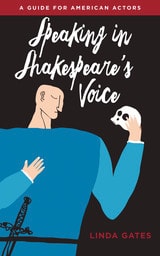
Speaking in Shakespeare's Voice
A Guide for American ActorsLinda Gates
Northwestern University Press, 2019
Speaking in Shakespeare's Voice: A Guide for American Actors is a book for undergraduate and graduate students of acting as well as for the professional who would like to perform Shakespeare with the skill of a classical actor. It is also valuable for European actors interested in performing Shakespeare in American English and British actors who would like to explore Shakespeare from an American perspective.
This guide focuses on the technical elements of voice and speech, including breathing, resonance, and diction, as well as providing an introduction to verse speaking and scansion and to Shakespeare’s rhetorical devices, such as antithesis, alliteration, onomatopoeia, irony, metaphor, and wordplay. These topics are annotated with examples from Shakespeare’s plays to demonstrate how an actor can apply the lessons to actual performance. The book also explores the history of Shakespearean performance in the United States and provides guidance on current editions of Shakespeare’s text from the Folio to online Open Source Shakespeare. A helpful appendix offers examples of two-person scenes and contextualized monologues.
Stage Rigging Handbook, Fourth Edition
Jay O. Glerum and Shane Kelly with a foreword by Mark Shanda
Southern Illinois University Press, 2024
Updating the industry standard stage rigging text for a new generation
First published in 1987 and revised in 1997 and 2007, Stage Rigging Handbook remains the only book in any language that covers the design, operation, and maintenance of stage rigging equipment. Though often unnoticed, these systems are critical in both easing the workload of stage technicians and creating storytelling magic for the audience. This landmark text imparts the foundations for understanding and implementing rigging systems, such that upon completion of the book, the reader is ready to begin hands-on training and practice.
Organized into four sections, the handbook combines research and practical experience to guide riggers through their work. It begins by explaining the construction and care of basic lifting media. Part two analyzes types of rigging systems; then the handbook details the forces that impact rigging, from Newtonian physics to calculating expansive modern systems. Finally, it presents day-to-day best safety practices, including brand new sections on risk assessment and fall protection.
This reorganized and greatly expanded fourth edition of Jay O. Glerum’s industry standard text updates much of the information in the previous editions with the addition of chapters on truss (the framework that supports lighting, screens, and other accessories), motorized chain hoists, hardware, and job safety, including fall protection systems. Award-winning production manager Shane Kelly preserves Glerum’s voice while bringing fresh information to a new generation of riggers, supplementing the text with updated versions of earlier photographs and drawings as well as an additional one hundred illustrations. The handbook facilitates the development of a rigging practice rooted in safety, precision, and professionalism.
Stage Rigging Handbook, Third Edition
Jay O. Glerum
Southern Illinois University Press, 2007
Student Experiences In and Out of the Classroom
Impacts of Arts Integration and Interdisciplinary PracticeGabriel Harp
A2RU Intervals, 2020
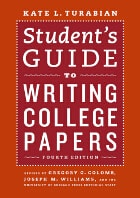
Student's Guide to Writing College Papers
Fourth EditionKate L. Turabian
University of Chicago Press, 2010
High school students, two-year college students, and university students all need to know how to write a well-reasoned, coherent research paper—and for decades Kate Turabian’s Student’s Guide to Writing College Papers has helped them to develop this critical skill. In the new fourth edition of Turabian’s popular guide, the team behind Chicago’s widely respected The Craft of Research has reconceived and renewed this classic for today’s generation. Designed for less advanced writers than Turabian’s Manual of Writers of Research Papers, Theses, and Dissertations, Seventh Edition, Gregory G. Colomb and Joseph M. Williams here introduce students to the art of defining a topic, doing high-quality research with limited resources, and writing an engaging and solid college paper.
The Student’s Guide is organized into three sections that lead students through the process of developing and revising a paper. Part 1, "Writing Your Paper," guides students through the research process with discussions of choosing and developing a topic, validating sources, planning arguments, writing drafts, avoiding plagiarism, and presenting evidence in tables and figures. Part 2, "Citing Sources," begins with a succinct introduction to why citation is important and includes sections on the three major styles students might encounter in their work—Chicago, MLA, and APA—all with full coverage of electronic source citation. Part 3, "Style," covers all matters of style important to writers of college papers, from punctuation to spelling to presenting titles, names, and numbers.
With the authority and clarity long associated with the name Turabian, the fourth edition of Student’s Guide to Writing College Papers is both a solid introduction to the research process and a convenient handbook to the best practices of writing college papers. Classroom tested and filled with relevant examples and tips, this is a reference that students, and their teachers, will turn to again and again.
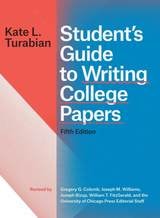
Student’s Guide to Writing College Papers, Fifth Edition
Kate L. Turabian
University of Chicago Press, 2019
This new edition includes fresh examples of research topics, clarified terminology, more illustrations, and new information about using online sources and citation software. It features updated citation guidelines for Chicago, MLA, and APA styles, aligning with the latest editions of these popular style manuals. It emphasizes argument, research, and writing as extensions of activities that students already do in their everyday lives. It also includes a more expansive view of what the end product of research might be, showing that knowledge can be presented in more ways than on a printed page.
Friendly and authoritative, the fifth edition of Student’s Guide to Writing College Papers combines decades of expert advice with new revisions based on feedback from students and teachers. Time-tested and teacher-approved, this book will prepare students to be better critical thinkers and help them develop a sense of inquiry that will serve them well beyond the classroom.
Successful Community Outreach
A How-To-Do-It Manual for LibrariansBarbara Blake
American Library Association, 2011
Supervision & Management
A Guide to Modifying Work BehaviorMARR JOHN
University of Arkansas Press, 1994
Supplement to Introduction to Classical and New Testament Greek
Michael Boler
Catholic University of America Press, 2024