Results by title
62 books match the query 'Hawaii' and 5 start with s
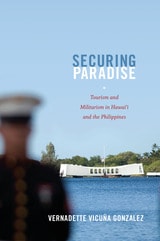
Securing Paradise
Tourism and Militarism in Hawai'i and the PhilippinesVernadette Vicuña Gonzalez
Duke University Press, 2013
In Securing Paradise, Vernadette Vicuña Gonzalez shows how tourism and militarism have functioned together in Hawai`i and the Philippines, jointly empowering the United States to assert its geostrategic and economic interests in the Pacific. She does so by interpreting fiction, closely examining colonial and military construction projects, and delving into present-day tourist practices, spaces, and narratives. For instance, in both Hawai`i and the Philippines, U.S. military modes of mobility, control, and surveillance enable scenic tourist byways. Past and present U.S. military posts, such as the Clark and Subic Bases and the Pearl Harbor complex, have been reincarnated as destinations for tourists interested in World War II. The history of the U.S. military is foundational to tourist itineraries and imaginations in such sites. At the same time, U.S. military dominance is reinforced by the logics and practices of mobility and consumption underlying modern tourism. Working in tandem, militarism and tourism produce gendered structures of feeling and formations of knowledge. These become routinized into everyday life in Hawai`i and the Philippines, inculcating U.S. imperialism in the Pacific.
[more]
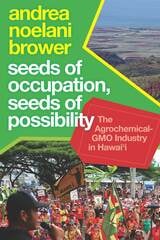
Seeds of Occupation, Seeds of Possibility
The Agrochemical-GMO Industry in Hawai‘iAndrea Noelani Brower
West Virginia University Press, 2022
How Hawaiʻi became the epicenter of the biotech seed industry, and how a resistance movement arose to confront the industry’s power.
Hawaiʻi is a primary site for development of herbicide-resistant corn seed and, until recently, was host to more experimental field trials of genetically engineered crops than anywhere else in the world. It is also a node of powerful resistance. While documentaries and popular news stories have profiled the biotech seed industry in Hawaiʻi, Seeds of Occupation, Seeds of Possibility is the first book to detail the social and historical conditions by which the chemical-seed oligopoly came to occupy the most geographically isolated islands in the world and made the soils of Hawaiʻi the epicenter of agrochemical and agricultural biotechnology testing.
Andrea Brower, an activist-scholar from Hawaiʻi, examines the consequences related to genetically engineered seed development for Hawaiʻi’s people and the social movement that has risen in response. With insights beyond the islands, Seeds of Occupation, Seeds of Possibility illuminates why visions for a radically better world must be expanded by intersectional and systemically oriented movements.
[more]
Settler Militarism
World War II in Hawai'i and the Making of US EmpireJuliet Nebolon
Duke University Press, 2024
Under martial law during World War II, Hawaiʻi was located at the intersection of home front and war front. In Settler Militarism, Juliet Nebolon shows how settler colonialism and militarization simultaneously perpetuated, legitimated, and concealed one another in wartime Hawaiʻi for the purposes of empire building in Asia and the Pacific Islands. She demonstrates how settler militarism operated through a regime of racial liberal biopolitics that purported to protect all people in Hawaiʻi, even as it intensified the racial and colonial differentiation of Kanaka Maoli, Asian settlers, and white settlers. Nebolon identifies settler militarism’s inherent contradiction: It depends on life, labor, and land to reproduce itself, yet it avariciously consumes, via violent and extractive projects, those same lives and natural resources that it needs to subsist. From vaccination and blood bank programs to the administration of internment and prisoner-of-war camps, Nebolon reveals how settler militarism and racial liberal biopolitics operated together in the service of capitalism. Collectively, the social reproduction of these regimes created the conditions for the late-twentieth-century expansion of US military empire.
[more]
Staking Claim
Settler Colonialism and Racialization in Hawai'iJudy Rohrer
University of Arizona Press, 2016
In the heart of the Pacific Ocean, Hawai‘i exists at a global crosscurrent of indigeneity and race, homeland and diaspora, nation and globalization, sovereignty and imperialism. In order to better understand how settler colonialism works and thus move decolonization efforts forward, Staking Claim analyzes competing claims of identity, belonging, and political status in Hawai‘i.
Author Judy Rohrer brings together an analysis of racial formation and colonization in the islands through a study of legal cases, contemporary public discourse (local media and literature), and Hawai‘i scholarship. Her analysis exposes how racialization works to obscure—with the ultimate goal of eliminating—native Hawaiian indigeneity, homeland, nation, and sovereignty.
Staking Claim argues that the dual settler colonial processes of racializing native Hawaiians (erasing their indigeneity), and indigenizing non-Hawaiians, enable the staking of non-Hawaiian claims to Hawai‘i. It encourages us to think beyond a settler-native binary by analyzing the ways racializations of Hawaiians and various non-Hawaiian settlers and arrivants bolster settler colonial claims, structures, and white supremacist ideologies.
[more]
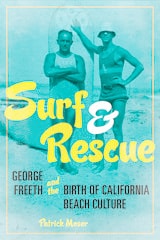
Surf and Rescue
George Freeth and the Birth of California Beach CulturePatrick Moser
University of Illinois Press, 2022
The mixed-race Hawaiian athlete George Freeth brought surfing to Venice, California, in 1907. Over the next twelve years, Freeth taught Southern Californians to surf and swim while creating a modern lifeguard service that transformed the beach into a destination for fun, leisure, and excitement. Patrick Moser places Freeth’s inspiring life story against the rise of the Southern California beach culture he helped shape and define. Freeth made headlines with his rescue of seven fishermen, an act of heroism that highlighted his innovative lifeguarding techniques. But he also founded California's first surf club and coached both male and female athletes, including Olympic swimming champion and “father of modern surfing” Duke Kahanamoku. Often in financial straits, Freeth persevered as a teacher and lifeguarding pioneer--building a legacy that endured long after his death during the 1919 influenza pandemic.
A compelling merger of biography and sports history, Surf and Rescue brings to light the forgotten figure whose novel way of seeing the beach sparked the imaginations of people around the world.
[more]