Results by title
73 books match the query 'Health Care Delivery' and 2 start with s
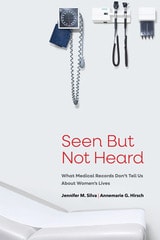
Seen But Not Heard
What Medical Records Don’t Tell Us About Women’s LivesJennifer M. Silva
Russell Sage Foundation, 2026
Medical clinicians, who are already overworked and burned out, are increasingly expected to understand and treat systemic social issues like poverty and racism. One aspect of this is documenting patient’s social risk factors in electronic health records (EHRs). But EHRs do not aways give the full story. Critically, they omit patients’ voices and perspectives about their lives, care, and whether their needs are being met. In Seen But Not Heard, sociologist Jennifer M. Silva and epidemiologist Annemarie G. Hirsch explore the gaps between what clinicians document in EHRs and women’s lived experiences.
Drawing on interviews with 87 non-college-educated, economically disadvantaged women living in rural America and their health records from a large, non-profit health system, Silva and Hirsch find that the stories that medical records provide and the stories that women tell about themselves differ dramatically. Medical charts often translate women’s suffering into sterile diagnostic codes, prescriptions, and treatment plans. Some women felt heard by their clinicians, believed they received adequate care. Many of these women thought their clinicians went above and beyond to help meet their needs by offering them information on how to apply for benefits like food stamps or childcare subsidies and helping them obtain necessary items like mattress covers and winter coats. More often, however, women felt that clinicians were detached from their everyday struggles to survive, whether that meant keeping their families intact even in the face of violence or finding money to pay the never-ending string of bills.
Silva and Hirsch argue that because the system of healthcare delivery interprets social problems as individual failings it often reproduces long-standing injurious stereotypes of women as hysterical, recalcitrant, impure, and gluttonous. For some healthcare providers, knowledge about patients’ social risk factors can become a source of control and punishment, such as denying patients care or reporting patients to child welfare services. Patients described clinicians mobilizing harmful stereotypes about marriage and motherhood, race, and poverty during their appointments. Some of the women’s most traumatic experiences in the healthcare system were completely missing from their EHRs. These troubling experiences ultimately deter women from accessing healthcare, discourages them from sharing their experiences with clinicians, and in some cases, makes their health and social problems worse. Silva and Hirsch offer several policies and practices that would improve women’s experiences in clinical encounters, such as training clinicians in trauma-informed and culturally responsive care, as well as national investments in housing, food security, transportation, and environmental justice.
Seen But Not Heard is a disturbing but necessary examination of the ways vulnerable women are often failed by the healthcare system and offers solutions that will allow healthcare workers to better address the structural barriers faced by their patients.

Special Care
Medical Decisions at the Beginning of LifeFred M. Frohock
University of Chicago Press, 1986
But there is a dark underside to the exercise of these skills. A growing number of babies live only to be tethered to life-support systems, unconscious or suffering incessant pain for years and sometimes for the duration of their lives. The ethical issues raised by these children are among the most difficult in our society. Should life be maintained no matter what its quality? Or is there a point at which treatment should be stopped on humane grounds? Who is to make decisions on continuing or ending therapy for damaged children? Is the law a suitable instrument for regulating medical decisions in intensive care nurseries? Should the growing cost of intensive care influence therapy decisions?
Special Care explores the moral and legal issues in neonatal intensive care. Fred M. Frohock spent four months in a special care nursery, observing the daily actions of doctors and nurses and interviewing staff and parents of patients. This engaging, human drama is told through the author's own journal entries interspersed with generous excerpts from taped interviews that display the practical reasoning of staff and parents as they address the moral problems raised by intensive care medicine. Several case studies of infants highlight the often contradictory directions in which medical staffs are pulled and the painful decisions that doctors and parents together are often called upon to make. The result is a book that reconstructs the ordinary life of a neonatal nursery and presents the moral views of those who are most intimately involved in therapy decisions.
This book is an urgently needed entry in the current discussions of treatment for badly damaged babies. Frohock argues that our tradition of rights language, which rests on the premise that we know what a human being is, is inappropriate when dealing with the paradoxes of decision making in neonatal nurseries. Calling for a new moral vocabulary better adapted to the world of medicine, he introduces the notion of harm in place of rights, a concept drawn from medicine's Hippocratic oath that pledges to "do no harm," as a way to begin framing questions and making decisions. Special Care will interest anyone who wants to understand medical decisions at the margins of human life.