Results by title
82 books match the query 'Hermeneutics' and 3 start with s
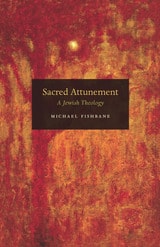
Sacred Attunement
A Jewish TheologyMichael Fishbane
University of Chicago Press, 2008
Contemporary theology, and Jewish theology in particular, Michael Fishbane asserts, now lies fallow, beset by strong critiques from within and without. For Jewish reality, a coherent and wide-ranging response in thoroughly modern terms is needed. Sacred Attunement is Fishbane’s attempt to renew Jewish theology for our time, in the larger context of modern and postmodern challenges to theology and theological thought in the broadest sense.
The first part of the book regrounds theology in this setting and opens up new pathways through nature, art, and the theological dimension as a whole. In the second section, Fishbane introduces his hermeneutical theology—one grounded in the interpretation of scripture as a distinctly Jewish practice. The third section focuses on modes of self-cultivation for awakening and sustaining a covenant theology. The final section takes up questions of scripture, authority, belief, despair, and obligation as theological topics in their own right.
The first full-scale Jewish theology in America since Abraham J. Heschel’s God in Search of Man and the first comprehensive Jewish philosophical theology since Franz Rosenzweig’s Star of Redemption, Sacred Attunement is a work of uncommon personal integrity and originality from one of the most distinguished scholars of Judaica in our time.
[more]
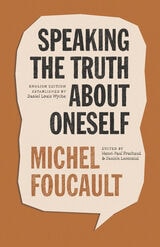
Speaking the Truth about Oneself
Lectures at Victoria University, Toronto, 1982Michel Foucault
University of Chicago Press, 2021
Now in paperback, this collection of Foucault’s lectures traces the historical formation and contemporary significance of the hermeneutics of the self.
Just before the summer of 1982, French philosopher Michel Foucault gave a series of lectures at Victoria University in Toronto. In these lectures, which were part of his project of writing a genealogy of the modern subject, he is concerned with the care and cultivation of the self, a theme that becomes central to the second, third, and fourth volumes of his History of Sexuality. Foucault had always been interested in the question of how constellations of knowledge and power produce and shape subjects, and in the last phase of his life, he became especially interested not only in how subjects are formed by these forces but in how they ethically constitute themselves.
In this lecture series and accompanying seminar, Foucault focuses on antiquity, starting with classical Greece, the early Roman empire, and concluding with Christian monasticism in the fourth and fifth centuries AD. Foucault traces the development of a new kind of verbal practice—“speaking the truth about oneself”—in which the subject increasingly comes to be defined by its inner thoughts and desires. He deemed this new form of “hermeneutical” subjectivity important not just for historical reasons, but also due to its enduring significance in modern society.
[more]
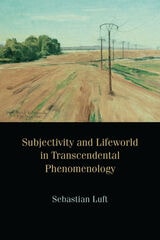
Subjectivity and Lifeworld in Transcendental Phenomenology
Sebastian Luft
Northwestern University Press, 2011
Subjectivity and Lifeworld in Transcendental Phenomenology contributes to discussions about Edmund Husserl’s phenomenology in light of the ongoing publication of his manuscripts. It accounts for the historical origins and influence of the phenomenological project by articulating Husserl's relationship to authors who came before and after him. Finally, it argues for the viability of the phenomenological project as conceived by Husserl in his later years, showing that Husserlian phenomenology is not exhausted in its early, Cartesian perspective, which is indeed its weakest and most vulnerable perspective. Rather, Sebastian Luft convincingly argues, Husserlian phenomenology is a robust and philosophically necessary approach when considered from its late, hermeneutic perspective.
The key point Luft brings into focus is that Husserl's hermeneutic phenomenology is distinct from other hermeneutic philosophers', namely Ernst Cassirer, Martin Heidegger, and Hans-Georg Gadamer. Unlike them, Husserl's focus centers on the work subjects must do in order to uncover the prejudices that guide their unreflective relationship to the world. Luft also demonstrates that there is a deep consistency within Husserl's own writings—from early to late—around the guiding themes of the natural attitude, the need and function of the epoché, and the split between egos, where the transcendental self (distinct from the natural self) is seen as the fundamental ability we all have to inquire into the genesis of our tradition-laden attitudes toward the world.
The key point Luft brings into focus is that Husserl's hermeneutic phenomenology is distinct from other hermeneutic philosophers', namely Ernst Cassirer, Martin Heidegger, and Hans-Georg Gadamer. Unlike them, Husserl's focus centers on the work subjects must do in order to uncover the prejudices that guide their unreflective relationship to the world. Luft also demonstrates that there is a deep consistency within Husserl's own writings—from early to late—around the guiding themes of the natural attitude, the need and function of the epoché, and the split between egos, where the transcendental self (distinct from the natural self) is seen as the fundamental ability we all have to inquire into the genesis of our tradition-laden attitudes toward the world.
[more]