Results by title
72 books match the query 'Hinduism' and 6 start with s
Sacrifice
René Girard
Michigan State University Press, 2011
In Sacrifice, René Girard interrogates the Brahmanas of Vedic India, exploring coincidences with mimetic theory that are too numerous and striking to be accidental. Even that which appears to be dissimilar fails to contradict mimetic theory, but instead corresponds to the minimum of illusion without which sacrifice becomes impossible.
The Bible reveals collective violence, similar to that which generates sacrifice everywhere, but instead of making victims guilty, the Bible and the Gospels reveal the persecutors of a single victim. Instead of elaborating myths, they tell the truth absolutely contrary to the archaic sense. Once exposed, the single victim mechanism can no longer function as the model for would-be sacrificers.
Recognizing that the Vedic tradition also converges on a revelation that discredits sacrifice, mimetic theory locates within sacrifice itself a paradoxical power of quiet reflection that leads, in the long run, to the eclipse of this institution which is violent but nevertheless fundamental to the development of human culture. Far from unduly privileging the Western tradition and awarding it a monopoly on the knowledge and repudiation of blood sacrifice, mimetic analysis recognizes comparable, but never truly identical, traits in the Vedic tradition.
Secularisms
Janet R. Jakobsen and Ann Pellegrini, eds.
Duke University Press, 2008
With essays addressing secularism in India, Iran, Turkey, Great Britain, China, and the United States, this collection crucially complicates the dominant narrative by showing that secularism is multifaceted. How secularism is lived and experienced varies with its national, regional, and religious context. The essays explore local secularisms in relation to religious traditions ranging from Islam to Judaism, Hinduism to Christianity. Several contributors explicitly take up the way feminism has been implicated in the dominant secularization story. Ultimately, by dislodging secularism’s connection to the single (and singular) progress narrative, this volume seeks to open spaces for other possible narratives about both secularism and religion—as well as for other possible ways of inhabiting the contemporary world.
Contributors: Robert J. Baird, Andrew Davison, Tracy Fessenden, Janet R. Jakobsen, Laura Levitt,
Molly McGarry, Afsaneh Najmabadi, Taha Parla, Geeta Patel, Ann Pellegrini, Tyler Roberts,
Ranu Samantrai, Banu Subramaniam, Rajeswari Sunder Rajan, Angela Zito
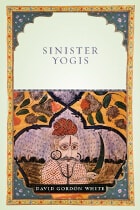
Sinister Yogis
David Gordon White
University of Chicago Press, 2009
Since the 1960s, yoga has become a billion-dollar industry in the West, attracting housewives and hipsters, New Agers and the old-aged. But our modern conception of yoga derives much from nineteenth-century European spirituality, and the true story of yoga’s origins in South Asia is far richer, stranger, and more entertaining than most of us realize.
To uncover this history, David Gordon White focuses on yoga’s practitioners. Combing through millennia of South Asia’s vast and diverse literature, he discovers that yogis are usually portrayed as wonder-workers or sorcerers who use their dangerous supernatural abilities—which can include raising the dead, possession, and levitation—to acquire power, wealth, and sexual gratification. As White shows, even those yogis who aren’t downright villainous bear little resemblance to Western assumptions about them. At turns rollicking and sophisticated, Sinister Yogis tears down the image of yogis as detached, contemplative teachers, finally placing them in their proper context.
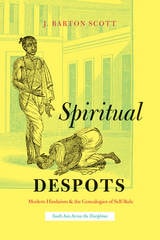
Spiritual Despots
Modern Hinduism and the Genealogies of Self-RuleJ. Barton Scott
University of Chicago Press, 2016
Through this alternative genealogy of the self-ruling subject, Spiritual Despots demonstrates that Hindu reform movements cannot be understood solely within the precolonial tradition, but rather need to be read alongside other movements of their period. The book’s focus moves fluidly between Britain and India—engaging thinkers such as James Mill, Keshub Chunder Sen, Max Weber, Karsandas Mulji, Helena Blavatsky, M. K. Gandhi, and others—to show how colonial Hinduism shaped major modern discourses about the self. Throughout, Scott sheds much-needed light how the rhetoric of priestcraft and practices of worldly asceticism played a crucial role in creating a new moral and political order for twentieth-century India and demonstrates the importance of viewing the emergence of secularism through the colonial encounter.
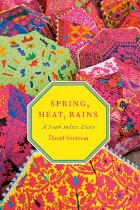
Spring, Heat, Rains
A South Indian DiaryDavid Shulman
University of Chicago Press, 2008
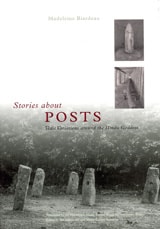
Stories about Posts
Vedic Variations around the Hindu GoddessMadeleine Biardeau
University of Chicago Press, 2004
After exploring several ethnographic facts that have escaped the notice of previous observers, Biardeau presents a variety of hunches, hypotheses, and insights building up to the provocative thesis of Stories about Posts: that the variations found in the contemporary cult of the Goddess—in both her royal and rural village aspects—reveal untraced regional histories of the Vedic sacrificial post, the yupa. Biardeau's work opens up new ways of thinking about Vedic sacrificial themes and elements as they recur in post-Vedic texts and iconographies. It also connects wayside stones in Maharashtra named after the buffalo to stones, posts, and people named after a so-called Buffalo King in Maharashtra, Andhra Pradesh, Karnataka, and Tamilnadu.
A work of magnificent scholarship and fieldwork, Stories about Posts, in ways no previous work has attempted, much less accomplished, unravels much of the mystery surrounding contemporary Hindu ritual by connecting it to the ancient Sanskrit epics. As such, it will fascinate students of Indology, religious studies, and anthropology for years to come.