Results by title
184 books match the query 'Hispanic Americans' and 7 start with s

Selenidad
Selena, Latinos, and the Performance of MemoryDeborah Paredez
Duke University Press, 2009
Paredez argues that Selena’s death galvanized Latina/o efforts to publicly mourn collective tragedies (such as the murders of young women along the U.S.-Mexico border) and to envision a brighter future. At the same time, reactions to the star’s death catalyzed political jockeying for the Latino vote and corporate attempts to corner the Latino market. Foregrounding the role of performance in the politics of remembering, Paredez unravels the cultural, political, and economic dynamics at work in specific commemorations of Selena. She analyzes Selena’s final concert, the controversy surrounding the memorial erected in the star’s hometown of Corpus Christi, and the political climate that served as the backdrop to the touring musicals Selena Forever and Selena: A Musical Celebration of Life. Paredez considers what “becoming” Selena meant to the young Latinas who auditioned for the biopic Selena, released in 1997, and she surveys a range of Latina/o queer engagements with Selena, including Latina lesbian readings of the star’s death scene and queer Selena drag. Selenidad is a provocative exploration of how commemorations of Selena reflected and changed Latinidad.

Shaming into Brown
Somatic Transactions of Race in Latina/o LiteratureStephanie Fetta
The Ohio State University Press, 2018
In Shaming into Brown: Somatic Transactions of Race in Latina/o Literature, Stephanie Fetta asserts that our bodies are fundamental to how we live and how we make meaning. Anchored by two psychoanalytic theories, bioenergetic analysis developed by Alexander Lowen and affect theory put forth by Silvan Tomkins, Fetta examines Latinx fiction to draw attention to the cultural role of the intelligent, emotional, and communicative body—the soma—in relation to shame. She argues that we bring the soma—the physical, emotive, and social register of our subjectivity—to the text as we do to our lives,proposing that the power of racialization operates at the level of somatic expression and reception through habituated, socially cued behaviors that are not readily subject to intentional control.
Fetta examines shame beyond individual experiences, looking at literary renderings of the cultural practice of racial shaming that are deeply embedded into our laws, hiring practices, marketing strategies, and more. Grounding her analysis in the works of Gloria Anzaldúa and Cherríe Moraga, Shaming into Brown focuses on exposing the underpinnings of racialized shame and does so through analyzing “scenes of racialization” in prominent works by authors such as Junot Díaz, Sandra Cisneros, and Oscar Zeta Acosta.

Shared Selves
Latinx Memoir and Ethical Alternatives to HumanismSuzanne Bost
University of Illinois Press, 2019

Sites of Translation
What Multilinguals Can Teach Us about Digital Writing and RhetoricLaura Gonzales
University of Michigan Press, 2018
Winner of the 2016 Sweetland Digital Rhetoric Collaborative Book Prize
Sites of Translation illustrates the intricate rhetorical work that multilingual communicators engage in as they translate information for their communities. Blending ethnographic and empirical methods from multiple disciplines, Laura Gonzales provides methodological examples of how linguistic diversity can be studied in practice, both in and outside the classroom, and provides insights into the rhetorical labor that is often unacknowledged and made invisible in multilingual communication. Sites of Translation is relevant to researchers and teachers of writing as well as technology designers interested in creating systems, pedagogies, and platforms that will be more accessible and useful to multilingual audiences. Gonzales presents multilingual communication as intellectual labor that should be further valued in both academic and professional spaces, and supported by multilingual technologies and pedagogies that center the expertise of linguistically diverse communicators.
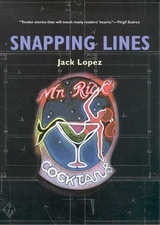
Snapping Lines
Jack Lopez
University of Arizona Press, 2001
A couple searches for a lost dog along the beach because the dog is more important than their relationship . . .
A drunken man picks up a girl hitchhiker and remembers what it once felt like to have feelings for someone else . . .
What does it mean to be male in a world in which old borders no longer exist? How can a man have a relationship if he doesn't even know who he is—and what better way to find out than by committing to a woman? Snapping Lines brings familiar and new stories together in a collection that explores the lives of loners searching for love. Jack Lopez writes about people who have adopted a stoical indifference to a world in which they always seem to find themselves on the losing end. These stories explore Latino male identity and the forces that shape it: friends, family, and lovers; culture, place, and relationships. They focus on men—often working men in the building trades—who construct their lives through their work and live in perpetual limbo because they don't know who they are. Men who stumble onto the relationships they need almost by accident. Men who try to control their relationships but fail.
Written in spare, electric language and energized by memorable scenes, these stories enlighten as much as they entertain. When you have read Snapping Lines, you will come to see the faces of strangers in new and familiar ways.

Strangers No Longer
Latino Belonging and Faith in Twentieth-Century WisconsinSergio M. González
University of Illinois Press, 2024
Hospitality practices grounded in religious belief have long exercised a profound influence on Wisconsin’s Latino communities. Sergio M. González examines the power relations at work behind the types of hospitality--welcoming and otherwise--practiced on newcomers in both Milwaukee and rural areas of the Badger State. González’s analysis addresses central issues like the foundational role played by religion and sacred spaces in shaping experiences and facilitating collaboration among disparate Latino groups and across ethnic lines; the connections between sacred spaces and the moral justification for social justice movements; and the ways sacred spaces evolved into places for mitigating prejudice and social alienation, providing sanctuary from nativism and repression, and fostering local and transnational community building.
Perceptive and original, Strangers No Longer reframes the history of Latinos in Wisconsin by revealing religion’s central role in the settlement experience of immigrants, migrants, and refugees.
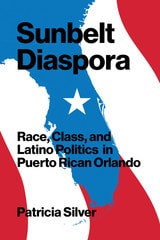
Sunbelt Diaspora
Race, Class, and Latino Politics in Puerto Rican OrlandoBy Patricia Silver
University of Texas Press, 2020
2021 — Silver Medal, Raul Yzaguirre Best Political/Current Affairs Book – International Latino Book Awards, Latino Literacy Now
An in-depth look at an emerging Latino presence in Orlando, Florida, where Puerto Ricans and others navigate differences of race, class, and place of origin in their struggle for social, economic, and political belonging.
Puerto Ricans make up half of Orlando-area Latinos, arriving from Puerto Rico as well as from other long-established diaspora communities to a place where Latino politics has long been about Cubans in Miami. Together with other Latinos from multiple places, Puerto Ricans bring diverse experiences of race and class to this Sunbelt city. Tracing the emergence of the Puerto Rican and Latino presence in Orlando from the 1940s through an ethnographic moment of twenty-first-century electoral redistricting, Sunbelt Diaspora provides a timely prism for viewing how differences of race, class, and place play out in struggles to claim political, social, and economic ground for Latinos.
Drawing on over a decade of ethnographic, oral history, and archival research, Patricia Silver situates her findings in Orlando’s historically black-white racial landscape, post-1960s claims to “color-blindness,” and neoliberal celebrations of individualism. Through the voices of diverse participants, Silver brings anthropological attention to the question of how social difference affects collective identification and political practice. Sunbelt Diaspora asks what constitutes community and how criteria for membership and legitimate representation are negotiated.