Results by title
131 books match the query 'History, Local' and 10 start with s
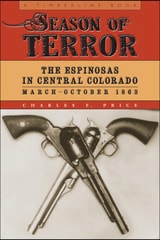
Season of Terror
The Espinosas in Central Colorado, March–October 1863Charles F. Price
University Press of Colorado, 2013
For eight months during the spring and fall of 1863, brothers Felipe Nerio and José Vivián Espinosa and their young nephew, José Vincente, New Mexico–born Hispanos, killed and mutilated an estimated thirty-two victims before their rampage came to a bloody end. Their motives were obscure, although they were members of the Penitentes, a lay Catholic brotherhood devoted to self-torture in emulation of the sufferings of Christ, and some suppose they believed themselves inspired by the Virgin Mary to commit their slaughters.
Until now, the story of their rampage has been recounted as lurid melodrama or ignored by academic historians. Featuring a fascinating array of frontier characters, Season of Terror exposes this neglected truth about Colorado’s past and examines the ethnic, religious, political, military, and moral complexity of the controversy that began as a regional incident but eventually demanded the attention of President Lincoln.

Sense of History
The Place of the Past in American LifeDavid Glassberg
University of Massachusetts Press, 2001
As Americans enter the new century, their interest in the past has never been greater. In record numbers they visit museums and historic sites, attend commemorative ceremonies and festivals, watch historically based films, and reconstruct family genealogies. The question is, Why? What are Americans looking for when they engage with the past? And how is it different from what scholars call “history?”
In this book, David Glassberg surveys the shifting boundaries between the personal, public, and professional uses of the past and explores their place in the broader cultural landscape. Each chapter investigates a specific encounter between Americans and their history: the building of a pacifist war memorial in a rural Massachusetts town; the politics behind the creation of a new historical festival in San Francisco; the letters Ken Burns received in response to his film series on the Civil War; the differing perceptions among black and white residents as to what makes an urban neighborhood historic; and the efforts to identify certain places in California as worthy of commemoration. Along the way, Glassberg reflects not only on how Americans understand and use the past, but on the role of professional historians in that enterprise. Combining the latest research on American memory with insights gained from Glassberg's more than twenty years of personal experience in a variety of public history projects, Sense of History offers stimulating reading for all who care about the future of history in America.
Sentinels of History
Reflections on Arkansas Properties on the National Register of Historic PlacesMark Christ
University of Arkansas Press, 2000
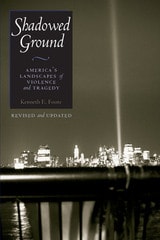
Shadowed Ground
America’s Landscapes of Violence and TragedyBy Kenneth E. Foote
University of Texas Press, 2003
Winner, John Brinckerhoff Jackson Prize, Association of American Geographers, 1997
Shadowed Ground explores how and why Americans have memorialized—or not—the sites of tragic and violent events spanning three centuries of history and every region of the country. For this revised edition, Kenneth Foote has written a new concluding chapter that looks at the evolving responses to recent acts of violence and terror, including the destruction of the Branch Davidian compound at Waco, Texas, the Oklahoma City bombing, the Columbine High School massacre, and the terrorist attacks of 9/11.
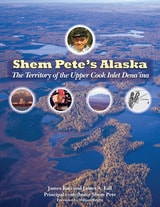
Shem Pete's Alaska
The Territory of the Upper Cook Inlet Dena'inaJames Kari and James A. Fall
University of Alaska Press, 2003
This expanded edition of Shem Pete's Alaska presents 973 named places in 16 drainage-based chapters. The names form a reconstructed network from the vantage points of the life experiences of Shem Pete and other Dena'ina and Ahtna speakers. It is annotated with comments and stories by Shem Pete and more than 50 other contributors, plus historic references, vignettes, copious photographs, historic maps, and shaded-relief placename maps. The authors provide perspective on Dena'ina language and culture, as well as a summary of Dena'ina geographic knowledge and placename research methodology.
This beautifully produced edition is a treasure for all Alaskans and for anyone interested in the "personal connectedness to a beautiful land" voiced by Dena'ina elders.
From the foreword by William Bright: "Shem Pete's experience and wisdom as an elder of the Dena'ina Athabascan Indians shine through this work like the sun—as do the skill and devotion of James Kari, James Fall, and the other Dena'ina, Ahtna, Alaska Native, and Anglo-American people who contributed to making the book a reality. . . . We have a volume that offers a vivid picture of Native Alaskan culture, history, geography, and language, with added glimpses of oral literature and music. . . . All Native American Peoples, indeed, all traditional communities in the world would be fortunate and proud to have this kind of record of their life and culture."
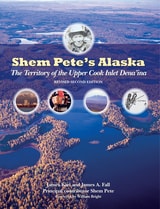
Shem Pete's Alaska
The Territory of the Upper Cook Inlet Dena'inaJames Kari and James A. Fall
University of Alaska Press, 2016
The first two editions of Shem Pete’s Alaska contributed much to Dena’ina cultural identity and public appreciation of the Dena’ina place names network in Upper Cook Inlet. This new edition adds nearly thirty new place names to its already extensive source material from Shem Pete and more than fifty other contributors, along with many revisions and new annotations. The authors provide synopses of Dena’ina language and culture and summaries of Dena’ina geographic knowledge, and they also discuss their methodology for place name research.
Exhaustively refined over more than three decades, Shem Pete’s Alaska will remain the essential reference work on the landscape of the Dena’ina people of Upper Cook Inlet. As a book of ethnogeography, Native language materials, and linguistic scholarship, the extent of its range and influence is unlikely to be surpassed.
Spirit of the New England Tribes
Indian History and Folklore, 1620–1984William S. Simmons
University Press of New England, 1986
Stepping Twice Into the River
Following Dakota WatersRobert King
University Press of Colorado, 2005
Blending travel narrative and poetic reflection, Stepping Twice Into the River takes readers on a journey through time, revealing both stability and change and offering prairie wisdom. An affectionate and shrewd observer, King illuminates the ordinary from the perspectives of history, science, and literature. In the hands of this gifted thinker and writer, local facts yield universal metaphor.
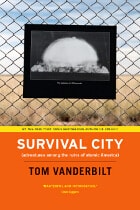
Survival City
Adventures among the Ruins of Atomic AmericaTom Vanderbilt
University of Chicago Press, 2002
On the road to Survival City, Tom Vanderbilt maps the visible and invisible legacies of the cold war, exhuming the blueprints for the apocalypse we once envisioned and chronicling a time when we all lived at ground zero. In this road trip among ruined missile silos, atomic storage bunkers, and secret test sites, a lost battleground emerges amid the architecture of the 1950s, accompanied by Walter Cotten’s stunning photographs. Survival City looks deep into the national soul, unearthing the dreams and fears that drove us during the latter half of the twentieth century.
“A crucial and dazzling book, masterful, and for me at least, intoxicating.”—Dave Eggers
“A genuinely engaging book, perhaps because [Vanderbilt] is skillful at conveying his own sense of engagement to the reader.”—Los Angeles Times
“A retracing of Dr. Strangelove as ordinary life.”—Greil Marcus, Bookforum
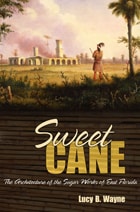
Sweet Cane
The Architecture of the Sugar Works of East FloridaLucy B. Wayne
University of Alabama Press, 2010
From the late eighteenth century to early 1836, the heart of the Florida sugar industry was concentrated in East Florida, between the St. Johns River and the Atlantic Ocean. Producing the sweetest sugar, molasses, and rum, at least 22 sugar plantations dotted the coastline by the 1830s. This industry brought prosperity to the region—employing farm hands, slaves, architects, stone masons, riverboats and their crews, shop keepers, and merchant traders. But by January 1836, Native American attacks of the Second Seminole War, intending to rid the Florida frontier of settlers, devastated the whole sugar industry.
Although sugar works again sprang up in other Florida regions just prior to the Civil War, the competition from Louisiana and the Caribbean blocked a resurgence of sugar production for the area. The sugar industry would never regain its importance in East Florida—only two of the original sugar works were ever rebuilt. Today, remains of this once thriving industry are visible in a few parks. Some are accessible but others lie hidden, slowly disintegrating and almost forgotten. Archaeological, historical, and architectural research in the last decade has returned these works to their once prominent place in Florida’s history, revealing the beauty, efficiency of design, as well as early industrial engineering. Equally important is what can be learned of the lives of those associated with the sugar works and the early plantation days along the East Florida frontier