148 books match the query 'History, Military' and 20 start with s
cover of Saber’s Edge: A Combat Medic in Ramadi, Iraq

Saber’s Edge

A Combat Medic in Ramadi, Iraq

Thomas A. Middleton

University Press of New England, 2010
The National Guardsman, the citizen soldier called upon to fight for this nation in a time of war, is one of the least understood — and perhaps one of the most compelling — figures of the Iraq War. Saber’s Edge is the story of a middle-aged Vermont firefighter called upon to be a soldier in the worst place on earth — Ramadi, Iraq. In a few short weeks Thomas A. Middleton went from being a suburban dad to a combat medic traveling between platoons, filling in for other medics and engaging in some of the fiercest and most crucial fighting of the war. This is the war as experienced from the ground level: days of tedium interspersed with the adrenalin of combat; moments of lighthearted laughter broken by the sorrow of loss. This is also the story of the unique wartime perspective of our guardsmen. Unlike the raw, unformed young recruit, the mature guardsman often comes with the burdens of family, experience, and a developed sense of self. Accordingly, Sgt. Middleton’s story chronicles the inner conflict created by his long-time professional role as a healer and his newfound life as a warrior in the urban battlefields of Iraq. Thrust into a culture and theater of war that he is little equipped or trained for, the author tries to make sense of his actions. Coarsened by combat and increasingly disdainful of the local population, he receives solace and insight from his life-long faith and ultimately emerges as a man who understands his role in the world. Saber’s Edge is also the story of the Green Mountain Boys of Task Force Saber: a story of comradeship and communion amid fierce street fighting in a crucial theater of the Iraq War (the eventual site of the “Al Anbar Awakening”). Based on the author’s first-hand experiences and interviews with other soldiers, Saber’s Edge presents a riveting account of modern urban warfare and the inspiring story of one man reconciling his actions in warfare.
[more]
cover of Sacred Ground: AMERICANS AND THEIR BATTLEFIELDS

Sacred Ground

AMERICANS AND THEIR BATTLEFIELDS

Edward Tabor Linenthal

University of Illinois Press, 1991

      Americans have persistently expressed fascination with the nation's most
        famous battlefields through patriotic rhetoric, monument building, physical
        preservation, and battle reenactment. But each site is also a place where
        different groups of Americans come to compete for ownership of cherished
        national stories and to argue about the meaning of war, the importance
        of martial sacrifice, and the significance of preserving the nation's
        patriotic landscape.
      From the anniversary speeches at Lexington and Concord that shaped the
        image of the minuteman to Alamo Day speeches invoking the Texas "freedom
        fighters" of 1836 in support of the contras in Nicaragua; from passionate
        arguments over the placement of Confederate monuments at Gettysburg to
        confrontations between militant American Indian Movement and "Custer
        loyalists" during the Little Bighorn centennial in 1976; from the
        treatment of the USS Arizona at Pearl Harbor to continuing attempts
        to maintain the purity of these places in the face of commercialization---Sacred
        Ground details the ongoing struggles to define, control, and subvert
        patriotic faith as expressed at these ceremonial sites.
     
 
[more]
cover of Sargon II, King of Assyria

Sargon II, King of Assyria

Josette Elayi

SBL Press, 2017

A critical resource that traces the reign of Sargon in context

Josette Elayi's book is the only existing biography of Sargon II, the famous Assyrian king, who was a megalomaniac and a warlord. Elayi addresses such important questions, including what was his precise role in the disappearance of the kingdom of Israel; how did Sargon II succeed in enlarging the borders of the Assyrian Empire by several successful campaigns; how did he organize his empire (administration, trade, agriculture, libraries), and what was the so-called sin of Sargon?

Features:

  • Interpretations of decisive events during the life and reign of the Assyrian king
  • An evaluation of Sargon II s reign
  • Maps, tables, and illustrations
[more]
cover of Secrets of the English War Bow

Secrets of the English War Bow

Hugh D. H. Soar

Westholme Publishing, 2010

A Complete Recreation of the Deadliest Medieval Arm
Dominating medieval battlefields for more than two centuries but requiring long and arduous practice to command, the English war bow and its battle shaft are the symbols of the rise of British power in Europe. Despite being crafted for hundreds of years and wielded by generations of archers, no example of the war bow—the military version of the longbow—exists, outside of a single broken limb. Now for the first time, expert craftsmen use all available evidence including applied archaeology to unlock the secrets of the English war bow. Historian Hugh D. H. Soar is joined by Mark Stretton, master blacksmith, and Joseph Gibbs, bowyer, in order to demonstrate how a war bow and its associated arrow heads and shafts may have been constructed and used. In addition to showing the complete manufacture of a bow from tree selection to stringing and how specialized arrowheads were forged and attached to shafts, Secrets of the English War Bowprovides information on the actual performance of the war bow, including the bow's effectiveness against various materials and, for the first time, its use against moving targets, since bows were often drawn against mounted soldiers. Armed with this new information, Soar provides an analysis of both successes and failures of the war bow in several important battles. Illustrated in color and black and white, Secrets of the English War Bowprovides an invaluable service for those interested in medieval military history, archery, and technology.
[more]
cover of Send the Alabamians: World War I Fighters in the Rainbow Division

Send the Alabamians

World War I Fighters in the Rainbow Division

Nimrod T. Frazer

University of Alabama Press, 2014

The Remarkable Story of Alabama's Soldiers in America's Great War.

Send the Alabamians recounts the story of the 167th Infantry Regiment of the WWI Rainbow Division from their recruitment to their valiant service on the bloody fields of eastern France in the climactic final months of World War I.

To mark the centenary of World War I, Send the Alabamians tells the remarkable story of a division of Alabama recruits whose service Douglas MacArthur observed had not “been surpassed in military history.” The book borrows its title from a quip by American General Edward H. Plummer who commanded the young men during the inauspicious early days of their service. Impressed with their ferocity and esprit de corps but exasperated by their rambunctiousness, Plummer reportedly exclaimed: In time of war, send me all the Alabamians you can get, but in
time of peace, for Lord’s sake, send them to somebody else!

The ferocity of the Alabamians, so apt to get them in trouble at home, proved invaluable in the field. At the climactic Battle of Croix Rouge, the hot-blooded 167th exhibited unflinching valor and, in the face of machine guns, artillery shells, and poison gas, sustained casualty rates over 50 percent to dislodge and repel the deeply entrenched and heavily armed enemy.

Relying on extensive primary sources such as journals, letters, and military reports, Frazer draws a vivid picture of the individual soldiers who served in this division, so often overlooked but critical to the war’s success. After Gettysburg, the Battle of Croix Rouge is the most significant military engagement to involve Alabama soldiers in the state’s history. Families and genealogists will value the full roster of the 167th that accompanies the text.

Richly researched yet grippingly readable, Nimrod T. Frazer’s Send the Alabamians will delight those interested in WWI, the World Wars, Alabama history, or southern military history in general. Historians of the war, regimental historians, military history aficionados, and those interested in previously unexplored facets of Alabama history will prize this unique volume as well.
[more]
cover of Sherman's Mississippi Campaign

Sherman's Mississippi Campaign

Buck T. Foster

University of Alabama Press, 2006

The campaign that shaped Sherman's path to victory and changed the future of Civil War warfare.

With the fall of Vicksburg to Union forces in mid-1863, the Federals began work to extend and consolidate their hold on the lower Mississippi Valley. As a part of this plan, Major General William Tecumseh Sherman set out from Vicksburg on February 3, 1864, with an army of some 25,000 infantry and a battalion of cavalry. They expected to be joined by another Union force moving south from Memphis and supported themselves off the land as they traveled due east across Mississippi.

Sherman entered Meridian on February 14 and thoroughly destroyed its railroad facilities, munitions plants, and cotton stores, before returning to Vicksburg. Though not a particularly effective campaign in terms of enemy soldiers captured or killed, it offers a rich opportunity to observe how this large-scale raid presaged Sherman’s Atlanta and Carolina campaigns, revealing the transformation of Sherman’s strategic thinking.
[more]
cover of Sixty Years' War for the Great Lakes, 1754-1814

Sixty Years' War for the Great Lakes, 1754-1814

David Curtis Skaggs

Michigan State University Press, 2001

The Sixty Years' War for the Great Lakes contains twenty essays concerning not only military and naval operations, but also the political, economic, social, and cultural interactions of individuals and groups during the struggle to control the great freshwater lakes and rivers between the Ohio Valley and the Canadian Shield. Contributing scholars represent a wide variety of disciplines and institutional affiliations from the United States, Canada, and Great Britain.
Collectively, these important essays delineate the common thread, weaving together the series of wars for the North American heartland that stretched from 1754 to 1814. The war for the Great Lakes was not merely a sideshow in a broader, worldwide struggle for empire, independence, self-determination, and territory. Rather, it was a single war, a regional conflict waged to establish hegemony within the area, forcing interactions that divided the Great Lakes nationally and ethnically for the two centuries that followed.

[more]
cover of Small Town America in World War II: War Stories from Wrightsville, Pennsylvania

Small Town America in World War II

War Stories from Wrightsville, Pennsylvania

Ronald E. Marcello

University of North Texas Press, 2014
[more]
cover of Soldier's Paradise: Militarism in Africa after Empire

Soldier's Paradise

Militarism in Africa after Empire

Samuel Fury Childs Daly

Duke University Press, 2024
In Soldier’s Paradise, Samuel Fury Childs Daly tells the story of how Africa’s military dictators tried and failed to transform their societies into martial utopias. Across the continent, independence was followed by a wave of military coups and revolutions. The soldiers who led them had a vision. In Nigeria and other former British colonies, officers governed like they fought battles—to them, politics was war by other means. Civilians were subjected to military-style discipline, which was indistinguishable from tyranny. Soldiers promised law and order, and they saw judges as allies in their mission to make society more like an army. But law was not the disciplinary tool soldiers thought it was. Using legal records, archival documents, and memoirs, Daly shows how law both enabled militarism and worked against it. For Daly, the law is a place to see decolonization’s tensions and ironies—independence did not always mean liberty, and freedom had a militaristic streak. In a moment when militarism is again on the rise in Africa, Daly describes not just where it came from but why it lasted so long.
[more]
cover of Soldiers and Silver: Mobilizing Resources in the Age of Roman Conquest

Soldiers and Silver

Mobilizing Resources in the Age of Roman Conquest

By Michael J. Taylor

University of Texas Press, 2020

By the middle of the second century BCE, after nearly one hundred years of warfare, Rome had exerted its control over the entire Mediterranean world, forcing the other great powers of the region—Carthage, Macedonia, Egypt, and the Seleucid empire—to submit militarily and financially. But how, despite its relative poverty and its frequent numerical disadvantage in decisive battles, did Rome prevail? Michael J. Taylor explains this surprising outcome by examining the role that manpower and finances played, providing a comparative study that quantifies the military mobilizations and tax revenues for all five powers. Though Rome was the poorest state, it enjoyed the largest military mobilization, drawing from a pool of citizens, colonists, and allies, while its wealthiest adversaries failed to translate revenues into large or successful armies. Taylor concludes that state-level extraction strategies were decisive in the warfare of the period, as states with high conscription and low taxation raised larger, more successful armies than those that primarily sought to maximize taxation. Comprehensive and detailed, Soldiers and Silver offers a new and sophisticated perspective on the political dynamics and economies of these ancient Mediterranean empires.
[more]
cover of Soldiers of the French Revolution

Soldiers of the French Revolution

Alan Forrest

Duke University Press, 1989

In this work Alan Forrest brings together some of the recent research on the Revolutionary army that has been undertaken on both sides of the Atlantic by younger historians, many of whom look to the influential work of Braudel for a model. Forrest places the armies of the Revolution in a broader social and political context by presenting the effects of war and militarization on French society and government in the Revolutionary period.
Revolutionary idealists thought of the French soldier as a willing volunteer sacrificing himself for the principles of the Revolution; Forrest examines the convergence of these ideals with the ordinary, and often dreadful, experience of protracted warfare that the soldier endured.

[more]
cover of States at War, Volume 1: A Reference Guide for Connecticut, Maine, Massachusetts, New Hampshire, Rhode Island, and Vermont in the Civil War

States at War, Volume 1

A Reference Guide for Connecticut, Maine, Massachusetts, New Hampshire, Rhode Island, and Vermont in the Civil War

Edited by Richard F. Miller

University Press of New England, 2013
While many Civil War reference books exist, there is no single compendium that contains important details about the combatant states (and territories) that Civil War researchers can readily access for their work. People looking for information about the organization, activities, economies, demographics, and prominent personalities of Civil War states and state governments must assemble data from a variety of sources, and many key sources remain unavailable online. This volume, the first of six, provides a crucial reference book for Civil War scholars and historians, professional or amateur, seeking information about individual states or groups of states. Its principal sources include the Official Records, state adjutant-general reports, legislative journals, state and federal legislation, federal and state executive speeches and proclamations, and the general and special orders issued by the military authorities of both governments. Designed and organized for easy use, this book can be read in two ways: by individual state, with each chapter offering a stand-alone skeletal history of an individual state’s war years, or across states, comparing reactions to the same event or solutions to the same problems.
[more]
cover of States at War, Volume 2: A Reference Guide for New York in the Civil War

States at War, Volume 2

A Reference Guide for New York in the Civil War

Edited by Richard F. Miller

University Press of New England, 2014
While many Civil War reference books exist, there is no single compendium that contains important details about the combatant states (and territories) that Civil War researchers can readily access for their work. People looking for information about the organizations, activities, economies, demographics, and prominent personalities of Civil War states and state governments must assemble data from a variety of sources, with many key sources remaining unavailable online. This volume provides a crucial reference book for Civil War scholars and historians, professional or amateur, seeking information about New York during the war. Its principal sources include the Official Records, state adjutant general reports, legislative journals, state and federal legislation, executive speeches and proclamations on the federal and state levels, and the general and special orders issued by the military authorities of both governments, North and South. Designed and organized for easy use, this book can be read in two ways: by individual state, with each chapter offering a stand-alone history of an individual state’s war years; or across states, comparing reactions to the same event or solutions to the same problems.
[more]
cover of States at War, Volume 3: A Reference Guide for Pennsylvania in the Civil War

States at War, Volume 3

A Reference Guide for Pennsylvania in the Civil War

Edited by Richard F. Miller

University Press of New England, 2014
While many Civil War reference books exist, there is no single compendium that contains important details about the combatant states (and territories) that Civil War researchers can readily access for their work. People looking for information about the organizations, activities, economies, demographics, and prominent personalities of Civil War states and state governments must assemble data from a variety of sources, with many key sources remaining unavailable online. This volume provides a crucial reference book for Civil War scholars and historians, professional or amateur, seeking information about Pennsylvania during the war. Its principal sources include the Official Records, state adjutant general reports, legislative journals, state and federal legislation, executive speeches and proclamations on the federal and state levels, and the general and special orders issued by the military authorities of both governments, North and South. Designed and organized for easy use, this book can be read in two ways: by individual state, with each chapter offering a stand-alone history of an individual state’s war years; or across states, comparing reactions to the same event or solutions to the same problems.
[more]
cover of States at War, Volume 4: A Reference Guide for Delaware, Maryland, and New Jersey in the Civil War

States at War, Volume 4

A Reference Guide for Delaware, Maryland, and New Jersey in the Civil War

Edited by Richard F. Miller

University Press of New England, 2015
While many Civil War reference books exist, there is no single compendium that contains important details about the combatant states (and territories) that Civil War researchers can readily access for their work. People looking for information about the organizations, activities, economies, demographics, and prominent personalities of Civil War States and state governments must assemble data from a variety of sources, with many key sources remaining unavailable online. This crucial reference book, the fourth in the States at War series, provides vital information on the organization, activities, economies, demographics, and prominent personalities of Delaware, Maryland, and New Jersey during the Civil War. Its principal sources include the Official Records, state adjutant-general reports, legislative journals, state and federal legislation, federal and state executive speeches and proclamations, and the general and special orders issued by the military authorities of both governments, North and South. Designed and organized for easy use by professional historians and amateurs, this book can be read in two ways: by individual state, with each chapter offering a stand-alone history of an individual state’s war years; or across states, comparing reactions to the same event or solutions to the same problems.
[more]
cover of States at War, Volume 5: A Reference Guide for Ohio in the Civil War

States at War, Volume 5

A Reference Guide for Ohio in the Civil War

Edited by Richard F. Miller

University Press of New England, 2015
While many Civil War reference books exist, there is no single compendium that contains important details about the combatant states (and territories) that Civil War researchers can readily access for their work. People looking for information about the organizations, activities, economies, demographics, and prominent personalities of Civil War States and state governments must assemble data from a variety of sources, with many key sources remaining unavailable online. This crucial reference book, the fifth in the States at War series, provides vital information on the organization, activities, economies, demographics, and prominent personalities of Ohio during the Civil War. Its principal sources include the Official Records, state adjutant-general reports, legislative journals, state and federal legislation, federal and state executive speeches and proclamations, and the general and special orders issued by the military authorities of both governments, North and South. Designed and organized for easy use by professional historians and amateurs, this book can be read in two ways: by individual state, with each chapter offering a stand-alone history of an individual state’s war years; or across states, comparing reactions to the same event or solutions to the same problems.
[more]
cover of States at War, Volume 6: The Confederate States Chronology and a Reference Guide for South Carolina in the Civil War

States at War, Volume 6

The Confederate States Chronology and a Reference Guide for South Carolina in the Civil War

Edited by Richard F. Miller

University Press of New England, 2018
Although many Civil War reference books exist, Civil War researchers have until now had no single compendium to consult on important details about the combatant states (and territories). This crucial reference work, the sixth in the States at War series, provides vital information on the organization, activities, economies, demographics, and laws of Civil War South Carolina. This volume also includes the Confederate States Chronology. Miller enlists multiple sources, including the statutes, Journals of Congress, departmental reports, general orders from Richmond and state legislatures, and others, to illustrate the rise and fall of the Confederacy. In chronological order, he presents the national laws intended to harness its manpower and resources for war, the harsh realities of foreign diplomacy, the blockade, and the costs of states’ rights governance, along with mounting dissent; the effects of massive debt financing, inflation, and loss of credit; and a growing raggedness within the ranks of its army. The chronology provides a factual framework for one of history’s greatest ironies: in the end, the war to preserve slavery could not be won while 35 percent of the population was enslaved.
[more]
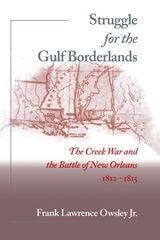
cover of Struggle for the Gulf Borderlands: The Creek War and the Battle of New Orleans, 1812-1815

Struggle for the Gulf Borderlands

The Creek War and the Battle of New Orleans, 1812-1815

Frank L. Owsley

University of Alabama Press, 2000

Examination of the Creek War which integrates that struggle into the larger conflict that broke out in 1812 between Great Britain and the United States
 
Using American, British, and Spanish documents, many previously unknown, Frank Owsley’s study establishes the Creek War and the struggle to control the Gulf borderlands as integral parts of the War of 1812. The war between the United States and a large part of the Creek nation is usually studied as local or regional history. These documentary sources, however, show the larger picture. They show Spain to have been a major influence in the Creek War and indicate the extent to which the British were aiding the Indians and using them to redirect American troops. On the other hand, Andrew Jackson, in charge of the American forces on the Gulf Coast, emerged from the conflict as a first-rate military commander. His victories on the Gulf gave the West a leader and aided in shifting political power from the eastern seaboard to the South and West.
 
Owsley concludes that the victories in the Gulf region were of sufficient magnitude to justify the claim that the War of 1812 was not a draw but a decisive American victory and that had there been a general of Jackson's caliber on the northern frontier, the United States might have had a clear-cut victory there.
 
As a result of the war, the United States held its claim on Louisiana, annexed the Mobile district, forced Spain out of Florida, and broke the power of the southern Indians, thus opening vast lands for settlement from the new nation on the eastern seaboard.


[more]
cover of Success and Failure in Limited War: Information and Strategy in the Korean, Vietnam, Persian Gulf, and Iraq Wars

Success and Failure in Limited War

Information and Strategy in the Korean, Vietnam, Persian Gulf, and Iraq Wars

Spencer D. Bakich

University of Chicago Press, 2014

Common and destructive, limited wars are significant international events that pose a number of challenges to the states involved beyond simple victory or defeat. Chief among these challenges is the risk of escalation—be it in the scale, scope, cost, or duration of the conflict. In this book, Spencer D. Bakich investigates a crucial and heretofore ignored factor in determining the nature and direction of limited war: information institutions.

Traditional assessments of wartime strategy focus on the relationship between the military and civilians, but Bakich argues that we must take into account the information flow patterns among top policy makers and all national security organizations. By examining the fate of American military and diplomatic strategy in four limited wars, Bakich demonstrates how not only the availability and quality of information, but also the ways in which information is gathered, managed, analyzed, and used, shape a state’s ability to wield power effectively in dynamic and complex international systems.

Utilizing a range of primary and secondary source materials, Success and Failure in Limited War makes a timely case for the power of information in war, with crucial implications for international relations theory and statecraft.
[more]
cover of Supplying Custer: The Powder River Supply Depot, 1876

Supplying Custer

The Powder River Supply Depot, 1876

Gerald R. Clark

University of Utah Press, 2014

The Battle of the Little Bighorn is one of the best-known events in the history of the American West. Questions surrounding Custer’s fate have been discussed and researched at length, but details about the transportation and logistics of military supplies have not been thoroughly investigated. Archaeologist Gerald Clark stumbled upon the remnants of a supply depot while surveying the area near the confluence of the Yellowstone and Powder Rivers. It turned out to have been established by General Terry during the Sioux War and utilized by Custer and part of the 7th Calvary.
     The book details the items recovered archaeologically, including ale and soda bottles, cartridges, packing crates, and a horseshoe and ceramic doll. It also addresses the army’s knowledge of this area and how the supply depot fit into the broader military campaign. This book connects archaeology and history to explore how the American military planned, maneuvered, and operated on the northern plains from the end of the Civil War through 1876.
[more]