Results by title
219 books match the query 'Holocaust, Jewish (1939-1945)' and 16 start with s
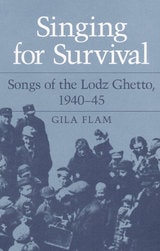
SINGING FOR SURVIVAL
"SONGS OF THE LODZ GHETTO, 1940-45"Gila Flam
University of Illinois Press, 1992
"An extremely accurate and valuable work. There is nothing like it in either the extensive holocaust literature or the ethnomusicology literature."
-- Mark Slobin, author of Chosen Voices: The Story of the American Cantorate
Seed of Sarah
Memoirs of a SurvivorJudith Magyar Isaacson
University of Illinois Press, 1990
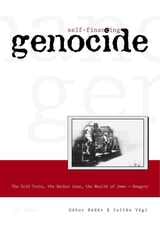
Self-Financing Genocide
The Gold Train, the Becher Case and the Wealth of Hungarian JewsGábor Kádár
Central European University Press, 2004
Discusses the process of the economic annihilation of the Jews in Hungary, who– from the economic point of view – were more influential than any other Jewish community in Europe. Following the German occupation in March 1944 the collaborating Hungarian government attempted to assert its claim concerning the complete confiscation of Jewish assets at all stages of the road leading to the extermination camps. The cooperation with the Germans proved to be the most problematic in this area.
The story of the Jewish Gold Train is a relatively small but all the more emblematic chapter of the economic annihilation. The circumstances of the freight’s assembling, the German-Hungarian conflicts concerning the train, the looting attempts, the fate of the assets seized by the Allies (double victimization of the survivors) provide the reader with an insight into the history of the repeated looting of the Hungarian Jewry
The book analyzes the role played by SS-Obersturmbannführer Kurt Becher, one of the most controversial and mysterious figures in the Hungarian and universal history of the Holocaust. Becher, delegated to Hungary by Himmler, administered and benefited from the confiscation of an enormous amount of Jewish assets.

Shadows of Treblinka
Miriam Kuperhand and Saul Kuperhand
University of Illinois Press, 1998
will move and inform generations. As we lose eyewitnesses to this ultimate
horror, the Kuperhands present us with an elegantly restrained, yet hard-hitting,
Kaddish to Polish Jewry.
Miriam was the daughter of a prosperous furrier; Saul was the son of
a poor shoemaker. Miriam was sixteen when she and her brother roamed the
wild countryside of Poland, searching for food and shelter--and for their
parents. Saul was only a few years older when he watched the smoke rising
from the crematoria and knew that his parents, sister, and eight brothers
were gone forever. Miriam lived by hiding; Saul lived by escaping from
the camp.
The authors emphasize the essential role that Polish Christians played
in their survival and stress that wit, courage, faith, luck, and even
a strong will to live were worthless without their help.
The travail of their survival is wrenching yet comforting, tragic yet
upbeat, cinematic yet intimate. Shadows of Treblinka will haunt
and inspire its readers.
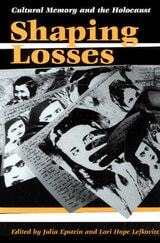
Shaping Losses
CULTURAL MEMORY AND THE HOLOCAUSTEdited by Julia Epstein and Lori Hope Lefkovitz
University of Illinois Press, 2001
This eloquent volume examines how memoirs, films, photographs, art, and literature, as well as family conversations and personal remembrances, embody the impulse to preserve what is destroyed. The contributors -- all distinguished women scholars, most of them survivors or daughters of survivors--examine classic memorializations such as Claude Lanzmann's film Shoah and Roman Vishniac's photographs of prewar Jews as well as several less-well-known works. They also address ways in which children of survivors of the Holocaust--and of other catastrophic traumas--struggle with inherited or vicarious memory, striving to come to terms with losses that centrally define them although they experience them only indirectly.
Shaping Losses considers the limitations of Holocaust representations and testimonies that capture shards of the experience but are necessarily selective and reductive. Contributors discuss artistic efforts to "preserve the rawness" of memory, to resist redemptive closure in Holocaust narratives and public memorials, and to prevent the Holocaust from being sealed in "the cold storage of history." The authors probe the nature of memory and of trauma, studying the use of language within and outside a traumatic context such as Auschwitz and pinpointing the qualities that make traumatic memory ineffable, untransmittable, and perhaps unreliable. Within the "haunted terrain of traumatized memory" that all Holocaust testimonies inhabit, the impulse to give form to emptiness--to shape loss--emerges as a necessary betrayal, a vital effort to bridge the gap between history and memory.
Shuva
The Future of the Jewish PastYehuda Kurtzer
Brandeis University Press, 2012
So We Died
A Memoir of Life and Death in the Ghetto of Šiauliai, LithuaniaLevi Shalit, translated and edited by Veronica Belling, Ellen Cassedy, and Andrew Cassel, introduction by Veronica Belling, afterword by Justin Cammy
University of Alabama Press, 2025
In the shadow of death, Levi Shalit wrote to remember—so we would never forget.
So We Died: A Memoir of Life and Death in the Ghetto of Šiauliai, Lithuania (Azoy zaynen mir geshtorbn) is a powerful eyewitness account of the Shavl ghetto during the Nazi occupation of Lithuania. Written in Yiddish by Levi Shalit and available now for the first time in English, the work fills a stark void in historical records.
Shalit divided his work into four sections. In the first, he describes the German invasion of Šiauliai, the murder of thousands of Jews in the city and surrounding countryside, and the forced relocation of the surviving Jews into the Shavl ghetto. In the second, he describes daily life in the ghetto in engrossing detail. In the third, titled “The Masada Book,” Shalit describes ghetto residents’ attempt to organize a resistance group of which he himself was a member. In the fourth, he narrates the transformation of the ghetto into a concentration camp and the seizure and deportation of the community’s children.
Few accounts of the Shavl ghetto survived the war. Shalit’s work offers English-language readers a rare insight into a vital chapter of history. The translators artfully reveal Shalit’s literary prowess and the ways he illuminated the Shavl ghetto’s daily struggles, false hopes, and atrocities.
More than an account of a previously overlooked episode in Holocaust history, So We Died is a testament to the enduring power of the human spirit in the face of unspeakable tragedy. It offers keen insight into a time of war, fascism, and resistance. A must-read for anyone seeking understanding and remembrance.
Sociology Confronts the Holocaust
Memories and Identities in Jewish DiasporasJudith M. Gerson and Diane L. Wolf, eds.
Duke University Press, 2007
Contributors explore diasporic Jewish identities in the post-Holocaust years; the use of sociohistorical analysis in studying the genocide; immigration and transnationalism; and collective action, collective guilt, and collective memory. In so doing, they illuminate various facets of the Holocaust, and especially post-Holocaust, experience. They investigate topics including heritage tours that take young American Jews to Israel and Eastern Europe, the politics of memory in Steven Spielberg’s collection of Shoah testimonies, and the ways that Jews who immigrated to the United States after the collapse of the Soviet Union understood nationality, religion, and identity. Contributors examine the Warsaw Ghetto Uprising of 1943 in light of collective action research and investigate the various ways that the Holocaust has been imagined and recalled in Germany, Israel, and the United States. Included in the commentaries about sociology and Holocaust studies is an essay reflecting on how to study the Holocaust (and other atrocities) ethically, without exploiting violence and suffering.
Contributors. Richard Alba, Caryn Aviv, Ethel Brooks, Rachel L. Einwohner, Yen Le Espiritu, Leela Fernandes, Kathie Friedman, Judith M. Gerson, Steven J. Gold , Debra R. Kaufman, Rhonda F. Levine , Daniel Levy, Jeffrey K. Olick, Martin Oppenheimer, David Shneer, Irina Carlota Silber, Arlene Stein, Natan Sznaider, Suzanne Vromen, Chaim Waxman, Richard Williams, Diane L. Wolf
Some Measure of Justice
The Holocaust Era Restitution Campaign of the 1990sMichael R. Marrus; Foreword by William A. Schabas
University of Wisconsin Press, 2009
Writings on the subject of Holocaust reparations have largely come from participants, lawyers, philosophers, journalists, and social scientists specializing in restitution. In Some Measure of Justice Michael Marrus takes up the issue as a historian deeply involved with legal issues. He engages with larger questions about historical understanding and historical interpretation as they enter the legal arena. Ultimately this book asks, What constitutes justice for a great historic wrong? And, Is such justice possible?

Soundless Roar
Stories, Poems, and DrawingsAva Kadishson Schieber
Northwestern University Press, 2002
Schieber's drawings, paintings, poetry, and prose are all intimate reflections of one another. Her experience forged the unusual sense of time that shapes Schieber's stories. In her preface, Phyllis Lassner writes: "The timetable of Ava's stories often consists of circles within circles, of patterns of an intertwined past, the past present of hiding, and the present looking back at those distinctly separate but inseparable pasts."
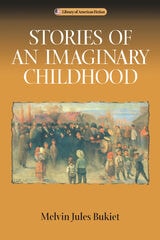
Stories Of An Imaginary Childhood
Melvin Jules Bukiet
University of Wisconsin Press, 2002
In Stories of an Imaginary Childhood Melvin Jules Bukiet inscribes the world that might have been his own if not for the catastrophe that destroyed most of Jewish life in eastern Europe during the 1940s. Set before the Holocaust in the tiny Polish shtetl of Proszowice, each interconnected story follows the young protagonist through the pleasures and humiliations of childhood and the rites of manhood, as he fights against historical, social, and psychological forces that threaten to pull him down.
"Bukiet proves that he is an expert at the [short story] form. His stories lift and soar, encompassing a world of truth in just a few pages. His characters have flesh and life. . . . Bukiet’s topics are varied and universal: first love, growing up, trying to get along with people who are different. Each of these is approached with great humor and a deep respect for life experience."—Daniel Neman, Richmond News Leader
"Jewish-American fiction of a new order, one able to bring the best that has been thought and said about voice and literary texture to the service of a world with richer meaning and a deeper resonance."—Sanford Pinsker, Midstream
"Bukiet is enchanting, original, and thoroughly irresistible in any disguise. Stories of an Imaginary Childhood is an extraordinary achievement, an immensely enjoyable collection of truly remarkable tales."—Susan Miron, Miami Herald

Storm from Paradise
The Politics of Jewish MemoryJonathan Boyarin
University of Minnesota Press, 1992
Storm from Paradise was first published in 1992. Minnesota Archive Editions uses digital technology to make long-unavailable books once again accessible, and are published unaltered from the original University of Minnesota Press editions.
"Usefully complicating common sense understandings of history, catastrophe, loss, otherness, and possibility through reflections on contemporary Jewishness, Boyarin draws on Benjamins's famous image of the Angel of History blown into the future by a "storm from paradise" to constantly interrogate and recuperate the past, "without pretending for long that we can recoup its plentitude". The book's seven thoughtful essays are at times deliberately intangible but always worth reading. An important book for the rethinking of the relevance of Jewishness to anthropology and cultural studies." –Religious Studies Review
"An essay in the richest sense of that term, inspired by and modeled on Walter Benjamin's essays. Based on varied, diverse, and abundantly cross-disciplinary readings, it moves and builds, questions and interrogates, and ultimately convinces us that the Jewish experience with being the 'other' and, conversely and recently, with 'othering' is indeed relevant to theorists of contemporary culture." –Marianne Hirsch
Jonathan Boyarin is the author of Palestine and Jewish History, and co-editor, with Daniel Boyarin, of Jews and Other Differences and Powers of Diaspora.
Surreal Geographies
A New History of Holocaust ConsciousnessKathryn L. Brackney
University of Wisconsin Press, 2024
Brackney offers a new look at familiar works by authors and artists such as Claude Lanzmann, W. G. Sebald, and Paul Celan, while making surprising connections to contemporary scholars like Timothy Snyder and Donna Haraway, and events such as the Space Race. In the process, she maps out a decades-long process through which transnational conventions of mourning have emerged in Western Europe, North America, and Israel, functioning to constitute Jewish victimization as “grievable life.” Ultimately, she shows how the Holocaust has developed into a figure for the destabilization and reformulation of the category of humanity and the problem of mourning across difference.
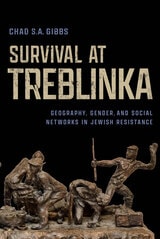
Survival at Treblinka
Geography, Gender, and Social Networks in Jewish ResistanceChad S.A. Gibbs
University of Wisconsin Press, 2026
On August 2, 1943, prisoners at the Nazi extermination camp Treblinka, located in occupied Poland, launched an uprising against their captors, during which hundreds successfully escaped while guards killed as many in the process. In this groundbreaking work, Chad S.A. Gibbs draws upon recently discovered sources and novel research methods to fundamentally reassess Jewish resistance at Treblinka—both before and during the revolt.
Using the testimonies of revolt survivors, prior escapees, those who passed through the camp, and a handful of bystander witnesses and former SS guards, Gibbs sheds new light on the events of August 2 as well as many prior acts of resistance. Critical to these new interpretations of the revolt are the actions of women prisoners, who here assume a central place in this story for the first time.
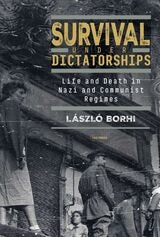
Survival under Dictatorships
Life and Death in Nazi and Communist RegimesLászló Borhi
Central European University Press, 2024
A complex array of individual responses to the abuse of power by the state is represented in this book in three horrific episodes in the history of East-Central Europe. The three events followed each other within a span of about ten years: the deportation and murder of Hungarian Jews in Nazi death and labor camps; the Arrow Cross terrorist rule in Budapest; and finally the Stalinist terror in Hungary and East-Central Europe. Through the prism of survival, László Borhi explores the relationship between the individual and power, attempting to understand the mechanism of oppression and terror produced by arbitrary, unbridled power through the experience of normal people.
Despite the obvious peculiarities of time and place, the Hungarian cases convey universal lessons about the Holocaust, Nazism, and Stalinism. In the author's conception, the National Socialist and Stalinist experiences are linked on several levels. Both regimes defended their visions of the future against social groups whom they saw as implacable enemies of those visions, and who therefore had to be destroyed for sake of social perfection. Furthermore, the social practices of National Socialism were passed on. And although Stalinism was imposed by a foreign power, some of the survival skills for coping with it were rehearsed under the previous hellish experience.
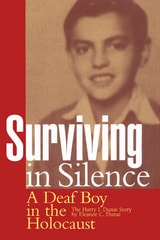
Surviving in Silence
A Deaf Boy in the Holocaust, The Harry I. Dunai StoryEleanor C. Dunai
Gallaudet University Press, 2002
Izrael Zachariah Deutsch was born on March 15, 1934, in Komjata, Czechoslovakia. The second youngest child, Izrael lived a bucolic existence with nine brothers and sisters on a farm, differing from them only in that he was deaf. When he was six, his mother took him to Budapest, Hungary, and enrolled him in a Jewish school for deaf children, where he thrived. Soon, however, the Nazi regime in Germany and the Arrow Cross fascists in Hungary destroyed Izrael’s world forever.
Izrael realized that by being both Jewish and deaf, he faced a double threat of being exported to the gas chambers in Poland. But at every lethal junction, he found a way to survive, first by buying and reselling pastries for extra money that later saved his life in the Budapest ghetto. Still, Izrael was close to death from starvation when he was liberated by Russian soldiers on January 18, 1945.
Izrael survived the war only to learn that his parents and two brothers had been murdered by the Nazis. The rest of his brothers and sisters scattered to distant parts of the world. Forced to remain in Budapest, Izrael finished school and became an accomplished machinist. He avoided any part in the Hungarian uprising in 1956 so that he could secure a visa to leave for Sweden. From Sweden he traveled throughout Europe and Israel, using an amazing network of Holocaust survivors, relatives, and deaf friends to ease his journey. He finally settled in Los Angeles, where he married a deaf Jewish woman he had met years before. Along the way, he changed his name from Izrael Deutsch to Harry Dunai.