Results by title
51 books match the query 'Holocaust survivors' and 5 start with s

Second Scroll
A.M. Klein
Northwestern University Press, 1985
The Second Scroll, Klein’s only novel, combines the lyric genius of his poetic works with compelling reportage to create one of the most eloquent and original works in Canadian fiction.
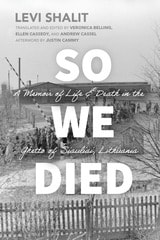
So We Died
A Memoir of Life and Death in the Ghetto of Šiauliai, LithuaniaLevi Shalit, translated and edited by Veronica Belling, Ellen Cassedy, and Andrew Cassel, introduction by Veronica Belling, afterword by Justin Cammy
University of Alabama Press, 2025
In the shadow of death, Levi Shalit wrote to remember—so we would never forget.
So We Died: A Memoir of Life and Death in the Ghetto of Šiauliai, Lithuania (Azoy zaynen mir geshtorbn) is a powerful eyewitness account of the Shavl ghetto during the Nazi occupation of Lithuania. Written in Yiddish by Levi Shalit and available now for the first time in English, the work fills a stark void in historical records.
Shalit divided his work into four sections. In the first, he describes the German invasion of Šiauliai, the murder of thousands of Jews in the city and surrounding countryside, and the forced relocation of the surviving Jews into the Shavl ghetto. In the second, he describes daily life in the ghetto in engrossing detail. In the third, titled “The Masada Book,” Shalit describes ghetto residents’ attempt to organize a resistance group of which he himself was a member. In the fourth, he narrates the transformation of the ghetto into a concentration camp and the seizure and deportation of the community’s children.
Few accounts of the Shavl ghetto survived the war. Shalit’s work offers English-language readers a rare insight into a vital chapter of history. The translators artfully reveal Shalit’s literary prowess and the ways he illuminated the Shavl ghetto’s daily struggles, false hopes, and atrocities.
More than an account of a previously overlooked episode in Holocaust history, So We Died is a testament to the enduring power of the human spirit in the face of unspeakable tragedy. It offers keen insight into a time of war, fascism, and resistance. A must-read for anyone seeking understanding and remembrance.
Sociology Confronts the Holocaust
Memories and Identities in Jewish DiasporasJudith M. Gerson and Diane L. Wolf, eds.
Duke University Press, 2007
Contributors explore diasporic Jewish identities in the post-Holocaust years; the use of sociohistorical analysis in studying the genocide; immigration and transnationalism; and collective action, collective guilt, and collective memory. In so doing, they illuminate various facets of the Holocaust, and especially post-Holocaust, experience. They investigate topics including heritage tours that take young American Jews to Israel and Eastern Europe, the politics of memory in Steven Spielberg’s collection of Shoah testimonies, and the ways that Jews who immigrated to the United States after the collapse of the Soviet Union understood nationality, religion, and identity. Contributors examine the Warsaw Ghetto Uprising of 1943 in light of collective action research and investigate the various ways that the Holocaust has been imagined and recalled in Germany, Israel, and the United States. Included in the commentaries about sociology and Holocaust studies is an essay reflecting on how to study the Holocaust (and other atrocities) ethically, without exploiting violence and suffering.
Contributors. Richard Alba, Caryn Aviv, Ethel Brooks, Rachel L. Einwohner, Yen Le Espiritu, Leela Fernandes, Kathie Friedman, Judith M. Gerson, Steven J. Gold , Debra R. Kaufman, Rhonda F. Levine , Daniel Levy, Jeffrey K. Olick, Martin Oppenheimer, David Shneer, Irina Carlota Silber, Arlene Stein, Natan Sznaider, Suzanne Vromen, Chaim Waxman, Richard Williams, Diane L. Wolf
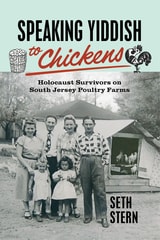
Speaking Yiddish to Chickens
Holocaust Survivors on South Jersey Poultry FarmsSeth Stern
Rutgers University Press, 2023
Most of the roughly 140,000 Holocaust survivors who came to the United States in the first decade after World War II settled in big cities such as New York. But a few thousand chose an alternative way of life on American farms. More of these accidental farmers wound up raising chickens in southern New Jersey than anywhere else. Speaking Yiddish to Chickens is the first book to chronicle this little-known chapter in American Jewish history when these mostly Eastern European refugees – including the author’s grandparents - found an unlikely refuge and gateway to new lives in the US on poultry farms. They gravitated to a section of south Jersey anchored by Vineland, a small rural city where previous waves of Jewish immigrants had built a rich network of cultural and religious institutions.
This book relies on interviews with dozens of these refugee farmers and their children, as well as oral histories and archival records to tell how they learned to farm while coping with unimaginable grief. They built small synagogues within walking distance of their farms and hosted Yiddish cultural events more frequently found on the Lower East Side than perhaps anywhere else in rural America at the time. Like refugees today, they embraced their new American identities and enriched the community where they settled, working hard in unfamiliar jobs for often meager returns. Within a decade, falling egg prices and the rise of industrial-scale agriculture in the South would drive almost all of these novice poultry farmers out of business, many into bankruptcy. Some hated every minute here; others would remember their time on south Jersey farms as their best years in America. They enjoyed a quieter way of life and more space for themselves and their children than in the crowded New York City apartments where so many displaced persons settled. This is their remarkable story of loss, renewal, and perseverance in the most unexpected of settings.
Author Facebook page (https://www.facebook.com/YiddishtoChickens)
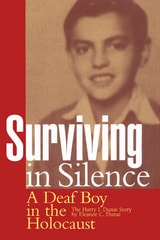
Surviving in Silence
A Deaf Boy in the Holocaust, The Harry I. Dunai StoryEleanor C. Dunai
Gallaudet University Press, 2002
Izrael Zachariah Deutsch was born on March 15, 1934, in Komjata, Czechoslovakia. The second youngest child, Izrael lived a bucolic existence with nine brothers and sisters on a farm, differing from them only in that he was deaf. When he was six, his mother took him to Budapest, Hungary, and enrolled him in a Jewish school for deaf children, where he thrived. Soon, however, the Nazi regime in Germany and the Arrow Cross fascists in Hungary destroyed Izrael’s world forever.
Izrael realized that by being both Jewish and deaf, he faced a double threat of being exported to the gas chambers in Poland. But at every lethal junction, he found a way to survive, first by buying and reselling pastries for extra money that later saved his life in the Budapest ghetto. Still, Izrael was close to death from starvation when he was liberated by Russian soldiers on January 18, 1945.
Izrael survived the war only to learn that his parents and two brothers had been murdered by the Nazis. The rest of his brothers and sisters scattered to distant parts of the world. Forced to remain in Budapest, Izrael finished school and became an accomplished machinist. He avoided any part in the Hungarian uprising in 1956 so that he could secure a visa to leave for Sweden. From Sweden he traveled throughout Europe and Israel, using an amazing network of Holocaust survivors, relatives, and deaf friends to ease his journey. He finally settled in Los Angeles, where he married a deaf Jewish woman he had met years before. Along the way, he changed his name from Izrael Deutsch to Harry Dunai.