Results by title
195 books match the query 'Homes and haunts' and 9 start with s
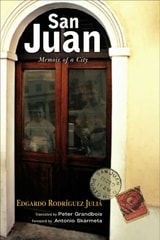
San Juan
Memoir of a CityEdgardo Rodriguez Julia; Translated by Peter Grandbois
University of Wisconsin Press, 2007
In the allusive cityscape he recreates, Rodríguez Juliá invokes the ghosts of his childhood, of San Juan's elder literati, and of characters from his own novels. On the most tangible level, the city is a place of cabarets and cockfighting clubs, flâneurs and beach bums, smoke-filled bars and honking automobiles. Poised between a colonial past and a commercial future, the San Juan he portrays feels at times perilously close to the pitfalls of modernization. Tenement houses and fading mansions yield to strip malls and Tastee Freezes; asphalt hems in jacarandas and palm trees. "In Puerto Rico," he muses, "life is not simply cruel, it is also busy erasing our tracks." Through this book—available here in English for the first time—Rodríguez Juliá resists that erasure, thoughtfully etching a palimpsest that preserves images of the city where he grew up and rejoicing in the one where he still lives.
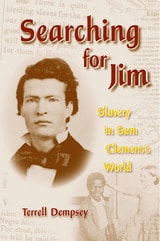
Searching for Jim
Slavery in Sam Clemens's WorldTerrell Dempsey
University of Missouri Press, 2005
During Sam’s earliest years, his father, John Marshall Clemens, had significant interaction with slaves. Newly discovered court records show the senior Clemens in his role as justice of the peace in Hannibal enforcing the slave ordinances. With the death of his father, young Sam was apprenticed to learn the printing and newspaper trade. It was in the newspaper that slaves were bought and sold, masters sought runaways, and life insurance was sold on slaves. Stories the young apprentice typeset helped Clemens learn to write in black dialect, a skill he would use throughout his writing, most notably in Huckleberry Finn.
Missourians at that time feared abolitionists across the border in Illinois and Iowa. Slave owners suspected every traveling salesman, itinerant preacher, or immigrant of being an abolition agent sent to steal slaves. This was the world in which Sam Clemens grew up. Dempsey also discusses the stories of Hannibal’s slaves: their treatment, condition, and escapes. He uncovers new information about the Underground Railroad, particularly about the role free blacks played in northeast Missouri.
Carefully reconstructed from letters, newspaper articles, sermons, speeches, books, and court records, Searching for Jim offers a new perspective on Clemens’s writings, especially regarding his use of race in the portrayal of individual characters, their attitudes, and worldviews. This fascinating volume will be valuable to anyone trying to measure the extent to which Clemens transcended the slave culture he lived in during his formative years and the struggles he later faced in dealing with race and guilt. It will forever alter the way we view Sam Clemens, Hannibal, and Mark Twain.
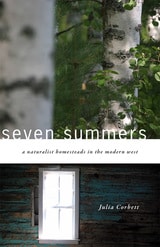
Seven Summers
A Naturalist Homesteads in the Modern WestJulia Corbett
University of Utah Press, 2013
Seven Summers is the story of a naturalist-turned-professor who flees city life each summer with her pets and power tools to pursue her lifelong dream—building a cabin in the Wyoming woods. With little money and even less experience, she learns that creating a sanctuary on her mountain meadow requires ample doses of faith, patience, and luck. This mighty task also involves a gradual and sometimes painful acquisition of flexibility and humility in the midst of great determination and naive enthusiasm.
For Corbett, homesteading is not about wresting a living from the land, but respecting and immersing herself in it—observing owls and cranes, witnessing seasons and cycles, and learning the rhythms of wind and weather in her woods and meadow. The process changes her in unexpected ways, just as it did for women homesteaders more than a century ago. The more she works with wood, the more she understands the importance of “going with the grain” in wood as well as in life. She must learn to let go, to move through loss and grief, to trust her voice, and to balance independence and dependence. Corbett also gains a better understanding of her fellow Wyomingites, a mix of ranchers, builders, gas workers, and developers, who share a love of place but often hold decidedly different values. This beautifully written memoir will appeal to readers who appreciate stories of the western landscape, independent women, or the appreciation of the natural world.
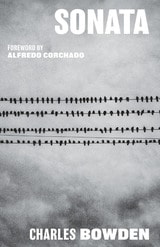
Sonata
By Charles Bowden; foreword by Alfredo Corchado
University of Texas Press, 2020
"I believe every sunrise and I remember the smell of wet grass, the color of robins, and rustle of leaves on the big oaks that outlive nations, all this comes with each sunrise."
Sonata marks the sixth and final installment of Charles Bowden’s towering “Unnatural History of America” series. While his earlier volumes were suffused with violence and war, Bowden offers here a celebration of rebirth and regrowth. Rendered in Bowden's inimitable style, more prose poetry than reportage, he evokes panoramas that contain the potential for respite and offer a state of grace all but lost in the endless wars of man.
Bowden travels back in time to the worlds of artists Francisco Goya and Vincent van Gogh, the latter painting furiously against encroaching madness. “Van Gogh tries to dream a life of color,” writes Bowden. “Powder blue sheds, yellow stubble, pink skies—but the fears and dark things drag him down.” As Bowden’s vivid prose wrestles with the madness of the world, van Gogh’s paintings represent an act of resistance, ultimately unsuccessful, against depression and suicide.
Moving from the vibrant hues of van Gogh’s painted gardens to America’s southern border, Bowden returns once more to the Mexican asylum run by "El Pastor," Jose Antonio Galvan, who was first introduced to readers of the sextet in Jericho. Here, too, is the dream of a garden that will be planted in the desert, a promise of regeneration in a world gone mad. Poetic, elegiac, and elliptical, Sonata is the final, captivating book of Bowden’s monumental career.
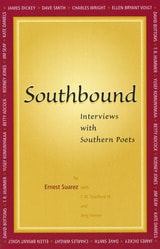
Southbound
Interviews with Southern PoetsEdited by Ernest Suarez, T. W. Stanford III, & Amy Verner
University of Missouri Press, 1999
"There's a real flowering, I think, of southern poetry right now, . . . assembling at the edges of everything." This observation by Pulitzer Prize-winning poet Charles Wright reflects upon the continuing vibrancy and importance of the southern poetic tradition. Although the death of James Dickey in 1997 left southern poetry without a recognizably dominant voice, an array of other vibrant voices continue to be heard and recognized. Southbound: Interviews with Southern Poets provides detailed discussion of the art and craft of poetry by many writers who promise to keep southern poetry vital into the twenty-first century.
Beginning with an interview with the late literary giant James Dickey, Southbound collects the ideas and insights of both well-known and rising southern poets, including Dave Smith, Charles Wright, Ellen Bryant Voigt, Yusef Komunyakaa, and Rodney Jones. Suarez's guiding principle for conducting and revising the interviews was to let the poets express themselves as clearly and fully as possible. Each interview is ultimately defined by the poet's own personality and voice, yet all explore similar themes—the relationship between technique and subject, the nature of the southern canon and each poet's place in it, and the state of contemporary poetry. As Dave Smith relates, "My sense of appreciation of what life means or could mean, whatever I know about life, stems from a sense of place, a sense of the ghostliness of meaning." It is this sense of place and meaning that Suarez allows each poet to convey truthfully in his interviews.
Including a brief introduction to each interview and a bibliography of primary and secondary sources for each poet, Southbound is a useful tool for scholars and a springboard for casual readers. More important, this collection of interviews makes a significant contribution to the tradition of southern poetry and its most prominent voices.
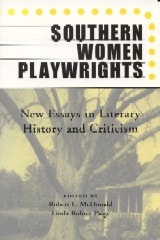
Southern Women Playwrights
New Essays in History and CriticismEdited by Robert McDonald and Linda Rohrer Paige
University of Alabama Press, 2001
This timely collection addresses the neglected state of scholarship on southern women dramatists by bringing together the latest criticism on some of the most important playwrights of the 20th century.
Coeditors Robert McDonald and Linda Rohrer Paige attribute the neglect of southern women playwrights in scholarly criticism to "deep historical prejudices" against drama itself and against women artists in general, especially in the South. Their call for critical awareness is answered by the 15 essays they include in Southern Women Playwrights, considerations of the creative work of universally acclaimed playwrights such as Beth Henley, Marsha Norman, and Lillian Hellman (the so-called "Trinity") in addition to that of less-studied playwrights, including Zora Neale Hurston, Carson McCullers, Alice Childress, Naomi Wallace, Amparo Garcia, Paula Vogel, and Regina Porter.
This collection springs from a series of associated questions regarding the literary and theatrical heritage of the southern woman playwright, the unique ways in which southern women have approached the conventional modes of comedy and tragedy, and the ways in which the South, its types and stereotypes, its peculiarities, its traditions-both literary and cultural-figure in these women's plays. Especially relevant to these questions are essays on Lillian Hellman, who resisted the label "southern writer," and Carson McCullers, who never attempted to ignore her southernness.
This book begins by recovering little-known or unknown episodes in the history of southern drama and by examining the ways plays assumed importance in the lives of southern women in the early 20th century. It concludes with a look at one of the most vibrant, diverse theatre scenes outside New York today-Atlanta.
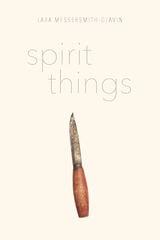
Spirit Things
Lara Messersmith-Glavin
University of Alaska Press, 2022
“Spirit things” are those mundane objects that offer new insights into the world on closer consideration—fishing nets, a favorite knife, and the bioluminescent gleam of seawater in a twilight that never truly grows dark. Spirit Things recounts stories of fishing, family, synesthesia, storytelling, gender, violence, and meaning. Each essay takes an object and follows it through histories: personal, material, and scientific, drawing together the delicate lines that link things through their making and use, their genesis and evolution, and the ways they gain significance in an individual’s life.
A contemplative take on everything from childcare to neurodivergence, comfort foods to outlaws, Spirit Things uses experiences from the human world and locates them on the edges of nature. Contact with wilderness, with wildness, be it twenty-foot seas in the ocean off Alaska’s coast or chairs flying through windows of a Kodiak bar, provides an entry point for meditations on the ways in which patterns, magic, and wonder overlap.

Street Scenes
Brecht, Benjamin and BerlinNicolas Whybrow
Intellect Books, 2004
Bertolt Brecht, meanwhile, stands as one of the principal thinkers about art and politics in the 20th century. The "Street Scene" model, which was the foundation for his theory of an epic theatre, relied precisely on establishing a connection between art's functioning and everyday life. His preoccupation with the ceaselessness of change, an impulse implying rupture and movement as the key characteristics informing the development of a democratic cultural identity, correlates resonantly with the notion of an ever-evolving city.
Premised on an understanding of performance as the articulation of movement in space, Street Scenes interrogates what kind of "life" is permitted to "flow" in the "new Berlin." Central to this method is the flaneur figure, a walker of streets who provides detached observations on the revealing "detritus of modern urban existence." Walter Benjamin, himself a native of Berlin as well as friend and seminal critic of Brecht, exercised the practice in exemplary form in his portrait of the city One-Way Street.
Street Scenes offers various points of entry for the reader, including those interested in: theatre, performance, visual art, architecture, theories of everyday life and culture, and the politics of identity. Ultimately, it is an interdisciplinary book, which strives to establish the 'porosity' of areas of theory and practice rather than hard boundaries.
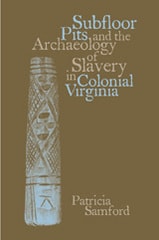
Subfloor Pits and the Archaeology of Slavery in Colonial Virginia
Patricia Samford
University of Alabama Press, 2007
Enslaved Africans and their descendants comprised a significant portion of colonial Virginia populations, with most living on rural slave quarters adjacent to the agricultural fields in which they labored. Archaeological excavations into these home sites have provided unique windows into the daily lifeways and culture of these early inhabitants.