Results by title
72 books match the query 'Honor' and 6 start with s
Shakespeare without Boundaries
Essays in Honor of Dieter MehlChrista Jansohn
University of Delaware Press, 2011
Shakespeare without Boundaries: Essays in Honor of Dieter Mehl offers a wide-ranging collection of essays written by an international team of distinguished scholars who attempt to define, to challenge, and to erode boundaries that currently inhibit understanding of Shakespeare, and to exemplify how approaches that defy traditional bounds of study and criticism may enhance understanding and enjoyment of a dramatist who acknowledged no boundaries in art.
The Volume is published in tribute to Professor Dieter Mehl, whose critical and scholarly work on authors from Chaucer through Shakespeare to D. H. Lawrence has transcended temporal and national boundaries in its range and scope, and who, as Ann Jennalie Cook writes, has contributed significantly to the erasure of political boundaries that have endangered the unity of German literary scholarship and, more broadly, through his work for the International Shakespeare Association, to the globalization of Shakespeare studies.
Published by University of Delaware Press. Distributed worldwide by Rutgers University Press.
Spaces of Honor
Making German Civil Society, 1700-1914Heikki Lempa
University of Michigan Press, 2021
The common understanding is that honor belongs to a bygone era, whereas civil society belongs to the future and modern society. Heikki Lempa argues that honor was not gone or even in decline between 1700 and 1914, and that civil society was not new but had long roots that stretched into the Middle Ages. In fact, what is peculiar for this era in Germany were the deep connections between practices of honor and civil society. This study focuses on collective actions of honor and finds them, in a series of case studies, at such communal spaces as schools, theaters, lunch and dinner tables, spas, workers’ strikes, and demonstrations. It is in these collective actions that we see civil society in making.
The Spaces of Honor sees civil society not primarily as an idea or an intellectual project but as a set of practices shaped in physical spaces. Around 1700, the declining power of religious authorities allowed German intellectuals to redefine civil society, starting with a new language of honor. Then, in the middle of the eighteenth century, an increasing number of voluntary associations and public spaces turned it into reality. Here, honor provided cohesion. In the nineteenth century, urbanization and industrialization ushered in powerful forces of atomization that civil society attempted to remedy. The remedy came from social and physical spaces that generated a culture of honor and emotional belonging. We find them in voluntary associations, spas, revived guilds, and labor unions. By the end of the nineteenth century, honor was deeply embedded in German civil society.
Stealing the General
The Great Locomotive Chase and the First Medal of HonorRussell S. Bonds
Westholme Publishing, 2007
Selected by Civil War Interactive as One of the Top Civil War Books of All Time
On April 12, 1862—one year to the day after Confederate guns opened on Fort Sumter and started the Civil War—a tall, mysterious smuggler and self-appointed Union spy named James J. Andrews and nineteen infantry volunteers infiltrated north Georgia and stole a steam engine called the General. Racing northward at speeds approaching sixty miles an hour, cutting telegraph lines and destroying track along the way, Andrews planned to open East Tennessee to the Union army, cutting off men and matériel from the Confederate forces in Virginia. If they succeeded, Andrews and his raiders could change the course of the war. But the General's young conductor, William A. Fuller, chased the stolen train first on foot, then by handcar, and finally aboard another engine, the Texas. He pursued the General until, running out of wood and water, Andrews and his men abandoned the doomed locomotive, ending the adventure that would soon be famous as The Great Locomotive Chase. But the ordeal of the soldiers involved was just beginning. In the days that followed, the "engine thieves" were hunted down and captured. Eight were tried and executed as spies, including Andrews. Eight others made a daring escape to freedom, including two assisted by a network of slaves and Union sympathizers. For their actions, before a personal audience with President Abraham Lincoln, six of the raiders became the first men in American history to be awarded the Medal of Honor—the nation's highest decoration for gallantry.
Americans north and south, both at the time and ever since, have been astounded and fascinated by this daring raid. But until now, there has not been a complete history of the entire episode and the fates of all those involved. Based on eyewitness accounts, as well as correspondence, diaries, military records, newspaper reports, deposition testimony and other primary sources, Stealing the General: The Great Locomotive Chase and the First Medal of Honor by Russell S. Bonds is a blend of meticulous research and compelling narrative that is now considered to be the definitive history of "the boldest adventure of the war."
Stones, Bones, and the Sacred
Essays on Material Culture and Ancient Religion in Honor of Dennis E.Alan H. Cadwallader
SBL Press, 2016
A crucial text for any university course on the interaction of archaeology and the Bible
The world of early Christians was not a world lived in texts; it was a world saturated with material reality and concerns: what, where and when to eat or drink; how to present oneself in the space of bodily life and that of death; how to move from one place to another; what impacted status or the adjudication of legal charges. All these and more controlled so much of life in the ancient world. The Christians were not immune from the impact of these realities. Sometimes they absorbed their surrounds; sometimes they quite explicitly rejected the material practices bearing in on them; frequently they modified the practice and the rationale to create a significant Christian alternative. The collection of essays in this volume come from a range of international scholars who, for all their different interests and critical commitments, are yet united in treasuring research into the Greek and Roman worlds in which Christians sought to make their way. They offer these essays in honor of one who has made a lifetime's work in mining ancient material culture to extract nuggets of insight into early Christian dining practices: Dennis E. Smith.
Features
- Rich examples of method in the utilization of ancient material culture for biblical interpretation.
- Thirteen essays with a response from Dennis E. Smith
- Maps, diagrams, and plates
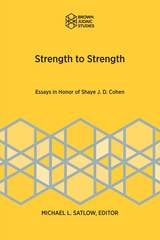
Strength to Strength
Essays in Honor of Shaye J. D. CohenMichael L. Satlow
SBL Press, 2018
Essays that engage the scholarship of Shaye J. D. Cohen
The essays in Strength to Strength honor Shaye J. D. Cohen across a range of ancient to modern topics. The essays seek to create an ongoing conversation on issues of identity, cultural interchange, and Jewish literature and history in antiquity, all areas of particular interest for Cohen. Contributors include: Moshe J. Bernstein, Daniel Boyarin, Jonathan Cohen, Yaakov Elman, Ari Finkelstein, Charlotte Elisheva Fonrobert, Steven D. Fraade, Isaiah M. Gafni, Gregg E. Gardner, William K. Gilders, Martin Goodman, Leonard Gordon, Edward L. Greenstein, Erich S. Gruen, Judith Hauptman, Jan Willem van Henten, Catherine Hezser, Tal Ilan, Richard Kalmin, Yishai Kiel, Ross S. Kraemer, Hayim Lapin, Lee I. Levine, Timothy H. Lim, Duncan E. MacRae, Ivan Marcus, Mahnaz Moazami, Rachel Neis, Saul M. Olyan, Jonathan J. Price, Jeffrey L. Rubenstein, Michael L. Satlow, Lawrence H. Schiffman, Daniel R. Schwartz, Joshua Schwartz, Karen Stern, Stanley Stowers, and Burton L. Visotzky.
Features:
- A full bibliography of Cohen’s published works
- An essay on the contributions of Cohen
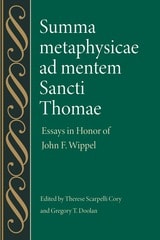
Summa metaphysicae ad mentem Sancti Thomae
Essays in Honor of John F. WippelTherese Scarpelli Cory
Catholic University of America Press, 2023