Results by title
72 books match the query 'Indian authors' and 14 start with s
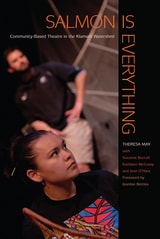
Salmon Is Everything
Community-Based Theatre in the Klamath WatershedTheresa May with Susanne Burcell, Kathleen McCovey, and Jean O'Hara
Oregon State University Press, 2014
Salmon Is Everything simultaneously illuminates the logistics of a crisis in the third largest watershed in the Pacific Northwest—the premature death of more than 30,000 salmon on the Lower Klamath River in 2002—and documents what happened when one community decided to use art to amplify the experiences of its members. The fish kill had unprecedented impact throughout the watershed, and for many tribal communities it signified an ongoing loss of traditional cultural practices. But in the political and ecological upheaval that followed, the role of salmon in tribal life went largely unacknowledged, which inspired the collaboration between May and members of the Yurok, Hoopa Valley, and Karuk tribes, as well as farmers, ranchers, and others invested in the Klamath watershed.
Salmon is Everything will appeal to readers interested in the environmental and cultural history of the Pacific Northwest and the ecological and civil challenges its communities face. For artists and activists, it’s a useful case study. Salmon is Everything offers a unique interdisciplinary resource for high school and college level courses in environmental studies, Native American studies, and theatre arts education.
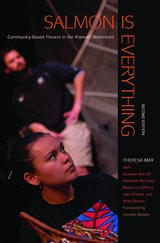
Salmon is Everything
Community-Based Theatre in the Klamath WatershedTheresa May with Susanne Burcell, Kathleen McCovey, and Jean O'Hara
Oregon State University Press, 2018
Salmon Is Everything simultaneously illuminates the logistics of a crisis in the third largest watershed in the Pacific Northwest—the premature death of more than 30,000 salmon on the Lower Klamath River in 2002—and documents what happened when one community decided to use art to amplify the experiences of its members. The fish kill had unprecedented impact throughout the watershed, and for many tribal communities it signified an ongoing loss of traditional cultural practices. But in the political and ecological upheaval that followed, the role of salmon in tribal life went largely unacknowledged, which inspired the collaboration between May and members of the Yurok, Hoopa Valley, and Karuk tribes, as well as farmers, ranchers, and others invested in the Klamath watershed.
Salmon is Everything will appeal to readers interested in the environmental and cultural history of the Pacific Northwest and the ecological and civil challenges its communities face. For artists and activists, it’s a useful case study. Salmon is Everything offers a unique interdisciplinary resource for high school and college level courses in environmental studies, Native American studies, and theatre arts education.
New materials in this second edition include additional essays by Native faculty and actors, an updated introduction by the author, minor textual corrections throughout, and a new online resource guide.
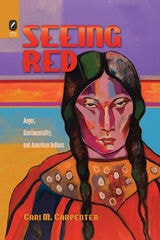
Seeing Red
Anger, Sentimentality, and American IndiansCari M. Carpenter
The Ohio State University Press, 2008
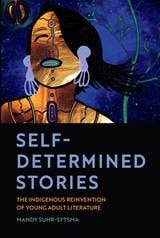
Self-Determined Stories
The Indigenous Reinvention of Young Adult LiteratureMandy Suhr-Sytsma
Michigan State University Press, 2018
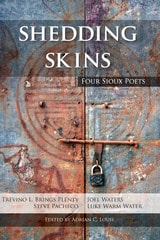
Shedding Skins
Four Sioux PoetsAdrian C. Louis
Michigan State University Press, 2008
Here's the myth: Native Americans are people of great spiritual depth, in touch with the rhythms of the earth, rhythms that they celebrate through drumming and dancing. They love the great outdoors and are completely in tune with the natural world. They can predict the weather by glancing at the sky, or hearing a crow cry, or somehow. Who knows exactly how? The point of the myth is that Indians are, well, special. Different from white people, but in a good way.
The four young male Native American poets whose work is brought together in this startling collection would probably raise high their middle fingers in salute to this myth. These guys and "guys" they are—don't buy into the myth. Their poems aren't about hunting and fishing or bonding with animal spirits. Their poems are about urban decay and homelessness, about loneliness and despair, about Payday Loans and 40-ounce beers, about getting enough to eat and too much to drink. And there is nothing romantic about their poetry, either. It is written in the vernacular of mean streets: often raw and coarse and vulgar, just like the lives it describes. Sure, they write about life on the reservation. However, for the Indians in their poems, life on the reservation is a lot like life in the city, but without the traffic. These poets are sick to death of the myth. You can feel it in their poems.
These poets are bound by a common attitude as well as a common heritage. All four—Joel Waters, Steve Pacheco, Luke Warm Water, and Trevino L. Brings Plenty—are Sioux, and all four identify themselves as "Skins" (as in "Redskins"). In their poems, they grapple with their heritage, wrestling with what it means to be a Sioux and a Skin today. It's a fight to the finish.
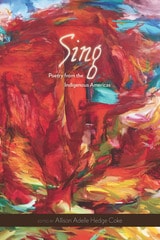
Sing
Poetry from the Indigenous AmericasEdited by Allison Adelle Hedge Coke
University of Arizona Press, 2011
They write from disparate zones and parallel experience, from lands of mounded earthwork long-since paved, from lands of ancient ball courts and the first great cities on the continents, from places of cold, from places of volcanic loam, from zones of erased history and ongoing armed conflict, where “postcolonial” is not an academic concept but a lived reality. As befits a volume of such geographical inclusivity, many poems here appear in multiple languages, translated by fellow poets and writers like Juan Felipe Herrera and Cristina Eisenberg.
Hedge Coke’s thematic organization of the poems gives them an added resonance and continuity, and readers will appreciate the story of the genesis of this project related in Hedge Coke’s deeply felt introduction, which details her experiences as an invited performer at several international poetry festivals. Sing is a journey compelled by the exploration of kinship and the desire for songs that open “pathways of return.”
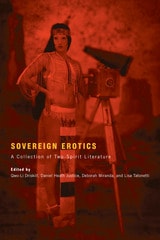
Sovereign Erotics
A Collection of Two-Spirit LiteratureEdited by Qwo-Li Driskill, Daniel Heath Justice, Deborah Miranda, and Lisa Tatonetti
University of Arizona Press, 2011
This landmark collection strives to reflect the complexity of identities within Native Gay, Lesbian, Bisexual, Transgender, Queer, and Two-Spirit (GLBTQ2) communities. Gathering together the work of established writers and talented new voices, this anthology spans genres (fiction, nonfiction, poetry, and essay) and themes (memory, history, sexuality, indigeneity, friendship, family, love, and loss) and represents a watershed moment in Native American and Indigenous literatures, Queer studies, and the intersections between the two.
Collaboratively, the pieces in Sovereign Erotics demonstrate not only the radical diversity among the voices of today’s Indigenous GLBTQ2 writers but also the beauty, strength, and resilience of Indigenous GLBTQ2 people in the twenty-first century.
Contributors: Indira Allegra, Louise Esme Cruz, Paula Gunn Allen, Qwo-Li Driskill, Laura Furlan, Janice Gould, Carrie House, Daniel Heath Justice, Maurice Kenny, Michael Koby, M. Carmen Lane, Jaynie Lara, Chip Livingston, Luna Maia, Janet McAdams, Deborah Miranda, Daniel David Moses, D. M. O’Brien, Malea Powell, Cheryl Savageau, Kim Shuck, Sarah Tsigeyu Sharp, James Thomas Stevens, Dan Taulapapa McMullin, William Raymond Taylor, Joel Waters, and Craig Womack
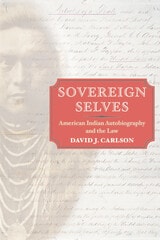
Sovereign Selves
American Indian Autobiography and the LawDavid J. Carlson
University of Illinois Press, 2005
Carlson argues that by drawing on the conventions of early colonial treaty-making, nineteenth- and early twentieth-century Indian autobiographers sought to adapt and redefine the terms of Indian law as a way to assert specific property-based and civil rights. Focusing primarily on the autobiographical careers of two major writers (William Apess and Charles Eastman), Sovereign Selves traces the way that their sustained engagement with colonial legal institutions gradually enabled them to produce a new rhetoric of "Indianness."
Sovereign Traces, Volume 1
Not (Just) (An)OtherGordon D. Henry Jr.
Michigan State University Press, 2018
Speak to Me Words
Essays on Contemporary American Indian PoetryEdited by Dean Rader and Janice Gould
University of Arizona Press, 2003
Speak to Me Words is a stimulating blend of classic articles and original pieces that reflect the energy of modern American Indian literary studies. Highlighting various aspects of poetry written by American Indians since the 1960s, it is a wide-ranging collection that balances the insights of Natives and non-Natives, men and women, old and new voices. Included here are such landmark articles as "Answering the Deer" by Paula Gunn Allen, "Herbs of Healing" by Carter Revard, and "Song, Poetry and Language—Expression and Perception" by Simon Ortiz—all pieces that have shaped how we think about Native poetry. Among the contributions appearing for the first time are Elaine Jahner writing on Paula Gunn Allen's use of formal structures; Robert Nelson addressing pan-Indian tropes of emergence, survival, return, and renewal; and Janet McAdams focusing on Carter Revard's "angled mirrors." Although many Native writers may disregard distinctions between genres, together these writings help readers see the difference between American Indian poetry and other forms of Native literature.
These essays are as broad, encompassing, and provocative as Native poetry itself, branching off from and weaving back into one another. In showing how American Indian poetry redefines our social order and articulates how Indian communities think about themselves, these writers establish a new foundation for the study—and enjoyment—of this vital art.
Speaking for the Generations
Native Writers on WritingEdited by Simon J. Ortiz
University of Arizona Press, 1997
Of varied backgrounds, the writers represent Indian heritages and cultures from the Pacific Northwest to the northern plains, from Canada to Guatemala. They are poets, novelists, and playwrights. And although their backgrounds are different and their statements intensely personal, they share common themes of their relationship to the land, to their ancestors, and to future generations of their people. From Gloria Bird's powerful recounting of personal and family history to Esther Belin's vibrant tale of her urban Native homeland in Los Angeles, these writers reveal the importance of place and politics in their lives. Leslie Marmon Silko calls upon the ancient tradition of Native American storytelling and its role in connecting the people to the land. Roberta J. Hill and Elizabeth Woody ponder some of the absurdities of contemporary Native life, while Guatemalan Victor Montejo takes readers to the Mayan world, where a native culture had writing and books long before Europeans came.
Together these pieces offer an inspiring portrait of what it means to be a Native writer in the twentieth century. With passion and urgency, these writers are speaking for themselves, for their land, and for the generations.
Speaking for the People
Native Writing and the Question of Political FormMark Rifkin
Duke University Press, 2021
Stories Through Theories/ Theories Through Stories
North American Indian Writing, Storytelling, and CritiqueGordon D. Henry Jr.
Michigan State University Press, 2009
Stories Through Theories/Theories Through Stories explores the uneasy relations—often contentious, sometimes complicit—between American Indian Literature and literary theory. Some of the essays in this book open American Indian narratives to theoretical critique based on "western depth models." Others work from a very different direction, finding critique in storytelling and processes of narrative production, thereby exposing dimensions of literary theory that grow from the indigenous ground of Native stories themselves.
This collection of essays—sometimes playfully but always insistently—changes our readings of Native works and challenges our roles as intellectual guides until we step deeper into the ambiguous territories where writer, listener, reader, and critic intersect.
Taken together, these essays provide compelling evidence for looking at primary Native cultures, authors, and histories as enrichments of Native literature.
Survival This Way
Interviews with American Indian PoetsJoseph Bruchac
University of Arizona Press, 1987