Results by title
59 books match the query 'Indians, Treatment of' and 4 start with s
Settler City Limits
Indigenous Resurgence and Colonial Violence in the Urban Prairie WestHeather Dorries
Michigan State University Press, 2019
While cities like Winnipeg, Minneapolis, Saskatoon, Rapid City, Edmonton, Missoula, Regina, and Tulsa are places where Indigenous marginalization has been most acute, they have also long been sites of Indigenous placemaking and resistance to settler colonialism. Settler City Limits addresses urban struggles involving Anishinabek, Cree, Creek, Dakota, Flathead, Lakota, and Métis peoples. Collectively, these studies showcase how Indigenous people in the city resist ongoing processes of colonial dispossession and create spaces for themselves and their families. Working at intersections of Indigenous studies, settler colonial studies, urban studies, geography, and sociology, this book examines how the historical and political conditions of settler colonialism have shaped urban development in the Canadian Prairies and American Great Plains. Settler City Limits frames cities as Indigenous spaces and places, both in terms of the historical geographies of the regions in which they are embedded and with respect to ongoing struggles for land, life, and self-determination.
[more]
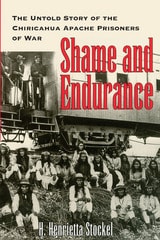
Shame and Endurance
The Untold Story of the Chiricahua Apache Prisoners of WarH. Henrietta Stockel
University of Arizona Press, 2004
Many readers may be familiar with the wartime exploits of the Apaches; this book relates the untold story of their postwar fate. It tells of the Chiricahua Apaches’ 27 years of imprisonment as recorded in American dispatches, reports, and news items: documents that disclose the confusion, contradictions, and raw emotions expressed by government and military officials regarding the Apaches while revealing the shameful circumstances in which they were held.
First removed from Arizona to Florida, the prisoners were eventually relocated to Mount Vernon Barracks in Alabama, where, in the words of one Apache, "We didn’t know what misery was until they dumped us in those swamps." Pulmonary disease took its toll—by 1894, disease had killed nearly half of the Apaches—and after years of pressure from Indian rights activists and bureaucratic haggling, Fort Sill in Oklahoma was chosen as a more healthful location. Here they were given the opportunity to farm, and here Geronimo, who eventually converted to Christianity, died of pneumonia in 1909 at the age of 89, still a prisoner of war. In the meantime, many Apache children had been removed to Carlisle, Pennsylvania, for education—despite earlier promises that families would not be split up—and most eventually lost their cultural identity.
Henrietta Stockel has combed public records to reconstruct this story of American shame and Native endurance. Unabashedly speaking on behalf of the Apaches, she has framed these documents within a readable narrative to show how exasperated public officials, eager to openly demonstrate their superiority over "savages" who had successfully challenged the American military for years, had little sympathy for the consequences of their confinement. Although the Chiricahua Apaches were not alone in losing their ancestral homelands, they were the only American Indians imprisoned for so long a time in an environment that continually exposed them to illnesses against which they had no immunity, devastating families even more than warfare. Shame and Endurance records events that ought never to be repeated—and tells a story that should never be forgotten.
[more]
Speaking for the People
Native Writing and the Question of Political FormMark Rifkin
Duke University Press, 2021
In Speaking for the People Mark Rifkin examines nineteenth-century Native writings to reframe contemporary debates around Indigenous recognition, refusal, and resurgence. Rifkin shows how works by Native authors (William Apess, Elias Boudinot, Sarah Winnemucca, and Zitkala-Ša) illustrate the intellectual labor involved in representing modes of Indigenous political identity and placemaking. These writers highlight the complex processes involved in negotiating the character, contours, and scope of Indigenous sovereignties under ongoing colonial occupation. Rifkin argues that attending to these writers' engagements with non-native publics helps provide further analytical tools for addressing the complexities of Indigenous governance on the ground—both then and now. Thinking about Native peoplehood and politics as a matter of form opens possibilities for addressing the difficult work involved in navigating among varied possibilities for conceptualizing and enacting peoplehood in the context of continuing settler intervention. As Rifkin demonstrates, attending to writings by these Indigenous intellectuals provides ways of understanding Native governance as a matter of deliberation, discussion, and debate, emphasizing the open-ended unfinishedness of self-determination.
[more]
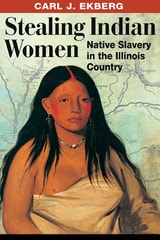
Stealing Indian Women
Native Slavery in the Illinois CountryCarl J. Ekberg
University of Illinois Press, 2009
Based almost entirely on original source documents from the United States, France, and Spain, Carl J. Ekberg’s Stealing Indian Women provides an innovative overview of Indian slavery in the Mississippi Valley. His detailed study of a fascinating and convoluted criminal case involving various slave women and a métis (mixed-blood) woodsman named Céladon illuminates race and gender relations, Creole culture, and the lives of Indian slaves--particularly women--in ways never before possible.
[more]