Results by title
63 books match the query 'Indigenous Languages in the Americas' and 2 start with s
Sonora Yaqui Language Structures
John M. Dedrick and Eugene H. Casad
University of Arizona Press, 1999
Yaqui is a Southern Uto-Aztecan language spoken by a people living predominantly in Sonora, with some communities in Arizona. This comprehensive reference on the Sonoran Yaqui language is a descriptive grammar that covers topics on phonology, word classes, verb structure, and complex sentences. John M. Dedrick, who lived and worked among the Yaquis for more than thirty years, shares his extensive knowledge of the language, while Uto-Aztecan specialist Eugene H. Casad helps put the material in a comparative perspective.
The book includes useful sections on quantifiers and adverbial and deictic particles, often inadequately treated in reference grammars. A section on auxiliary verbs and well-documented information on voice, aspect, and other features of verbal inflection provide readers with useful data for particular lines of linguistic inquiry. Each grammatical point is illustrated by example sentences distinguished by their naturalness and cultural relevance. At the end of the book, a Yaqui text provides a sample of connected sentences in a natural context.
Sonora Yaqui Language Structures is a valuable source not only for research on this language family but also for anthropological studies of the Arizona-Sonora cultural region. In addition, it documents an indigenous language for future generations of Yaqui speakers.
[more]
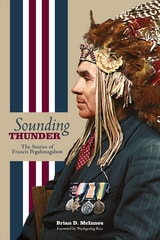
Sounding Thunder
The Stories of Francis PegahmagabowBrian D. McInnes
Michigan State University Press, 2016
Francis Pegahmagabow (1889–1952), an Ojibwe of the Caribou clan, was born in Shawanaga First Nation, Ontario. Enlisting at the onset of the First World War, he served overseas as a scout and sniper and became Canada’s most decorated Indigenous soldier. After the war, Pegahmagabow settled in Wasauksing First Nation, Ontario, where he married and raised six children. He served his community as both Chief and Councillor and was a founding member of the Brotherhood of Canadian Indians, the first national Indigenous political organization. In 1949 and 1950, he was elected the Supreme Chief of the National Indian Government.
Francis Pegahmagabow’s stories describe many parts of his life and are characterized by classic Ojibwe narrative. They reveal aspects of Francis’s Anishinaabe life and worldview. Interceding chapters by Brian McInnes provide valuable cultural, spiritual, linguistic, and historical insights that give a greater context and application for Francis’s words and world. Presented in their original Ojibwe as well as in English translation, the stories also reveal a rich and evocative relationship to the lands and waters of Georgian Bay.
In Sounding Thunder, Brian McInnes provides a new perspective on Pegahmagabow and his experience through a unique synthesis of Ojibwe oral history, historical record, and Pegahmagabow family stories.
[more]