Results by title
174 books match the query 'Indigenous peoples' and 11 start with s
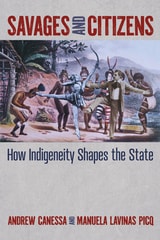
Savages and Citizens
How Indigeneity Shapes the StateAndrew Canessa and Manuela Lavinas Picq; Foreword by Jeff Ganohalidoh Corntassel
University of Arizona Press, 2024
Delving into European political philosophy, comparative politics, and contemporary international law, the book shows how the concept of indigeneity has shaped the development of the modern state. The exclusion of Indigenous people was not a collateral byproduct; it was a political project in its own right. The book argues that indigeneity is a political identity relational to modern nation-states and that Indigenous politics, although marking the boundary of the state, are co-constitutive of colonial processes of state-making. In showing how indigeneity is central to how the international system of states operates, the book forefronts Indigenous peoples as political actors to reject essentializing views that reduce them to cultural “survivors” rooted in the past.
With insights drawn from diverse global contexts and empirical research from Bolivia and Ecuador, this work advocates for the relevance of Indigenous studies within political science and argues for an ethnography of sovereignty in anthropology. Savages and Citizens makes a compelling case for the centrality of Indigenous perspectives to understand the modern state from political theory to international studies.
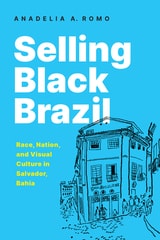
Selling Black Brazil
Race, Nation, and Visual Culture in Salvador, BahiaAnadelia Romo
University of Texas Press, 2022
2023 Honorable Mention, Brazil Section Humanities Book Prize, Latin American Studies Association (LASA)
This book explores visual portrayals of blackness in Brazil to reveal the integral role of visual culture in crafting race and nation across Latin America.
In the early twentieth century, Brazil shifted from a nation intent on whitening its population to one billing itself as a racial democracy. Anadelia Romo shows that this shift centered in Salvador, Bahia, where throughout the 1950s, modernist artists and intellectuals forged critical alliances with Afro-Brazilian religious communities of Candomblé to promote their culture and their city. These efforts combined with a growing promotion of tourism to transform what had been one of the busiest slaving depots in the Americas into a popular tourist enclave celebrated for its rich Afro-Brazilian culture. Vibrant illustrations and texts by the likes of Jorge Amado, Pierre Verger, and others contributed to a distinctive iconography of the city, with Afro-Bahians at its center. But these optimistic visions of inclusion, Romo reveals, concealed deep racial inequalities. Illustrating how these visual archetypes laid the foundation for Salvador’s modern racial landscape, this book unveils the ways ethnic and racial populations have been both included and excluded not only in Brazil but in Latin America as a whole.
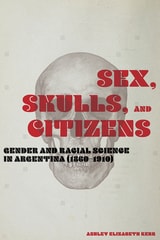
Sex, Skulls, and Citizens
Gender and Racial Science in Argentina (1860-1910)Ashley Elizabeth Kerr
Vanderbilt University Press, 2020
PROSE Awards Subject Category Finalist—Biological Anthropology, Ancient History, and Archaeology, 2021
Best Nineteenth-Century Book Award, Latin American Studies Association Nineteenth-Century Section, 2021
Analyzing a wide variety of late-nineteenth-century sources, Sex, Skulls, and Citizens argues that Argentine scientific projects of the era were not just racial encounters, but were also conditioned by sexual relationships in all their messy, physical reality.
The writers studied here (an eclectic group of scientists, anthropologists, and novelists, including Estanislao Zeballos, Lucio and Eduarda Mansilla, Ramón Lista, and Florence Dixie) reflect on Indigenous sexual practices, analyze the advisability and effects of interracial sex, and use the language of desire to narrate encounters with Indigenous peoples as they try to scientifically pinpoint Argentina's racial identity and future potential.
Kerr's reach extends into history of science, literary studies, and history of anthropology, illuminating a scholarly time and place in which the lines betwixt were much blurrier, if they existed at all.
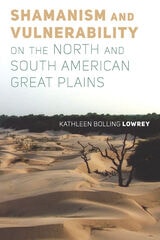
Shamanism and Vulnerability on the North and South American Great Plains
Kathleen Bolling Lowrey
University Press of Colorado, 2020
The book reveals the various ways in which anthropologists, historians, folklorists, and other writers have often misrepresented indigenous shamanism and revitalization movements by unconsciously projecting ideologies and assumptions derived from modern ‘contract societies’ onto ethnographic and historical realities. Lowrey also provides alternative ways of understanding indigenous American communities and their long histories of interethnic relations with expanding colonial and national states in the Americas. A creative historical and ethnographical reevaluation of the last few decades of scholarship on shamanism, disability, and dependence, Shamanism and Vulnerability on the North and South American Great Plains will be of interest to scholars of North and South American anthropology, indigenous history, American studies, and feminism.
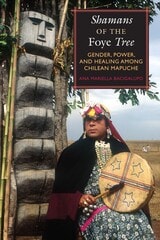
Shamans of the Foye Tree
Gender, Power, and Healing among Chilean MapucheBy Ana Mariella Bacigalupo
University of Texas Press, 2007
Drawing on anthropologist Ana Mariella Bacigalupo's fifteen years of field research, Shamans of the Foye Tree: Gender, Power, and Healing among Chilean Mapuche is the first study to follow shamans' gender identities and performance in a variety of ritual, social, sexual, and political contexts.
To Mapuche shamans, or machi, the foye tree is of special importance, not only for its medicinal qualities but also because of its hermaphroditic flowers, which reflect the gender-shifting components of machi healing practices. Framed by the cultural constructions of gender and identity, Bacigalupo's fascinating findings span the ways in which the Chilean state stigmatizes the machi as witches and sexual deviants; how shamans use paradoxical discourses about gender to legitimatize themselves as healers and, at the same time, as modern men and women; the tree's political use as a symbol of resistance to national ideologies; and other components of these rich traditions.
The first comprehensive study on Mapuche shamans' gendered practices, Shamans of the Foye Tree offers new perspectives on this crucial intersection of spiritual, social, and political power.

Sharing the Land, Sharing a Future
The Legacy of the Royal Commission on Aboriginal PeoplesKatherine Graham
University of Manitoba Press, 2021
Shipwrecked Identities
Navigating Race on Nicaragua's Mosquito CoastPineda, Baron
Rutgers University Press, 2006
Global identity politics rest heavily on notions of ethnicity and authenticity, especially in contexts where indigenous identity becomes a basis for claims of social and economic justice. In contemporary Latin America there is a resurgence of indigenous claims for cultural and political autonomy and for the benefits of economic development. Yet these identities have often been taken for granted.
In this historical ethnography, Baron Pineda traces the history of the port town of Bilwi, now known officially as Puerto Cabezas, on the Atlantic coast of Nicaragua to explore the development, transformation, and function of racial categories in this region. From the English colonial period, through the Sandinista conflict of the 1980s, to the aftermath of the Contra War, Pineda shows how powerful outsiders, as well as Nicaraguans, have made efforts to influence notions about African and Black identity among the Miskito Indians, Afro-Nicaraguan Creoles, and Mestizos in the region. In the process, he provides insight into the causes and meaning of social movements and political turmoil. Shipwrecked Identities also includes important critical analysis of the role of anthropologists and other North American scholars in the Contra-Sandinista conflict, as well as the ways these scholars have defined ethnic identities in Latin America.
As the indigenous people of the Mosquito Coast continue to negotiate the effects of a long history of contested ethnic and racial identity, this book takes an important step in questioning the origins, legitimacy, and consequences of such claims.

Sideways Selves
Travesti and Jotería Struggles Across the AméricasPJ DiPietro
University of Texas Press, 2025
2026 Sylvia Rivera Award in Transgender Studies, The Center for LGBTQ Studies (CLAGS), CUNY
How trans and non-binary networks engage in decoloniality across hemispheres.
A deeply informed, theoretically rich work of inquiry and critique, Sideways Selves learns from two communities of migrants as they contest their marginalization under the colonial regime of gender—colonial because, as PJ DiPietro affirms, Indigenous and Afro-diasporic conceptions of embodiment have been displaced by the European-Christian order of gender. Following gender-nonconforming Aymara, Kolla, and mixed-race exiles in Buenos Aires and K’iche’, Nahua, and Central American migrants in the San Francisco Bay Area, DiPietro takes stock of a collective, transnational effort to reimagine ideas of personhood and kinship that gender makes unthinkable.
The communities DiPietro studies create new kinds of identities, collective and genderless in nature. Their ways of thinking and doing, though radical, are motivated by old wisdom, storytelling, healing, and religion—brujería, curanderismo, Voudoun, and other practices that colonialism, capitalism, and the nation-state have unsuccessfully tried to erase. In equal measures philosophical and ethnographic, Sideways Selves witnesses and listens as these displaced people—displaced from their homes and from the moral geography of the West—show us what a just, decolonial world could actually be.

Slavery and Utopia
The Wars and Dreams of an Amazonian World TransformerBy Fernando Santos-Granero,
University of Texas Press, 2018
In the first half of the twentieth century, a charismatic Peruvian Amazonian indigenous chief, José Carlos Amaringo Chico, played a key role in leading his people, the Ashaninka, through the chaos generated by the collapse of the rubber economy in 1910 and the subsequent pressures of colonists, missionaries, and government officials to assimilate them into the national society. Slavery and Utopia reconstructs the life and political trajectory of this leader whom the people called Tasorentsi, the name the Ashaninka give to the world-transforming gods and divine emissaries that come to this earth to aid the Ashaninka in times of crisis.
Fernando Santos-Granero follows Tasorentsi’s transformations as he evolved from being a debt-peon and quasi-slave to being a slave raider; inspirer of an Ashaninka movement against white-mestizo rubber extractors and slave traffickers; paramount chief of a multiethnic, anti-colonial, and anti-slavery uprising; and enthusiastic preacher of an indigenized version of Seventh-Day Adventist doctrine, whose world-transforming message and personal influence extended well beyond Peru’s frontiers. Drawing on an immense body of original materials ranging from archival documents and oral histories to musical recordings and visual works, Santos-Granero presents an in-depth analysis of chief Tasorentsi’s political discourse and actions. He demonstrates that, despite Tasorentsi’s constant self-reinventions, the chief never forsook his millenarian beliefs, anti-slavery discourse, or efforts to liberate his people from white-mestizo oppression. Slavery and Utopia thus convincingly refutes those who claim that the Ashaninka proclivity to messianism is an anthropological invention.
Stored in the Bones
Safeguarding Indigenous Living HeritagesAgnieszka Pawłowska-Mainville
University of Manitoba Press, 2023
Structures of Indifference
An Indigenous Life and Death in a Canadian CityMary Jane Logan McCallum
University of Manitoba Press, 2018