Results by title
55 books match the query 'Individual Architects & Firms' and 3 start with s
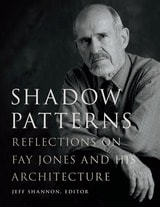
Shadow Patterns
Reflections on Fay Jones and His ArchitectureJeff Shannon
University of Arkansas Press, 2017
Winner, 2017 Ned Shank Award for Outstanding Preservation Publication from Preserve Arkansas
Shadow Patterns: Reflections on Fay Jones and His Architecture is a collection of critical essays and personal accounts of the man the American Institute of Architects honored with its highest award, the Gold Medal, in 1990.
The essays range from the academic, with appreciations and observations by Juhanni Palaasma and Robert McCarter and Ethel Goodstein-Murphree, to personal reflections by clients and friends. Two of Arkansas’s most accomplished writers, Roy Reed and Ellen Gilchrist, who each live in Fay Jones houses, have provided intimate portrayals of what it’s like to live in, and manage the quirks of, a “house built by a genius,” where “light is everywhere. . . . Everything is quiet, and everything is a surprise,” as Gilchrist says.
Through this compendium of perspectives, readers will learn about Jones’s personal qualities, including his strong will, his ability to convince other people of the rightness of his ideas, and yet his willingness, at times, to change his mind. We also enter into the work: powerful architecture like Stoneflower and Thorncrown Chapel and Pinecote Pavilion, along with private residences ranging from the modest to the monumental. And we learn about his relationship with his mentor, Frank Lloyd Wright.
Shadow Patterns broadens and enriches our understanding of this major figure in American architecture of the twentieth century.
Space Syntax
Selected Papers by Bill HillierEdited by Laura Vaughan, John Peponis, and Ruth Dalton
University College London, 2025
Few scholars have reshaped our understanding of architecture and urban design as profoundly as Bill Hillier. Space Syntax compiles the most influential works from his career, spanning over half a century, to showcase the evolution of his innovative theories on the spatial structure of cities and the social functions of built environments.
Including his early explorations of architecture as a research discipline and his later theories on how spatial configurations influence human movement and urban vitality, this collection provides a definitive overview of Hillier’s intellectual legacy. Featuring newly redrawn figures, rare texts, and expert introductions from leading theorists and practitioners, the volume offers fresh viewpoints on the continued relevance of space syntax in contemporary research and practice.
Relevant to subjects ranging from archaeology to physics, Space Syntax cements Hillier’s place as a revolutionary thinker whose ideas continue to shape how we design and understand space.
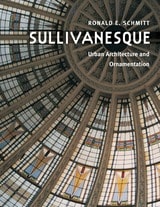
Sullivanesque
Urban Architecture and OrnamentationRonald E. Schmitt
University of Illinois Press, 2001