71 books match the query 'Inequality' and 5 start with s
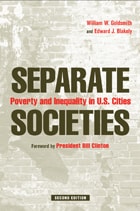
cover of Separate Societies: Poverty and Inequality in U.S. Cities

Separate Societies

Poverty and Inequality in U.S. Cities

Authored by William W. Goldsmith and Edward J. Blakely with a foreword by President Bill Clinton

Temple University Press, 2010

“Economic and political forces no longer combat poverty—they generate poverty!" exclaim William Goldsmith and Edward Blakely in their report on the plight of American's urban poor. In this revised and updated edition of their 1992 book Separate Societies,the authors present a compelling examination of the damaging divisions that isolate poor city minority residents from the middle-class suburban majority. They pay special attention to how the needs of the permanently poor have been unmet through the alternating years of promises and neglect, and propose a progressive turn away from 30 years of conservative policies.

Separate Societies vividly documents how the urban working class has been pushed out of industrial jobs through global economic restructuring, and how the Wall Street meltdown has aggravated underemployment, depleted public services, and sharpened racial and class inequalities.

The authors insist that the current U.S. approach puts Americans out of work and lowers the standard of living for all. As such, Goldsmith and Blakely urge the Obama administration to create better urban policy and foster better metropolitan management to effectively and efficiently promote equality.
[more]
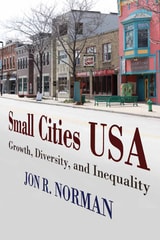
cover of Small Cities USA: Growth, Diversity, and Inequality

Small Cities USA

Growth, Diversity, and Inequality

Norman, Jon R

Rutgers University Press, 2012

While journalists document the decline of small-town America and scholars describe the ascent of such global cities as New York and Los Angeles, the fates of little cities remain a mystery. What about places like Providence, Rhode Island; Green Bay, Wisconsin; Laredo, Texas; and Salinas, California—the smaller cities that constitute much of America’s urban landscape? In Small Cities USA, Jon R. Norman examines how such places have fared in the wake of the large-scale economic, demographic, and social changes that occurred in the latter part of the twentieth century.

Drawing on an assessment of eighty small cities between 1970 and 2000, Norman considers the factors that have altered the physical, social, and economic landscapes of such places. These cities are examined in relation to new patterns of immigration, shifts in the global economy, and changing residential preferences. Small Cities USA presents the first large-scale comparison of smaller cities over time in the United States, showing that small cities that have prospered over time have done so because of diverse populations and economies. These "glocal" cities, as Norman calls them, are doing well without necessarily growing into large metropolises.
[more]
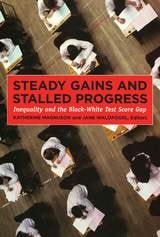
cover of Steady Gains and Stalled Progress: Inequality and the Black-White Test Score Gap

Steady Gains and Stalled Progress

Inequality and the Black-White Test Score Gap

Katherine Magnuson

Russell Sage Foundation, 2008
Addressing the disparity in test scores between black and white children remains one of the greatest social challenges of our time. Between the 1960s and 1980s, tremendous strides were made in closing the achievement gap, but that remarkable progress halted abruptly in the mid 1980s, and stagnated throughout the 1990s. How can we understand these shifting trends and their relation to escalating economic inequality? In Steady Gains and Stalled Progress, interdisciplinary experts present a groundbreaking analysis of the multifaceted reasons behind the test score gap—and the policies that hold the greatest promise for renewed progress in the future. Steady Gains and Stalled Progress shows that while income inequality does not directly lead to racial differences in test scores, it creates and exacerbates disparities in schools, families, and communities—which do affect test scores. Jens Ludwig and Jacob Vigdor demonstrate that the period of greatest progress in closing the gap coincided with the historic push for school desegregation in the 1960s and 1970s. Stagnation came after efforts to integrate schools slowed down. Today, the test score gap is nearly 50 percent larger in states with the highest levels of school segregation.  Katherine Magnuson, Dan Rosenbaum, and Jane Waldfogel show how parents' level of education affects children's academic performance: as educational attainment for black parents increased in the 1970s and 1980s, the gap in children's test scores narrowed. Sean Corcoran and William Evans present evidence that teachers of black students have less experience and are less satisfied in their careers than teachers of white students. David Grissmer and Elizabeth Eiseman find that the effects of economic deprivation on cognitive and emotional development in early childhood lead to a racial divide in school readiness on the very first day of kindergarten. Looking ahead, Helen Ladd stresses that the task of narrowing the divide is not one that can or should be left to schools alone. Progress will resume only when policymakers address the larger social and economic forces behind the problem. Ronald Ferguson masterfully interweaves the volume's chief findings to highlight the fact that the achievement gap is the cumulative effect of many different processes operating in different contexts. The gap in black and white test scores is one of the most salient features of racial inequality today. Steady Gains and Stalled Progress provides the detailed information and powerful insight we need to understand a complicated past and design a better future.
[more]
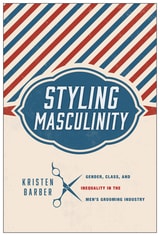
cover of Styling Masculinity: Gender, Class, and Inequality in the Men's Grooming Industry

Styling Masculinity

Gender, Class, and Inequality in the Men's Grooming Industry

Barber, Kristen

Rutgers University Press, 2016
The twenty-first century has seen the emergence of a new style of man: the metrosexual. Overwhelmingly straight, white, and wealthy, these impeccably coiffed urban professionals spend big money on everything from facials to pedicures, all part of a multi-billion-dollar male grooming industry. Yet as this innovative study reveals, even as the industry encourages men to invest more in their appearance, it still relies on women to do much of the work.
 
Styling Masculinity investigates how men’s beauty salons have persuaded their clientele to regard them as masculine spaces. To answer this question, sociologist Kristen Barber goes inside Adonis and The Executive, two upscale men’s salons in Southern California. Conducting detailed observations and extensive interviews with both customers and employees, she shows how female salon workers not only perform the physical labor of snipping, tweezing, waxing, and exfoliating, but also perform the emotional labor of pampering their clients and pumping up their masculine egos. 
 
Letting salon employees tell their own stories, Barber not only documents occasions when these workers are objectified and demeaned, but also explores how their jobs allow for creativity and confer a degree of professional dignity. In the process, she traces the vast network of economic and social relations that undergird the burgeoning male beauty industry. 
 
[more]
cover of Suddenly Diverse: How School Districts Manage Race and Inequality

Suddenly Diverse

How School Districts Manage Race and Inequality

Erica O. Turner

University of Chicago Press, 2020

For the past five years, American public schools have enrolled more students identified as Black, Latinx, American Indian, and Asian than white. At the same time, more than half of US school children now qualify for federally subsidized meals, a marker of poverty. The makeup of schools is rapidly changing, and many districts and school boards are at a loss as to how they can effectively and equitably handle these shifts.
Suddenly Diverse is an ethnographic account of two school districts in the Midwest responding to rapidly changing demographics at their schools. It is based on observations and in-depth interviews with school board members and superintendents, as well as staff, community members, and other stakeholders in each district: one serving “Lakeside,” a predominately working class, conservative community and the other serving “Fairview,” a more affluent, liberal community. Erica O. Turner looks at district leaders’ adoption of business-inspired policy tools and the ultimate successes and failures of such responses. Turner’s findings demonstrate that, despite their intentions to promote “diversity” or eliminate “achievement gaps,” district leaders adopted policies and practices that ultimately perpetuated existing inequalities and advanced new forms of racism.
While suggesting some ways forward, Suddenly Diverse shows that, without changes to these managerial policies and practices and larger transformations to the whole system, even district leaders’ best efforts will continue to undermine the promise of educational equity and the realization of more robust public schools.
[more]