Results by title
65 books match the query 'Intercultural communication' and 3 start with s

Shakespeare, Brecht, and the Intercultural Sign
Antony Tatlow
Duke University Press, 2001
Reflecting on how, why, and to what effect knowledges and styles of performance pollinate across cultures, Tatlow demonstrates that the employment of one culture’s material in the context of another defamiliarizes the conventions of representation in an act that facilitates access to what previously had been culturally repressed. By reading the intercultural, Tatlow shows, we are able not only to historicize the effects of those repressions that create a social unconscious but also gain access to what might otherwise have remained invisible.
This remarkable study will interest students of cultural interaction and aesthetics, as well as readers interested in theater, Shakespeare, Brecht, China, and Japan.

Show & The Gaze Of Theatre
A European PerspectiveErika Fischer-Lichte
University of Iowa Press, 1997
Theatre, in some respects, resembles a market. Stories, rituals, ideas, perceptive modes, conversations, rules, techniques, behavior patterns, actions, language, and objects constantly circulate back and forth between theatre and the other cultural institutions that make up everyday life in the twentieth century. These exchanges, which challenge the established concept of theatre in a way that demands to be understood, form the core of Erika Fischer-Lichte's dynamic book.
Each eclectic essay investigates the boundaries that separate theatre from other cultural domains. Every encounter between theatre and other art forms and institutions renegotiates and redefines these boundaries as part of an ongoing process. Drawing on a wealth of fascinating examples, both historical and contemporary, Fischer-Lichte reveals new perspectives in theatre research from quite a number of different approaches. Energetically and excitingly, she theorizes history, theorizes and historicizes performance analysis, and historicizes theory.
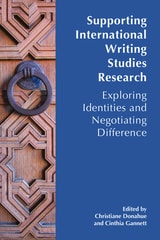
Supporting International Writing Studies Research
Cultivating Capacity through International ExchangesTiane Donahue
University Press of Colorado, 2025
Shedding light on international and transnational writing studies, this edited collection addresses the complexities of research and writing across global contexts. Based on the observation that knowledge-making transcends national borders and is contingent upon the interplay of local cultures and practices, the contributors to the volume contradict the notion that knowledge circulates freely in a “flat world.” Presenting diverse perspectives on writing research, they showcase the need for mutual understanding across borders and reflect the rich tapestry of writing research traditions worldwide, emphasizing interconnectedness and collective insight rather than hierarchical models of knowledge dissemination. Supporting International Writing Studies Research encourages readers and researchers to engage with and respect scholarship beyond English-language contexts, advocates for collaborative global dialogues in writing education, and underscores the importance of continued efforts to incorporate diverse scholarly voices and methodologies in the evolving landscape of writing studies.