Results by title
173 books match the query 'Ireland' and 8 start with s
Saying I No More
Subjectivity and Consciousness in the Prose of Samuel BeckettDaniel Katz
Northwestern University Press, 1999
Seamus Heaney and the Emblems of Hope
Karen Marguerite Moloney
University of Missouri Press, 2007
A rich body of mythology and literature has grown around the Celtic ritual known as the Feis of Tara or “marriage of sovereignty”—ancient ceremonies in which the future king pledges to care for the land and serve the goddess of sovereignty. Seamus Heaney, whose writing has attracted the overwhelming share of critical attention directed toward contemporary Irish poetry, has engaged this symbolic tradition in some of his most significant—and controversial—work.
Seamus Heaney and the Emblems of Hope explores Heaney’s use of the family of sovereignty motifs and redresses the imbalance of criticism that has overemphasized the theme of sacrifice to the detriment of more optimistic symbols. Moreover, Moloney reviews the development of the marriage motif in Irish poetry from the ninth to the twenty-first centuries with a focus on Heaney’s adaptations from The Frenzy of Sweeney and The Midnight Court and on the work of such poets as Kinsella, Montague, Boland, and Ní Dhomhnaill. Karen Marguerite Moloney examines the central role that Heaney assigns the Feis of Tara in his response to the crisis of Ulster and to the general spiritual bankruptcy of our times, showing in his verse how the relationship of the male lover to the goddess—particularly in her more repugnant guises—serves as prototype for the humility and deference needed to repair the effects of English colonization of Ireland and, by extension, centuries of worldwide patriarchal abuse.
Through close, sustained readings of poems previously overlooked or misinterpreted, such as “Ocean’s Love to Ireland,” “Come to the Bower,” and “Bone Dreams”—poems that Irish feminist critics have deemed flawed and distressingly sexist—Moloney refutes views that have long stood unchallenged. She also considers the direction of Heaney’s more recent poems, which continue to resonate to the twin demands of conscience and artistic integrity.
An impeccably researched and immensely readable work, Seamus Heaney and the Emblems of Hope reveals that Heaney’s poetry offers a reverence for archetypal femininity and Dionysian energy that can counter the sterility and violence of postcolonial Irish life. Moloney shows us that, in the tradition of poets who preceded him, Heaney turns to the marriage of sovereignty to encode a message for our times—and to offer up emblems of hope on behalf of us all.
Seamus Heaney and the End of Catholic Ireland
Kieran Quinlan
Catholic University of America Press, 2020
Selected Writings of John V. Kelleher on Ireland and Irish America
John V. Kelleher. Edited by Charles Fanning
Southern Illinois University Press, 2002
A collection of eighteen critical essays and twenty-six translations spanning the career of one of the founding intellects of Irish Studies, the Selected Writings of John V. Kelleher on Ireland and Irish America consists of five accessible sections. The first gathers Kelleher’s essays on the most widely known Irish cultural phenomenon—the literary renaissance of the early twentieth century. Part two contains his judicious assessments of Irish literature in its post-Revolutionary phase. The third section includes Kelleher’s insightful essays on the experience of the Irish in America. The fourth section contains essays that examine early Irish literature and culture, opening with a benchmark essay for Irish Studies, “Early Irish History and Pseudo-History,” which was read at the inaugural meeting of the American Conference for Irish Studies in 1961. The collection concludes with Kelleher’s translations and adaptations of poems in Old, Middle, and Modern Irish, illustrating his command of the language at every stage.

Shareholder Democracies?
Corporate Governance in Britain and Ireland before 1850Mark Freeman, Robin Pearson, and James Taylor
University of Chicago Press, 2011
Understanding the challenges of corporate governance is central to our comprehension of the economic dynamics driving corporations today. Among the most important institutions in capitalism today, corporations and joint-stock companies had their origins in Europe during the seventeenth and eighteenth centuries. And as they became more prevalent, the issue of internal governance became more pressing. At stake—and very much contested—was the allocation of rights and obligations among shareholders, directors, and managers.
This comprehensive account of the development of corporate governance in Britain and Ireland during its earliest stages highlights the role of political factors in shaping the evolution of corporate governance as well as the important debates that arose about the division of authority and responsibility. Political and economic institutions confronted similar issues, including the need for transparency and accountability in decision making and the roles of electors and the elected, and this book emphasizes how political institutions—from election procedures to assemblies to annual reporting—therefore provided apt models upon which companies drew readily. Filling a gap in the literature on early corporate economy, this book provides insight into the origins of many ongoing modern debates.

Sinn Fein and the Politics of Left Republicanism
Eoin O'Broin
Pluto Press, 2009
Sinn Féin is a growing force in Irish politics. Now the country's third largest party, Sinn Féin have been one of the central architects of the peace process and are increasingly setting the terms of political debate in Ireland north and south. Despite this, the party remains much misunderstood and often misrepresented.
In Sinn Féin & The Politics of Left Republicanism, Sinn Féin activist Eoin Ó Broin explores the ideological and organisational origins of the party, charts their history and recent political development and assesses their possible futures.
He argues that Sinn Féin is part of a distinct left-republican tradition in Irish society whose future lies in the globally resurgent radical democratic left.
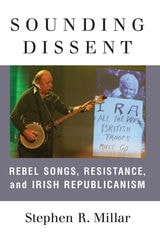
Sounding Dissent
Rebel Songs, Resistance, and Irish RepublicanismStephen R. Millar
University of Michigan Press, 2020
Sounding Dissent draws on three years of sustained fieldwork within Belfast's rebel music scene, in-depth interviews with republican musicians, contemporary audiences, and former paramilitaries, as well as diverse historical and archival material, including songbooks, prison records, and newspaper articles, to understand the history of political violence in Ireland.The book examines the potential of rebel songs to memorialize a pantheon of republican martyrs, and demonstrates how musical performance and political song not only articulate experiences and memories of oppression and violence, but also play a central role in the reproduction of conflict and exclusion in times of peace.

Suffrage and citizenship in Ireland, 1912-18
Senia Pašeta
University of London Press, 2019