Results by title
82 books match the query 'Japanese Americans' and 6 start with s
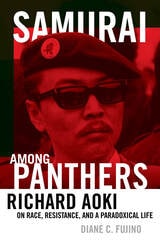
Samurai among Panthers
Richard Aoki on Race, Resistance, and a Paradoxical LifeDiane C. Fujino
University of Minnesota Press, 2012
An iconic figure of the Asian American movement, Richard Aoki (1938–2009) was also, as the most prominent non-Black member of the Black Panther Party, a key architect of Afro-Asian solidarity in the 1960s and ’70s. His life story exposes the personal side of political activism as it illuminates the history of ethnic nationalism and radical internationalism in America.
A reflection of this interconnection, Samurai among Panthers weaves together two narratives: Aoki’s dramatic first-person chronicle and an interpretive history by a leading scholar of the Asian American movement, Diane C. Fujino. Aoki’s candid account of himself takes us from his early years in Japanese American internment camps to his political education on the streets of Oakland, to his emergence in the Black Panther Party. As his story unfolds, we see how his parents’ separation inside the camps and his father’s illegal activities shaped the development of Aoki’s politics. Fujino situates his life within the context of twentieth-century history—World War II, the Cold War, and the protests of the 1960s. She demonstrates how activism is both an accidental and an intentional endeavor and how a militant activist practice can also promote participatory democracy and social service.
The result of these parallel voices and analysis in Samurai among Panthers is a complex—and sometimes contradictory—portrait of a singularly extraordinary activist and an expansion and deepening of our understanding of the history he lived.
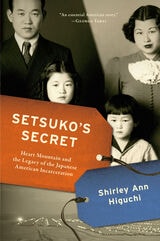
Setsuko's Secret
Heart Mountain and the Legacy of the Japanese American IncarcerationShirley Ann Higuchi
University of Wisconsin Press, 2020
Only after a serious cancer diagnosis did Shirley's mother, Setsuko, share her vision for a museum at the site of the former camp, where she had been donating funds and volunteering in secret for many years. After Setsuko's death, Shirley skeptically accepted an invitation to visit the site, a journey that would forever change her life and introduce her to a part of her mother she never knew.
Navigating the complicated terrain of the Japanese American experience, Shirley patched together Setsuko's story and came to understand the forces and generational trauma that shaped her own life. Moving seamlessly between family and communal history, Setsuko's Secret offers a clear window into the "camp life" that was rarely revealed to the children of the incarcerated. This volume powerfully insists that we reckon with the pain in our collective American past.
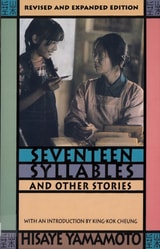
Seventeen Syllables and Other Stories
Yamamoto, Hisaye
Rutgers University Press, 2001
In addition to the contents of the original volume, this edition brings back into print the following works:
- Death Rides the Rails to Poston
- Eucalyptus
- A Fire in Fontana
- Florentine Gardens
Seventeen Syllables and Other Stories
Yamamoto, Hisaye
Rutgers University Press, 2001
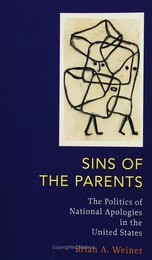
Sins Of The Parents
Politics Of National Apologies In The U.S.Brian A. Weiner
Temple University Press, 2005
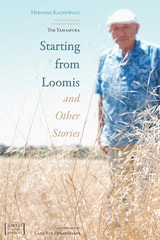
Starting from Loomis and Other Stories
Hiroshi Kashiwagi
University Press of Colorado, 2013
Central to this collection are Kashiwagi’s confinement at Tule Lake during World War II, his choice to answer “no” and “no” to questions 27 and 28 on the official government loyalty questionnaire, and the resulting lifelong stigma of being labeled a “No-No Boy” after his years of incarceration. His nonlinear, multifaceted writing not only reflects the fragmentations of memory induced by traumas of racism, forced removal, and imprisonment but also can be read as a bold personal response to the impossible conditions he and other Nisei faced throughout their lifetimes.