Results by title
356 books match the query 'Jewish Studies' and 23 start with s
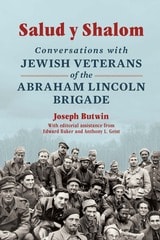
Salud y Shalom
Conversations with Jewish Veterans of the Abraham Lincoln BrigadeJoseph Butwin
University of Illinois Press, 2025
Joseph Butwin’s oral history presents conversations with ten Jewish veterans of the ALB. Recorded from 1992–94 in the wake of European communism’s collapse, the interviews explore the milieus that formed the volunteers. Immigrants established the secular Yiddish-speaking socialism that became a part of many Jewish American communities. Their children, reacting to economic depression and the rise of fascism, enlisted in the ALB. Butwin follows their stories from their youthful motives and choices through their lives as Jews and leftists, and records the reckonings that took place as they reflected on their past.
Insightful and revealing, Salud y Shalom explores the forces of identity and history that led young Jewish leftists to fight fascism.
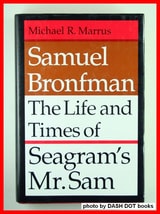
Samuel Bronfman
The Life and Times of Seagram’s Mr. SamMichael R. Marrus
Brandeis University Press, 1991
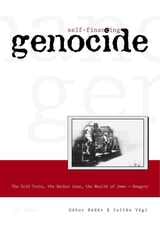
Self-Financing Genocide
The Gold Train, the Becher Case and the Wealth of Hungarian JewsGábor Kádár
Central European University Press, 2004
Discusses the process of the economic annihilation of the Jews in Hungary, who– from the economic point of view – were more influential than any other Jewish community in Europe. Following the German occupation in March 1944 the collaborating Hungarian government attempted to assert its claim concerning the complete confiscation of Jewish assets at all stages of the road leading to the extermination camps. The cooperation with the Germans proved to be the most problematic in this area.
The story of the Jewish Gold Train is a relatively small but all the more emblematic chapter of the economic annihilation. The circumstances of the freight’s assembling, the German-Hungarian conflicts concerning the train, the looting attempts, the fate of the assets seized by the Allies (double victimization of the survivors) provide the reader with an insight into the history of the repeated looting of the Hungarian Jewry
The book analyzes the role played by SS-Obersturmbannführer Kurt Becher, one of the most controversial and mysterious figures in the Hungarian and universal history of the Holocaust. Becher, delegated to Hungary by Himmler, administered and benefited from the confiscation of an enormous amount of Jewish assets.
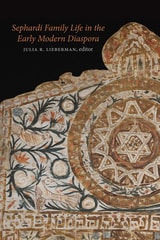
Sephardi Family Life in the Early Modern Diaspora
Edited by Julia R. Lieberman
Brandeis University Press, 2010
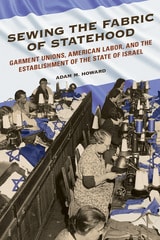
Sewing the Fabric of Statehood
Garment Unions, American Labor, and the Establishment of the State of IsraelAdam Howard
University of Illinois Press, 2017
Sexual Violence against Jewish Women during the Holocaust
Edited by Sonja M. Hedgepeth and Rochelle G. Saidel
Brandeis University Press, 2010
Shtetl
A Vernacular Intellectual HistoryShandler, Jeffrey
Rutgers University Press, 2014
In Yiddish, shtetl simply means “town.” How does such an unassuming word come to loom so large in modern Jewish culture, with a proliferation of uses and connotations? By examining the meaning of shtetl, Jeffrey Shandler asks how Jewish life in provincial towns in Eastern Europe has become the subject of extensive creativity, memory, and scholarship from the early modern era in European history to the present.
In the post-Holocaust era, the shtetl looms large in public culture as the epitome of a bygone traditional Jewish communal life. People now encounter the Jewish history of these towns through an array of cultural practices, including fiction, documentary photography, film, memoirs, art, heritage tourism, and political activism. At the same time, the shtetl attracts growing scholarly interest, as historians, social scientists, literary critics, and others seek to understand both the complex reality of life in provincial towns and the nature of its wide-ranging remembrance.
Shtetl: A Vernacular Intellectual History traces the trajectory of writing about these towns—by Jews and non-Jews, residents and visitors, researchers, novelists, memoirists, journalists and others—to demonstrate how the Yiddish word for “town” emerged as a key word in Jewish culture and studies. Shandler proposes that the intellectual history of the shtetl is best approached as an exemplar of engaging Jewish vernacularity, and that the variable nature of this engagement, far from being a drawback, is central to the subject’s enduring interest.
Shuva
The Future of the Jewish PastYehuda Kurtzer
Brandeis University Press, 2012
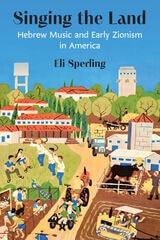
Singing the Land
Hebrew Music and Early Zionism in AmericaEli Sperling
University of Michigan Press, 2024
Exploring the history, events, contexts, and tensions that comprised what may be termed the ‘Zionization’ of American Jewry during the first half of the twentieth century, Eli Sperling analyzes primary sources within the historical contexts of Zionist national development and American Jewish life. Singing the Land offers insights into how and why musical frameworks were central to catalyzing American Jewry’s support of the Zionist cause by the 1940s, parallel to firm commitments to their American locale and national identities. The proliferation of this widespread American Jewish-Zionist embrace was achieved through a variety of educational, religious, economic, and political efforts, and Hebrew music was a thread consistent among them all.
Sites of European Antisemitism in the Age of Mass Politics, 1880–1918
Edited by Robert Nemes and Daniel Unowsky
Brandeis University Press, 2014
Six Memos from the Last Millennium
A Novelist Reads the TalmudBy Joseph Skibell
University of Texas Press, 2016
A thief-turned-saint, killed by an insult. A rabbi burning down his world in order to save it. A man who lost his sanity while trying to fathom the origin of the universe. A beautiful woman battling her brother’s and her husband’s egos to preserve their family. Stories such as these enliven the pages of the Talmud, the great repository of ancient wisdom that is one of the sacred texts of the Jewish people. Comprised of the Mishnah, the oral law of the Torah, and the Gemara, a multigenerational metacommentary on the Mishnah dating from between 3950 and 4235 (190 and 475 CE), the Talmud presents a formidable challenge to understand without scholarly training and study. But what if one approaches it as a collection of tales with surprising relevance for contemporary readers?
In Six Memos from the Last Millennium, critically acclaimed novelist Joseph Skibell reads some of the Talmud’s tales with a storyteller’s insight, concentrating on the lives of the legendary rabbis depicted in its pages to uncover the wisdom they can still impart to our modern age. He unifies strands of stories that are scattered throughout the Talmud into coherent narratives or “memos,” which he then analyzes and interprets from his perspective as a novelist. In Skibell’s imaginative and personal readings, this sacred literature frequently defies our conventional notions of piety. Sometimes wild, rude, and even bawdy, these memos from the last millennium pursue a livable transcendence, a way of fusing the mundane hours of earthly life with a cosmic sense of holiness and wonder.
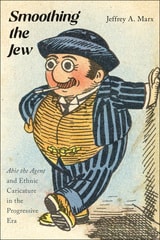
Smoothing the Jew
"Abie the Agent" and Ethnic Caricature in the Progressive EraJeffrey A. Marx
Rutgers University Press, 2024
Smoothing the Jew investigates how Jewish artists of the time attempted to “smooth over” these demeaning portrayals by focusing on the first Jewish comic strip published in English, Harry Hershfield’s Abie the Agent. Jeffrey Marx demonstrates how Hershfield created a Jewish protagonist who in part reassured nativists of the Jews’ ability to assimilate into American society while also encouraging immigrants and their children that, over time, they would be able to adopt American customs without losing their distinctly Jewish identity.
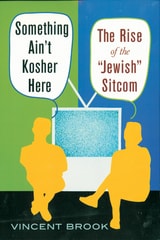
Something Ain't Kosher Here
The Rise of the 'Jewish' SitcomBrook, Vincent
Rutgers University Press, 2003
From 1989 through 2002 there was an unprecedented surge in American sitcoms featuring explicitly Jewish lead characters, thirty-two compared to seven in the previous forty years. Several of these—Mad About You, The Nanny, and Friends—were among the most popular and influential of all shows over this period; one program—Seinfeld—has been singled out as the “defining” series of the nineties. In addition, scriptwriters have increasingly created “Jewish” characters, although they may not be perceived to be by the show’s audience, Rachel Green on Friends being only one example.
In Something Ain’t Kosher Here, Vincent Brook asks two key questions: Why has this trend appeared at this particular historical moment and what is the significance of this phenomenon for Jews and non-Jews alike? He takes readers through three key phases of the Jewish sitcom trend: The early years of television before and after the first Jewish sitcom, The Goldbergs’, appeared; the second phase in which America found itself “Under the Sign of Seinfeld”; and the current era of what Brook calls “Post- Jewishness.”
Interviews with key writers, producers, and “showrunners” such as David Kohan, (Will and Grace), Marta Kauffman (Friends and Dream On), Bill Prady (Dharma and Greg), Peter Mehlman and Carol Leifer (Seinfeld), and close readings of individual episodes and series provoke the inescapable conclusion that we have entered uncharted “post-Jewish” territory. Brook reveals that the acceptance of Jews in mainstream white America at the very time when identity politics have put a premium on celebrating difference reinforces and threatens the historically unique insider/outsider status of Jews in American society. This paradox upsets a delicate balance that has been a defining component of American Jewish identity.
The rise of the Jewish sitcom represents a broader struggle in which American Jews and the TV industry, if not American society as a whole, are increasingly operating at cross-purposes— torn between the desire to celebrate unique ethnic identities, yet to assimilate: to assert independence, yet also to build a consensus to appeal to the widest possible audience. No reader of this book will ever be able to watch these television programs in quite the same way again.

Space and Place in Jewish Studies
Mann, Barbara E
Rutgers University Press, 2012
Scholars in the humanities have become increasingly interested in questions of how space is produced and perceived—and they have found that this consideration of human geography greatly enriches our understanding of cultural history. This “spatial turn” equally has the potential to revolutionize Jewish Studies, complicating familiar notions of Jews as “people of the Book,” displaced persons with only a common religious tradition and history to unite them.
Space and Place in Jewish Studies embraces these exciting critical developments by investigating what “space” has meant within Jewish culture and tradition—and how notions of “Jewish space,” diaspora, and home continue to resonate within contemporary discourse, bringing space to the foreground as a practical and analytical category. Barbara Mann takes us on a journey from medieval Levantine trade routes to the Eastern European shtetl to the streets of contemporary New York, introducing readers to the variety of ways in which Jews have historically formed communities and created a sense of place for themselves. Combining cutting-edge theory with rabbinics, anthropology, and literary analysis, Mann offers a fresh take on the Jewish experience.
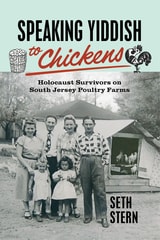
Speaking Yiddish to Chickens
Holocaust Survivors on South Jersey Poultry FarmsSeth Stern
Rutgers University Press, 2023
Most of the roughly 140,000 Holocaust survivors who came to the United States in the first decade after World War II settled in big cities such as New York. But a few thousand chose an alternative way of life on American farms. More of these accidental farmers wound up raising chickens in southern New Jersey than anywhere else. Speaking Yiddish to Chickens is the first book to chronicle this little-known chapter in American Jewish history when these mostly Eastern European refugees – including the author’s grandparents - found an unlikely refuge and gateway to new lives in the US on poultry farms. They gravitated to a section of south Jersey anchored by Vineland, a small rural city where previous waves of Jewish immigrants had built a rich network of cultural and religious institutions.
This book relies on interviews with dozens of these refugee farmers and their children, as well as oral histories and archival records to tell how they learned to farm while coping with unimaginable grief. They built small synagogues within walking distance of their farms and hosted Yiddish cultural events more frequently found on the Lower East Side than perhaps anywhere else in rural America at the time. Like refugees today, they embraced their new American identities and enriched the community where they settled, working hard in unfamiliar jobs for often meager returns. Within a decade, falling egg prices and the rise of industrial-scale agriculture in the South would drive almost all of these novice poultry farmers out of business, many into bankruptcy. Some hated every minute here; others would remember their time on south Jersey farms as their best years in America. They enjoyed a quieter way of life and more space for themselves and their children than in the crowded New York City apartments where so many displaced persons settled. This is their remarkable story of loss, renewal, and perseverance in the most unexpected of settings.
Author Facebook page (https://www.facebook.com/YiddishtoChickens)

Spinoza’s Challenge to Jewish Thought
Writings on His Life, Philosophy, and LegacyEdited by Daniel B. Schwartz
Brandeis University Press, 2019
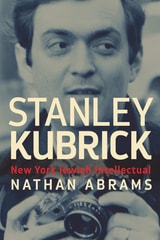
Stanley Kubrick
New York Jewish IntellectualAbrams, Nathan
Rutgers University Press, 2018
Stanley Kubrick reexamines the director’s work in context of his ethnic and cultural origins. Focusing on several of Kubrick’s key themes—including masculinity, ethical responsibility, and the nature of evil—it demonstrates how his films were in conversation with contemporary New York Jewish intellectuals who grappled with the same concerns. At the same time, it explores Kubrick’s fraught relationship with his Jewish identity and his reluctance to be pegged as an ethnic director, manifest in his removal of Jewish references and characters from stories he adapted.
As he digs deep into rare Kubrick archives to reveal insights about the director’s life and times, film scholar Nathan Abrams also provides a nuanced account of Kubrick’s cinematic artistry. Each chapter offers a detailed analysis of one of Kubrick’s major films, including Lolita, Dr. Strangelove, 2001, A Clockwork Orange, Barry Lyndon, The Shining, Full Metal Jacket, and Eyes Wide Shut. Stanley Kubrick thus presents an illuminating look at one of the twentieth century’s most renowned and yet misunderstood directors.
State of Israel, Diaspora, and Jewish Continuity
Essays on the “Ever-Dying People”Simon Rawidowicz
Brandeis University Press, 1998
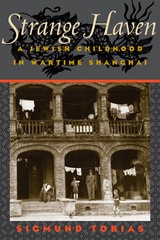
Strange Haven
A Jewish Childhood in Wartime ShanghaiSigmund Tobias
University of Illinois Press, 1998
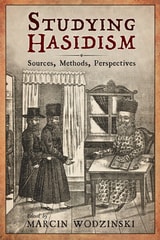
Studying Hasidism
Sources, Methods, PerspectivesMarcin Wodzinski
Rutgers University Press, 2019
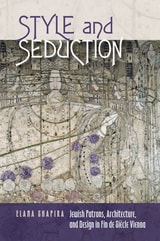
Style and Seduction
Jewish Patrons, Architecture, and Design in Fin de Siècle ViennaElana Shapira
Brandeis University Press, 2016
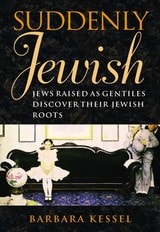
Suddenly Jewish
Jews Raised as Gentiles Discover Their Jewish RootsBarbara Kessel
Brandeis University Press, 2007
Surreal Geographies
A New History of Holocaust ConsciousnessKathryn L. Brackney
University of Wisconsin Press, 2024
Brackney offers a new look at familiar works by authors and artists such as Claude Lanzmann, W. G. Sebald, and Paul Celan, while making surprising connections to contemporary scholars like Timothy Snyder and Donna Haraway, and events such as the Space Race. In the process, she maps out a decades-long process through which transnational conventions of mourning have emerged in Western Europe, North America, and Israel, functioning to constitute Jewish victimization as “grievable life.” Ultimately, she shows how the Holocaust has developed into a figure for the destabilization and reformulation of the category of humanity and the problem of mourning across difference.