Results by title
59 books match the query 'Joseph, Gilbert M.' and 3 start with s

Satan's Playground
Mobsters and Movie Stars at America's Greatest Gaming ResortPaul J. Vanderwood
Duke University Press, 2010
Less than a year after Agua Caliente opened, gangsters held up its money-car in transit to a bank in San Diego, killing the courier and a guard and stealing the company money pouch. Paul J. Vanderwood weaves the story of this heist gone wrong, the search for the killers, and their sensational trial into the overall history of the often-chaotic development of Agua Caliente, Tijuana, and Southern California. Drawing on newspaper accounts, police files, court records, personal memoirs, oral histories, and “true detective” magazines, he presents a fascinating portrait of vice and society in the Jazz Age, and he makes a significant contribution to the history of the U.S.-Mexico border.
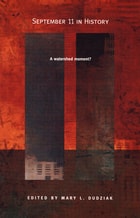
September 11 in History
A Watershed Moment?Mary L. Dudziak, ed.
Duke University Press, 2003
From a variety of perspectives, the contributors to this collection scrutinize claims about September 11, in terms of both their historical validity and their consequences. Essays range from an analysis of terms like “ground zero,” “homeland,” and “the axis of evil” to an argument that the U.S. naval base at Guantánamo Bay has become a site for acting out a repressed imperial history. Examining the effect of the attacks on Islamic self-identity, one contributor argues that Osama bin Laden enacted an interpretation of Islam on September 11 and asserts that progressive Muslims must respond to it. Other essays focus on the deployment of Orientalist tropes in categorizations of those who “look Middle Eastern,” the blurring of domestic and international law evident in a number of legal developments including the use of military tribunals to prosecute suspected terrorists, and the justifications for and consequences of American unilateralism. This collectionultimately reveals that everything did not change on September 11, 2001, but that some foundations of democratic legitimacy have been significantly eroded by claims that it did.
Contributors. Khaled Abou el Fadl, Mary L. Dudziak, Christopher L. Eisgruber, Laurence R. Helfer, Sherman A. Jackson, Amy B. Kaplan, Elaine Tyler May, Lawrence G. Sager, Ruti G. Teitel, Leti Volpp, Marilyn B. Young
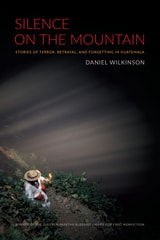
Silence on the Mountain
Stories of Terror, Betrayal, and Forgetting in GuatemalaDaniel Wilkinson
Duke University Press, 2004
Decades of terror-inspired fear have led the Guatemalans to adopt a survival strategy of silence so complete that it verges on collective amnesia. The author’s great triumph is that he finds a way for people to tell their stories, and it is through these stories—dramatic, intimate, heartbreaking—that we are shown the anatomy of a thwarted revolution that has relevance not only to Guatemala but also to countless places around the world where terror has been used as a political tool.