Results by title
403 books match the query 'Journalism' and 25 start with s

Santa Fe Different
22 Years and All I Got Was a CheeseburgerArnold Vigil
Museum of New Mexico Press, 2019
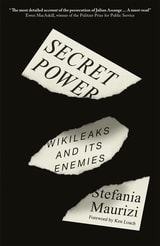
Secret Power
WikiLeaks and Its EnemiesStefania Maurizi
Pluto Press, 2022
*Winner of the European Award for Investigative And Judicial Journalism 2021*
*Winner of the Premio Alessandro Leogrande Award for Investigative Journalism 2022*
*Winner of the Premio Angelo Vassallo Award 2022*
'I want to live in a society where secret power is accountable to the law and to public opinion for its atrocities, where it is the war criminals who go to jail, not those who have the conscience and courage to expose them.'
It is 2008, and Stefania Maurizi, an investigative journalist with a growing interest in cryptography, starts looking into the little-known organisation WikiLeaks. Through hushed meetings, encrypted files and explosive documents, what she discovers sets her on a life-long journey that takes her deep into the realm of secret power.
Working closely with WikiLeaks' founder Julian Assange and his organisation for her newspaper, Maurizi has spent over a decade investigating state criminality protected by thick layers of secrecy, while also embarking on a solitary trench warfare to unearth the facts underpinning the cruel persecution of Assange and WikiLeaks.
With complex and disturbing insights, Maurizi’s tireless journalism exposes atrocities, the shameful treatment of Chelsea Manning and Edward Snowden, on up to the present persecution of WikiLeaks: a terrifying web of impunity and cover-ups.
At the heart of the book is the brutality of secret power and the unbearable price paid by Julian Assange, WikiLeaks and truthtellers.
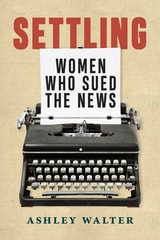
Settling
Women Who Sued the NewsAshley Walter
University of Massachusetts Press, 2026
A history of courage and collective action inside the most powerful newsrooms in America
In 1971, Susan Smith, a young researcher at Reader’s Digest, dared to imagine herself as an editor. Her ambition was swiftly dismissed by a hiring manager who told her, “Single girls just don’t do well in this job.” Crushed—and then furious—Smith sought out Harriet Rabb, the attorney who had successfully sued Newsweek for sex discrimination just a year earlier. Their meeting helped spark a class-action lawsuit that ultimately united two thousand women at the magazine and became part of a broader revolt inside American newsrooms. Smith’s experience was far from unique. For much of American history, journalism has been rigidly segregated by gender, with women confined to research, clerical work, or the “women’s pages,” while men dominated reporting, editing, and leadership. That system began to crack in the 1970s, as the 1964 Civil Rights Act and the women’s liberation movement emboldened newswomen to challenge daily discrimination. Yet this development has remained largely hidden, buried by editors reluctant to document inequities within their own institutions. Settling recovers this lost story.
Tracing class-action sex discrimination lawsuits at some of the most powerful news organizations in the United States—including The Washington Post, the Associated Press, The New York Times, and Time—Ashley Walter draws on oral histories and long-forgotten documents to reconstruct legal battles at eight major outlets. She argues that meaningful change came not from institutional goodwill but from the courage of women who organized, testified, and risked their careers to demand equality. Their victories reshaped journalism itself. As women assumed reporting and editorial roles, they broadened the scope of who counted as newsworthy, covering women as workers, political leaders, and authoritative sources. With this new illumination of women’s full participation in public life, newswomen shifted social norms and helped build women’s power across American society. By recovering these accounts, Settling reveals how newsroom struggles for gender equality transformed both journalism and the nation, offering urgent lessons for our present moment.
Sex Trafficking, Scandal, and the Transformation of Journalism, 1885-1917
Gretchen Soderlund
University of Chicago Press, 2013
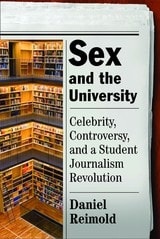
Sex and the University
Celebrity, Controversy, and a Student Journalism RevolutionReimold, Daniel
Rutgers University Press, 2010
Daniel Reimold gives readers of all generations an inside look at this phenomenon. Student sex columnists and sex magazine editors are both celebrities on their home campuses. One columnist, echoing the sentiments of many, said he became an overnight rock star golden child of journalism. But, with celebrity comes controversy. These columns and magazines have sparked contentious and far-reaching legal, religious, and intergenerational debates about sex, the student press, and the place of both within higher education. They are also the most prominent modern student press combatants in the fight for free speech. And they have blurred journalistic boundaries between what is considered public and private, art and pornography, and gossip and news.
Sex and the University explores the celebrity status that student sex columnists and magazine editors have received, the controversies they have caused, and the sexual generation and student journalism revolution they represent. Complete with a sexicon of slang, this book also dives into the columns and magazines themselves, sharing for the first time what modern students are saying about their sex and love lives, in their own words.
Shadow Press
The Myth and Making of Independent JournalismDaniel DeFraia
University of Missouri Press, 2027
Historians of journalism and mass media have tended to focus on journalism and news – its people and content – while neglecting the field’s broader and interconnected roles in United States history. Shadow Press: The Myth and Making of Independent Journalism explores how the extreme edges of reporting challenged and reshaped American journalism for over a century, from 1890 to 1980.
What a reporter is and does, and does not do, and the integrity of that idea, has always been an unsettled question, interrogated on the borders between journalism and the state. There, from battlefields in Cuba, revolution in Mexico, presidential politics in Washington, D.C., and world wars in Europe, reporters – formally and informally, officially and unofficially, openly and secretly – served the state. This book explains how and why reporters, amidst the allure of patriotism, prestige, and power, came to work for the state, and then stopped, culminating with the historically aberrant ascent of modern independent journalism.
To reclaim that history, Shadow Press spotlights famous, infamous, or previously unknown reporters whose careers reflected the usually submerged question of press-state collaboration and revealed wider changes within journalism. Part I documents how reporters traveled multiple routes into the state, including U.S. empire (the War of 1898), the Mexican Revolution, the presidencies of Theodore Roosevelt and Woodrow Wilson, the domestic reform efforts of First Lady Eleanor Roosevelt, and World War II. Part II documents how, during the Cold War, reporters, embedded within the state, separated to redefine journalism, and lobbied to establish in 1980 the uneasy policies of today that narrowly permit the CIA and FBI to impersonate reporters.
Shadow Press provides accessible plots and character-driven narrative arcs for general readers interested in American history. Moreover, journalism critics will take an interest in how the history provided in Shadow Press informs the debate over how best to do journalism today. During the last two decades, a historical caricature of news objectivity has emerged, a rigid model of amoral methodology and unacknowledged personal subjectivity that still lingers. That caricature has concealed the political activism of the self-declared objective press. Today’s “objectivity war” in journalism is a memory war. As a result, the debate about how best to cover the Republication Party, Donald Trump, and far right movements is based on a broad misunderstanding of how journalism functioned in US democracy. Combining expansive and rigorous archival investigation with the dramatic requirements of a good story, Shadow Press provides a new line of scholarly inquiry to expand the scope of journalism within US political history.
Shadow of the Racketeer
Scandal in Organized LaborDavid Witwer
University of Illinois Press, 2008
From a behind-the-scenes perspective, David Witwer describes how Pegler and his publisher, the politically powerful Roy W. Howard, shaped the news coverage of this scandal in ways that obscured the corrupt ties between employers and the mob while emphasizing the perceived menace of union leaders empowered by New Deal legislation that had legitimized organized labor. Pegler, Howard, and the rest of the mainstream press pointedly ignored evidence of the active role that business leaders took in the corruption, which badly tarnished the newly reborn labor movement.
Because he was more concerned with pursuing political gains for the conservative movement, Pegler's investigative journalism did little to reform union governance or organized crime's influence on labor unions. The union corruption scandal only undercut the labor movement. Pegler's continuing campaign against labor corruption framed the issue in ways that set the stage for postwar political defeats, culminating with the 1947 Taft-Hartley Act, which greatly limited the power of labor unions in the United States.
Demonstrating clearly and convincingly how journalism is wielded as a political weapon, Witwer studies a broad range of forces at play in the labor union scandal and its impact, including the influence of the press, organized crime, political corruption, and businessmen following their own economic imperatives.
Sioux War Dispatches
Reports from the Field, 1876-1877Marc H. Abrams
Westholme Publishing, 2012
Rare, First-Hand Accounts from Newspaper Correspondents Describing the Course of America’s Largest Indian War, Compiled and Edited for the First Time in One Volume
“No one commands better the story of the Great Sioux War of 1876–1877 as presented in the nation’s newspapers than does Marc Abrams. Here is Abrams’s story of America’s greatest Indian war woven from those timely reports, augmented with insightful introductions and annotations. Abrams has produced a significant addition to the historiography of this endlessly fascinating struggle and its colorful personalities.” —Paul L. Hedren, author of After Custer: Loss and Transformation in Sioux Country
“Marc Abrams has provided an invaluable service to both scholars and lay readers in compiling this treasure trove of primary information. Like the correspondents he has come to know through his research, Marc has done the hard work; we need only read in comfort and benefit from his efforts.” —Douglas W. Ellison, author of Sole Survivor: An Examination of the Frank Finkel Narrative
“Marc Abrams’s book is an exciting and innovative approach that brings immediacy to the campaigns of Custer, Crook, and Miles, and teems with fascinating new detail. Sioux War Dispatches not only offers a gripping contemporary window into those times, it fills an important reference need as well.” —Jerome A. Greene, author of Stricken Field: The Little Bighorn Since 1876
Sioux War Dispatches: Reports from the Field, 1876-1877, tells the story of the Great Sioux War, including the battle of the Little Big Horn, primarily through the eyes of contemporary newspaper correspondents, both civilian and military. The volume begins with the Black Hills dilemma and the issue of the unceded territory (the disputed lands that were adjacent to the Great Sioux Reservation) and continues through to the spring of 1877 with the surrender of the legendary Sioux leader Crazy Horse. Along the way readers will learn about the Reynolds battle, the skirmish at Tongue River Heights, the battle of the Rosebud, the battle of the Little Big Horn, the skirmish at Warbonnet Creek, the fight at Slim Buttes, and more. In addition to numerous annotated excerpts from those who were there, are rare original dispatches, reprinted in full, that will take readers on a wild ride through several battles.
Sixty Years of Journalism
University of Wisconsin Press, 1985
The late James M. Cain was a newspaperman, playwright, and novelist. Although best known for his controversial novels (The Postman Always Rings Twice, Double Indemnity, Mildred Pierce, Serenade, The Butterfly, and Past All Dishonor), Cain always considered himself a journalist, a "newpaperman who wrote yarns on the side." The book includes some of Cain's best articles and essays. The material is sometimes serious, sometimes humorous and provides a unique look at 60 years of history.
Sleeping with Custer and the 7th Cavalry
An Embedded Reporter in IraqWalter C. Rodgers
Southern Illinois University Press, 2005
An essential document of the first American war of the new century
Under a full opalescent moon in the spring of 2003, CNN correspondent Walter C. Rodgers and three colleagues climbed into an unarmored Humvee loaded with satellite transmission equipment and fell into column formation with the MIAI Abrams battle tanks and Bradley fighting vehicles of Apache Troop, Third Squadron, of the storied 7th Cavalry and crossed the Line of Departure between Kuwait and Iraq. Sleeping with Custer and the 7th Cavalry: An Embedded Reporter in Iraq is Rodgers’s account of the fight from the Kuwaiti border to the Iraqi capital of Baghdad.
Rodgers was embedded with the “tip of the tip of the spear,” the armored reconnaissance unit tasked with clearing the way for the invasion of Iraq. For the next three weeks Rodgers—a seasoned combat correspondent who has covered armed conflicts in the West Bank, along the “Green Line” in Lebanon, and in Sarajevo, Azerbaijan, and Afghanistan—was a first-person witness to the opening campaign of the most significant war America has embarked upon since Vietnam.
Rodgers and his journalistic colleagues in Operation Iraqi Freedom became pioneers in the process of embedding, the placing of journalists who can transmit video reports in real time under combat conditions with no censoring authority to block their reporting. During this journey into war, Rodgers and his crew embraced the dangers, the numbing fatigue, and the moments of stark fear of the young armored cavalrymen they lived with twenty-four hours each day, an experience that created for them the lifelong bond that only soldiers serving together under fire share.
Rodgers also details his return visit to Iraq a year later, reflecting on the nature of war and sharing his personal feelings about a conflict that has claimed the lives of over fifteen hundred American men and women. The volume is illustrated with photographs taken during the invasion by Jeff Barwise, the CNN engineer who accompanied Rodgers.
Small Worlds
Adopted Sons, Pet Piranhas, and Other Mortal ConcernsRobert Klose
University of Missouri Press, 2006
Soldiers of the Pen
The Writers' War Board in World War IIThomas Howell
University of Massachusetts Press, 2019
The WWB received federal money while retaining its status as a private organization that could mount campaigns without government oversight. Historian Thomas Howell argues that this unique position has caused its history to fall between the cracks, since it was not recognized as an official part of the government's war effort. Yet the WWB's work had a huge impact on the nation's wartime culture, and this fascinating history will inform contemporary thinking on propaganda, the media, and American society.
Somebody Told Me
The Newspaper Stories of Rick BraggRick Bragg
University of Alabama Press, 2000
Over the past twenty years, writer Rick Bragg has earned legions of fans with his award-winning newspaper stories and with his critically aclaimed memoir All Over but the Shoutin'. His unique storytelling talent and his sympathy for the day-to-day struggles of everyday people set him apart from journalists who focus on political intrigue and the foibles of the rich and famous.
This collection showcases Bragg's talent for turning seemingly ordinary situations into extraordinary stories by bringing together more than sixty of his most recent feature articles, most of them written for the New York Times. Bragg explores such questions as: What happens to someone released from prison for a crime he didn't commit? Who takes care of the graves of poor people? What keeps an elderly woman from selling her land for a tidy profit? Bragg's curiosity often leads him to society's margins, where he wins the confidence of those who have good reason to mistrust others.
Bragg has reported on some of the most newsworthy tragedies in the nation, and his unfolding coverage of events such as the Oklahoma City bombing and the Susan Smith child murders is included here. Once again, though, his special ability to connect with people allows him accesss and perspectives that many other reporters do not achieve.
Whether he's profiling the sheriff who broke the Smith case or relating the efforts of Alabama churchgoers to understand a Sunday morning tornado strike, Bragg writes with genuine compassion and sentiment but without being sensationalist. He looks where others don’t and gets behind the headlines to the people standing there stunned and often, until he finds them, voiceless. When asked how he came up with his remarkable stories, Bragg has his answer down pat: “Somebody told me.”
Sound Reporting, Second Edition
The NPR Guide to Broadcast, Podcast and Digital JournalismJerome Socolovsky
University of Chicago Press, 2024
A lot has changed in media in recent years, but one thing that remains steadfast is National Public Radio’s (NPR) position as a trusted source of news in the United States. Now producing dozens of shows and podcasts, plus livestreams and coverage on other media platforms, NPR is the leading authority on reporting, writing, and delivering audio news and storytelling to today's diverse audiences. In this completely revised guide, audio journalism trainer Jerome Socolovsky offers a look into just how NPR does it, following the same journey a story would from idea to the moment it reaches its listeners.
Based on more than eighty interviews with producers, reporters, editors, hosts, and other NPR staffers, Sound Reporting reveals how stories get pitched; how they are reported, produced, written, edited, voiced, and tailored to multiple media formats; and how shows and podcasts are put together. It begins with a presentation of NPR's values and includes a new chapter on journalist safety, a topic of timely importance. Podcasts, now part of the mainstream of the media universe, are treated alongside traditional programs throughout.
In these pages, the voices of NPR staff offer a glimpse into their profession. Discover how correspondent Ruth Sherlock overcame seemingly insurmountable odds as she raced to the scene of a devastating earthquake in Turkey, the four main ways Ramtin Arablouei incorporates music into podcasts, and how “Weekend Edition” host Ayesha Rascoe touches listeners so deeply she received a pair of homemade potholders in the mail from one of them. Reading this book is like sitting in a room full of top-notch producers, seasoned correspondents, trusted hosts, and rigorous editors—all telling you inspiring stories about their craft to help you learn from their experience.
At a time when the legitimacy and authority of journalism are under critique, transparency into how the news is made is more important than ever. This book offers a fascinating look behind the scenes at a premier public media organization and will be a trusted resource for anyone in or exploring a future in audio journalism.
Sound Reporting
The NPR Guide to Audio Journalism and ProductionJonathan Kern
University of Chicago Press, 2008
Jonathan Kern, who has trained NPR’s on-air staff for years, is a gifted guide, able to narrate a day in the life of a host and lay out the nuts and bolts of production with equal wit and warmth. Along the way, he explains the importance of writing the way you speak, reveals how NPR books guests ranging from world leaders to neighborhood newsmakers, and gives sage advice on everything from proposing stories to editors to maintaining balance and objectivity. Best of all—because NPR wouldn’t be NPR without its array of distinctive voices—lively examples from popular shows and colorful anecdotes from favorite personalities animate each chapter.
As public radio’s audience of millions can attest, NPR’s unique guiding principles and technical expertise combine to connect with listeners like no other medium can. With today’s technologies allowing more people to turn their home computers into broadcast studios, Sound Reporting couldn’t have arrived at a better moment to reveal the secrets behind the story of NPR’s success.
South Africa’s Resistance Press
Alternative Voices in the Last Generation under ApartheidLes Switzer
Ohio University Press, 2000
Spirit and System
Media, Intellectuals, and the Dialectic in Modern German CultureDominic Boyer
University of Chicago Press, 2005
Boyer analyzes the creation and mediation of the social knowledge of "German-ness" from nineteenth-century university culture and its philosophies of history, to the media systems and redemptive public cultures of the Third Reich and the German Democratic Republic, to the present-day experiences of former East German journalists seeking to explain life in post-unification Germany. Throughout this study, Boyer reveals how dialectical knowledge of "German-ness"—that is, knowledge that emphasizes a cultural tension between an inner "spirit" and an external "system" of social life —is modeled unconsciously upon intellectuals' self-knowledge as it tracks their fluctuation between alienation and utopianism in their interpretations of nation and modernity.
Sports Illusion, Sports Reality
A Reporter's View of Sports, Journalism, and SocietyLeonard Koppett
University of Illinois Press, 1994
ever written, I'd like to see the book that beats it. . . . Should be
read by every sports fan or -- for that matter -- social critic."
--From a five-star review, West Coast Review of Books.
"Explores its subject so thoroughly and demolishes so many commonly
held assumptions that after reading it even the most knowledgeable fans
(and some journalists) should feel like drunks who have suddenly been
forced to sober up."
-- Chicago Tribune
"Required reading for anyone who calls himself a fan."
-- Chicago Sun-Times
"An invaluable contribution to sports literature."
-- Howard Cosell
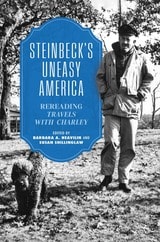
Steinbeck’s Uneasy America
Rereading “Travels with Charley”Edited by Barbara A. Heavilin and Susan Shillinglaw
University of Alabama Press, 2025
A road trip through Steinbeck’s America—revisited, reimagined, and reinterpreted.
Steinbeck’s Uneasy America is the first collection of critical scholarship devoted to Travels with Charley in Search of America, John Steinbeck’s best-selling, late-career travel memoir. In 1960, Steinbeck was a renowned man of American letters. Many considered him America’s troubadour of ordinary people, the conscience of the country. But weakened by two small strokes and anxious that he had lost touch with America, he embarked on a cross-country road trip accompanied by his wife’s standard poodle, Charley. Two years later, he published Travels with Charley to popular acclaim and robust sales.
Throughout this narrative, Steinbeck insists that all of our perceptions are “warped” by personality, history, and society. And while this hybrid and experimental book has long been accepted as an accurate account of his journey, journalists and scholars agree that the narrative is part factual, part fiction—America as seen through Steinbeck’s particular “warp.” The work is long overdue for scholarly assessment.
Steinbeck’s Uneasy America explores three main topics. Part 1 explores genre and form to consider the degree to which the work is fiction or nonfiction. Part 2 assesses Steinbeck’s increasingly bleak assessment of America—almost a jeremiad that warns citizens of ecological excess and political apathy. Part 3 focuses on Travels with Charley as a road text, travel adventure, and literary influence.
This volume’s authors offer rich scholarly insights and a wealth of stories, facts, and anecdotes about Steinbeck and the adventures and misadventures he and Charley met on the road. Lively and groundbreaking, the collection both enlightens and enlivens discussions of Steinbeck and of the twentieth-century American book world.
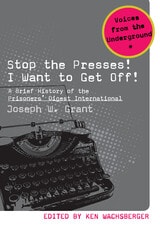
Stop the Presses! I Want to Get Off!
A Brief History of the Prisoners’ Digest InternationalJoseph W. Grant
Michigan State University Press, 2012
The final book in the groundbreaking Voices from the Underground series, Stop the Presses! I Want to Get Off!, is the inspiring, frenetic, funny, sad, always-cash-starved story of Joe Grant, founder and publisher of Prisoners’ Digest International, the most important prisoners’ rights underground newspaper of the Vietnam era. From Grant’s military days in pre-Revolutionary Cuba during the Korean War, to his time as publisher of a pro-union newspaper in Cedar Rapids and his eventual imprisonment in Leavenworth, Kansas, Grant’s personal history is a testament to the power of courage under duress. One of the more notorious federal penitentiaries in the nation, Leavenworth inspired Grant to found PDI in an effort to bring hope to prisoners and their families nationwide.
Storycraft, Second Edition
The Complete Guide to Writing Narrative NonfictionJack Hart
University of Chicago Press, 2021
In this new edition, Hart has expanded the book’s range to delve into podcasting and has incorporated new insights from recent research into storytelling and the brain. He has also added dozens of new examples that illustrate effective narrative nonfiction.
This edition of Storycraft is also paired with Wordcraft, a new incarnation of Hart’s earlier book A Writer’s Coach, now also available from Chicago.
Storycraft
The Complete Guide to Writing Narrative NonfictionJack Hart
University of Chicago Press, 2011
From the work of the New Journalists in the 1960s, to the New Yorker essays of John McPhee, Susan Orlean, Atul Gawande, and a host of others, to blockbuster book-length narratives such as Mary Roach’s Stiff or Erik Larson’s Devil in the White City, narrative nonfiction has come into its own. Yet writers looking for guidance on reporting and writing true stories have had few places to turn for advice. Now in Storycraft, Jack Hart, a former managing editor of the Oregonian who guided several Pulitzer Prize–winning narratives to publication, delivers what will certainly become the definitive guide to the methods and mechanics of crafting narrative nonfiction.
Hart covers what writers in this genre need to know, from understanding story theory and structure, to mastering point of view and such basic elements as scene, action, and character, to drafting, revising, and editing work for publication. Revealing the stories behind the stories, Hart brings readers into the process of developing nonfiction narratives by sharing tips, anecdotes, and recommendations he forged during his decades-long career in journalism. From there, he expands the discussion to other well-known writers to show the broad range of texts, styles, genres, and media to which his advice applies. With examples that draw from magazine essays, book-length nonfiction narratives, documentaries, and radio programs, Storycraft will be an indispensable resource for years to come.

Style as Argument
Contemporary American NonfictionChirs Anderson
Southern Illinois University Press, 1987
Taking the position that style has a value in its own right, that language forms a major component of the story a nonfiction writer has to tell, Anderson analyzes the work of America’s foremost practitioners of New Journalism—Tom Wolfe, Truman Capote, Norman Mailer, and Joan Didion.
Anderson does for nonfiction what insightful critics have long been doing for fiction and poetry. His approach is rhetorical, and his message is that the rhetoric of Wolfe, Capote, Mailer, and Didion is a direct response to the problem of trying to convey to a general audience the sublime, inexplicable, or private and intuitive experiences that conventional rhetoric cannot evoke.
The emphasis in this book is on style, not genre, and the analysis characterizes the distinctive styles of four American writers, showing how the richness and complexity of their prose discloses an important argument about the value of language itself. Their prose is complex, nuanced, layered, affecting, always aware of itself as style. This self-consciousness, Anderson contends, prepares the reader to regard style as argument, a “tacit but powerful statement about the value of form as form, style as style.”

Superman and Son
Schoenstein, Ralph
Rutgers University Press, 1995
"To Ralph Schoenstein, his father was the New York version of Superman: 'Not a mild-mannered reporter who put on a cape in a telephone booth, but a commanding editor who could use a telephone booth to get tickets to any sold-out Broadway show.' Father Paul was city editor of Hearst's New York Journal-American, the U.S.'s biggest evening paper through the '40s and '50s. . . . This affectionate memoir evokes a giant of great animal magnetism. . . a filial, funny book that Superman would have loved--and that anyone might admire."--Time Magazine
"Enjoy a sneaking look back at the days when newspapering was a game as well as a trade, when the world paraded through a newspaper's door without security passes, when scoop-hungry city editors not only breathed fire, they inhaled, Schoenstein's gem of a memoir brings it all back in a rush of wit and longing."--Columbia Journalism Review
"Father and son literature goes back to the Bible . . . but I doubt whether there has ever been anything quite like Schoenstein's memoir. Certainly nothing as funny, warm, and poignant all at once."--Los Angeles Times
Publisher's Note: This book was previously titled Citizen Paul: The Story of Father and Son, published in 1978 and out of print for many years. It was an Alternate Selection of the Book of the Month Club.
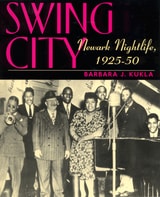
Swing City
Newark Lightlife, 1925-50Kukla, Barbara J.
Rutgers University Press, 2002
When people think of the hottest cities of the Jazz Age and Swing Era, New York, Nashville, New Orleans, Memphis, Kansas City, and Chicago immediately spring to mind. But Newark, New Jersey was just as happening as each of these towns. On any given evening, you could listen to a legendary singer like Sarah Vaughan or laugh at the celebrated comedy of Red Foxx. Newark was a veritable maze of thriving theaters, clubs, and after-hours joints where the sporting folks rambled through the night. There were plenty of jobs for musicians and entertainers, so the city was teaming with musical talent.
Swing City reveals Newark’s role as an undocumented entertainment mecca between 1922 and 1950. The book is based on interviews with musicians, singers, dancers, comedians, bartenders, waitresses, nightclub owners, and their families and is heavily illustrated with rare photographs from the author’s personal collection. Barbara J. Kukla presents a musical tour of the city, covering the vaudeville acts, the musicians who started at Newark’s Orpheum Theater and went on to join famous bands, and the teenage dancers who started as chorus girls and eventually toured with famous tap dancers. She also describes the house rent parties of the 1930s, the “colored only” clubs, the entertainment at Newark’s 1,000 saloons during Prohibition, and the Coleman Hotel where Billie Holiday often stayed. Throughout the book, which concentrates on performers’ lives and personalities, Kukla discusses music and other forms of entertainment as social and economic survival tools in Newark’s Third Ward during a time of ruthless segregation.
Swing City includes several appendixes that provide a virtual “Who’s Who” of 25 years of nightlife activities in Newark. Music and nostalgia buffs, students of African American history, and anyone who’s ever been to Newark will find in this bookfabulous entertainment.