187 books match the query 'Justice' and 5 start with s

cover of Sister: An African American Life in Search of Justice

Sister

An African American Life in Search of Justice

Sylvia Bell White and Jody LePage

University of Wisconsin Press, 2013

Raised with twelve brothers in a part of the segregated South that provided no school for African American children through the 1940s, Sylvia Bell White went North as a teenager, dreaming of a nursing career and a freedom defined in part by wartime rhetoric about American ideals. In Milwaukee she and her brothers persevered through racial rebuffs and discrimination to find work. Barred by both her gender and color from employment in the city’s factories, Sylvia scrubbed floors, worked as a nurse’s aide, and took adult education courses.
            When a Milwaukee police officer killed her younger brother Daniel Bell in 1958, the Bell family suspected a racial murder but could do nothing to prove it—until twenty years later, when one of the two officers involved in the incident unexpectedly came forward. Daniel’s siblings filed a civil rights lawsuit against the city and ultimately won that four-year legal battle. Sylvia was the driving force behind their quest for justice.
            Telling her whole life story in these pages, Sylvia emerges as a buoyant spirit, a sparkling narrator, and, above all, a powerful witness to racial injustice. Jody LePage’s chapter introductions frame the narrative in a historical span that reaches from Sylvia’s own enslaved grandparents to the nation’s first African American president. Giving depth to that wide sweep, this oral history brings us into the presence of an extraordinary individual. Rarely does such a voice receive a hearing.

Winner, Wisconsin Historical Society Book Award of Merit
[more]
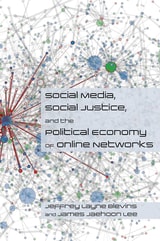
cover of Social Media, Social Justice and the Political Economy of Online Networks

Social Media, Social Justice and the Political Economy of Online Networks

Jeffrey Layne Blevins and James Jaehoon Lee

University of Minnesota Press, 2021

Next Generation e-book nonfiction 2023 Indie Book Award Prize.

While social network analyses often demonstrate the usefulness of social media networks to affective publics and otherwise marginalized social justice groups, this book explores the domination and manipulation of social networks by more powerful political groups. Jeffrey Layne Blevins and James Lee look at the ways in which social media conversations about race turn politically charged, and in many cases, ugly. Studies show that social media is an important venue for news and political information, while focusing national attention on racially involved issues. Perhaps less understood, however, is the effective quality of this discourse, and its connection to popular politics, especially when Twitter trolls and social media mobs go on the attack.

Taking on prominent case studies from the past few years, including the Ferguson protests and the Black Lives Matter movement, the 2016 presidential election, and the rise of fake news, this volume presents data visualization sets alongside careful scholarly analysis. The resulting volume provides new insight into social media, legacy news, and social justice.

[more]
cover of Some Measure of Justice: The Holocaust Era Restitution Campaign of the 1990s

Some Measure of Justice

The Holocaust Era Restitution Campaign of the 1990s

Michael R. Marrus; Foreword by William A. Schabas

University of Wisconsin Press, 2009

Can there ever be justice for the Holocaust? During the 1990s—triggered by lawsuits in the United States against Swiss banks, German corporations, insurance companies, and owners of valuable works of art—claimants and their lawyers sought to rectify terrible wrongs committed more than a half century earlier. Some Measure of Justice explores this most recent wave of justice-seeking for the Holocaust: what it has been, why it emerged when it did, how it fits with earlier reparation to the Jewish people, its significance for the historical representation of the Holocaust, and its implications for justice-seeking in our time.

Writings on the subject of Holocaust reparations have largely come from participants, lawyers, philosophers, journalists, and social scientists specializing in restitution. In Some Measure of Justice Michael Marrus takes up the issue as a historian deeply involved with legal issues. He engages with larger questions about historical understanding and historical interpretation as they enter the legal arena. Ultimately this book asks, What constitutes justice for a great historic wrong? And, Is such justice possible?

[more]
cover of Stacked Deck: A Story of Selfishness in America

Stacked Deck

A Story of Selfishness in America

Lawrence E. Mitchell

Temple University Press, 1998

Americans for generations have  been raised with the mantra that we can grow up to be anything we want to be, achieve anything we can imagine. How many of us believe the message? Dream big. It is a fundamental ideology of unbounded opportunity underscoring our drive to succeed. Yet for many Americans the reality, no matter how hard they try, is far from the visions of glory, the unattainable dream of rags to riches that leaves them feeling like failures.

To understand this ideology and its effect on society, Lawrence E. Mitchell instructs us to look at the myth of individualism that pervades our laws, our social thought, our institutions, and our philosophies. It is the touchstone of our national debates on welfare reform, salary equity, FDA regulations, and a criminal defendant's right to a fair trial -- and it even infiltrates our private lives every time we argue about the division of household chores or television time. In Stacked Deck, Mitchell shows us how this artificial reality buries the way we truly live.

Mithcell uses examples drawn from history, politics, law, and culture to show how our singular concern with fairness has diminished our sense of vulnerability, so that our ideas of justice, equality, and efficiency are  modeled on the capabilities of the strongest in society. Large scale examples -- such as blue collar layoffs and corporate downsizing, natural disasters and catastrophic illnesses -- illustrates the rickety bridge between comfort and disaster. We must be reminded that we are all vulnerable to the forces of economics, society, politics, and nature. Thus, Mitchell proposes, those who start out at the top tend to stay there, just as the weak tend to remain weak.

Stacked Deck does more than outline this problem of American selfishness; it proposes a solution tha tis nothing less than a massive reconception of the way we relate to one another. Mitchell retains what is productive about the myth of the self-reliant individual, while asserting what is necessary to restore a sense of community. He suggests a sweeping intellectual recovery of fairness available to all levels of American society, thereby reclaiming our true sense of responsibility to others in society.

[more]
cover of States of Marriage: Gender, Justice, and Rights in Colonial Mali

States of Marriage

Gender, Justice, and Rights in Colonial Mali

Emily S. Burrill

Ohio University Press, 2015

States of Marriage shows how throughout the colonial period in French Sudan (present-day Mali) the institution of marriage played a central role in how the empire defined its colonial subjects as gendered persons with certain attendant rights and privileges. The book is a modern history of the ideological debates surrounding the meaning of marriage, as well as the associated legal and sociopolitical practices in colonial and postcolonial Mali. It is also the first to use declassified court records regarding colonialist attempts to classify and categorize traditional marriage conventions in the southern region of the country. In French Sudan, as elsewhere in colonial Africa, the first stage of marriage reform consisted of efforts to codify African marriages, bridewealth transfers, and divorce proceedings in public records, rendering these social arrangements “legible” to the colonial administration. Once this essential legibility was achieved, other, more forceful interventions to control and reframe marriage became possible. This second stage of marriage reform can be traced through transformations in and by the colonial court system, African engagements with state-making processes, and formations of “gender justice.” The latter refers to gender-based notions of justice and legal rights, typically as defined by governing and administrative bodies as well as by socioxadpolitical communities. Gender justice went through a period of favoring the rights of women, to a period of favoring patriarchs, to a period of emphasizing the power of the individual—but all within the context of a paternalistic and restrictive colonial state.
[more]