Results by title
100 books match the query 'Kings and rulers' and 6 start with s
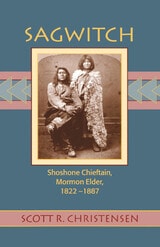
Sagwitch
Shoshone Chieftan, Mormon Elder 1822-1887Scott Christensen
Utah State University Press, 1999
The Northwestern Shoshone knew as home the northern Great Salt Lake, Bear River, Cache, and Bear Lake valleys of northern Utah. Sagwitch was born at a time when his people traded with the mountain men. In the late 1850s, wagons brought Mormon farmers to settle in Cache Valley, the Northwestern Shoshone heartland. Emigrants and settlers reduced Shoshone access to traditional village sites and food resources. Relationships with the Mormons were mostly good but often strained, and the Shoshone treatment of migrants, who now traveled north and south as well as west and east through the area, was increasingly opportunistic. It only took a few violent incidents for a zealous army colonel to seek severe punishment of the Northwestern Shoshone on a winter morning in 1863. The Bear River Massacre was among the bloodiest engagements of America's Indian wars. Hundreds of Shoshone, including Sagwitch's wife and two sons, died; Sagwitch was wounded but escaped. The band was shattered, other chiefs dead.
The following years were very hard for the survivors. The federal government negotiated a treaty with them but failed to get Sagwitch's signature when, en route to the sessions, he was arrested and then wounded by a white assassin. With the world around him changed, Sagwitch sought accommodation with the most immediate threat to his people's traditional way of survival—the Mormons occupying the Shoshone's valleys.
This, then, is also the story of the conversion of Sagwitch and his band to the Mormon Church. Though not without problems, that conversion was long lasting and thorough. Sagwitch and other Shoshone would demonstrate in important ways their new religious devotion. With the assistance of Mormon leaders, they established the Washakie community in northern Utah. Though efforts to secure a land base had an uneven history, they partly succeeded, and the story of these Shoshone's attempts at rural farming diverged significantly from what happened on government reservations. When Sagwitch died, his death went almost unnoticed outside of Washakie, but his children and grandchildren continued to be important voices among a people who, after experiencing near annihilation, survived in the new world into which Sagwitch led them.
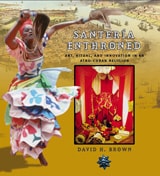
Santeria Enthroned
Art, Ritual, and Innovation in an Afro-Cuban ReligionDavid H. Brown
University of Chicago Press, 2003
Focusing on the royal throne as a potent metaphor in Santería belief and practice, Brown shows how negotiation among ideologically competing interests have shaped the religion's symbols, rituals, and institutions from the nineteenth century to the present. Rich case studies of change in Cuba and the United States, including a New Jersey temple and South Carolina's Oyotunji Village, reveal patterns of innovation similar to those found among rival Yoruba kingdoms in Nigeria. Throughout, Brown argues for a theoretical perspective on culture as a field of potential strategies and "usable pasts" that actors draw upon to craft new forms and identities—a perspective that will be invaluable to all students of the African Diaspora.
American Acemy of Religion Award for Excellence in the Study of Religion (Analytical-Descriptive Category)
Saul, Benjamin, and the Emergence of Monarchy in Israel
Biblical and Archaeological PerspectivesJoachim J. Krause
SBL Press, 2020
Ponder questions of the united monarchy under Saul and David in light of current historical and archaeological evidence
Reconstructing the emergence of the Israelite monarchy involves interpreting historical research, approaching questions of ancient state formation, synthesizing archaeological research from sites in the southern Levant, and reexamining the biblical traditions of the early monarchy embedded in the books of Samuel and Kings. Integrating these approaches allows for a nuanced and differentiated picture of one of the most crucial periods in the history of ancient Israel. Rather than attempting to harmonize archaeological data and biblical texts or to supplement the respective approach by integrating only a portion of data stemming from the other, both perspectives come into their own in this volume presenting the results of an interdisciplinary Tübingen–Tel Aviv Research Colloquium.
Features:
- Essays on Israel's monarchy by experts in biblical archaeology and biblical studies
- Methods for integrating archaeology and biblical traditions in reconstructing ancient Israel's history
- New research on the sociopolitical process of state formation in Israel and Judah

Selected Letters
Isabella d’Este
Iter Press, 2017
Isabella d’Este (1474–1539), daughter of the Este dukes of Ferrara and wife of Marchese Francesco II Gonzaga of Mantua, co-regent of the Gonzaga state, art collector, musician, diplomat, dynastic mother, traveler, reader, gardener, fashion innovator, and consummate politician, was also, as this volume attests, a prolific letter writer with a highly developed epistolary network. Presented here for the first time in any language is a representative selection from over 16,000 letters sent by Isabella to addressees across a wide social spectrum. Together, they paint a nuanced and colorful portrait of a brilliant and influential female protagonist of early modern European society.
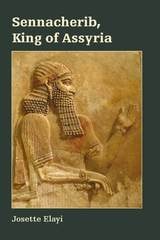
Sennacherib, King of Assyria
Josette Elayi
SBL Press, 2018
A critical resource for students and scholars of the ancient Near East and the Bible
Josette Elayi’s Sennacherib, King of Assyria is the only biography of Sargon II’s famous son. Elayi traces the reign of Sennacherib in context in order to illuminate more fully the life and contributions of this warlord, builder, innovator, and social reformer—a unique figure among the Assyrian kings. Elayi offers both an evaluation of this royal figure and an assessment of the Assyrian Empire by interpreting the historical information surrounding the decisive events of his reign.
Features:
- Exploration of why Sennacherib did not seize Jerusalem or remove Hezekiah from the throne
- An extensive investigation of annals, royal inscriptions, letters, palace reliefs, clay tablets, and excavation reports
- Maps and tables

Sitting Bull
Bill Yenne
Westholme Publishing, 2008
An Acclaimed Biography of the Greatest American Indian Leader
Sitting Bull's name is still the best known of any American Indian leader, but his life and legacy remain shrouded with misinformation and half-truths. Sitting Bull's life spanned the entire clash of cultures and ultimate destruction of the Plains Indian way of life. He was a powerful leader and a respected shaman, but neither fully captures the enigma of Sitting Bull. He was a good friend of Buffalo Bill and skillful negotiator with the American government, yet erroneously credited with both murdering Custer at the Little Big Horn and with being the chief instigator of the Ghost Dance movement. The reality of his life, as Bill Yenne reveals in his absorbing new portrait, Sitting Bull, is far more intricate and compelling. Tracing Sitting Bull's history from a headstrong youth and his first contact with encroaching settlers, through his ascension as the spiritual and military leader of the Lakota, friendship with a Swiss-American widow from New York, and death at the hands of the Indian police on the eve of the massacre at Wounded Knee, Yenne scoured rare contemporary records and consulted Sitting Bull's own "Hieroglyphic Autobiography" in the course of his research. While Sitting Bull was the leading figure of Plains Indian resistance his message, as Yenne explains, was of self-reliance, not violence. At the Battle of the Little Bighorn, Sitting Bull was not confronting Custer as popular myth would have it, but riding through the Lakota camp making sure the most defenseless of his tribe--the children--were safe. In Sitting Bull we find a man who, in the face of an uncertain future, helped ensure the survival of his people.