Results by title
69 books match the query 'Korea' and 4 start with s
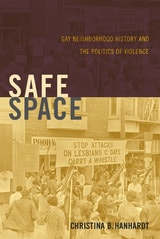
Safe Space
Gay Neighborhood History and the Politics of ViolenceChristina B. Hanhardt
Duke University Press, 2013
Since the 1970s, a key goal of lesbian and gay activists has been protection against street violence, especially in gay neighborhoods. During the same time, policymakers and private developers declared the containment of urban violence to be a top priority. In this important book, Christina B. Hanhardt examines how LGBT calls for "safe space" have been shaped by broader public safety initiatives that have sought solutions in policing and privatization and have had devastating effects along race and class lines.
Drawing on extensive archival and ethnographic research in New York City and San Francisco, Hanhardt traces the entwined histories of LGBT activism, urban development, and U.S. policy in relation to poverty and crime over the past fifty years. She highlights the formation of a mainstream LGBT movement, as well as the very different trajectories followed by radical LGBT and queer grassroots organizations. Placing LGBT activism in the context of shifting liberal and neoliberal policies, Safe Space is a groundbreaking exploration of the contradictory legacies of the LGBT struggle for safety in the city.
Service Economies
Militarism, Sex Work, and Migrant Labor in South KoreaJin-kyung Lee
University of Minnesota Press, 2010
Making surprising and revelatory connections, Jin-kyung Lee analyzes South Korean military labor in the Vietnam War, domestic female sex workers, South Korean prostitution for U.S. troops, and immigrant/migrant labor from Asia in contemporary South Korea. Foregrounding gender, sexuality, and race, Lee reimagines the South Korean economic "miracle" as a global and regional articulation of industrial, military, and sexual proletarianization.
Lee not only addresses these under-studied labors individually but also integrates and unites them to reveal an alternative narrative of a changing South Korean working class whose heterogeneity is manifested in its objectification. Delving into literary and popular cultural sources as well as sociological work, Lee locates South Korean development in its military and economic interactions with the United States and other Asian nation-states, offering a unique perspective on how these practices have shaped and impacted U.S.-South Korea relations.
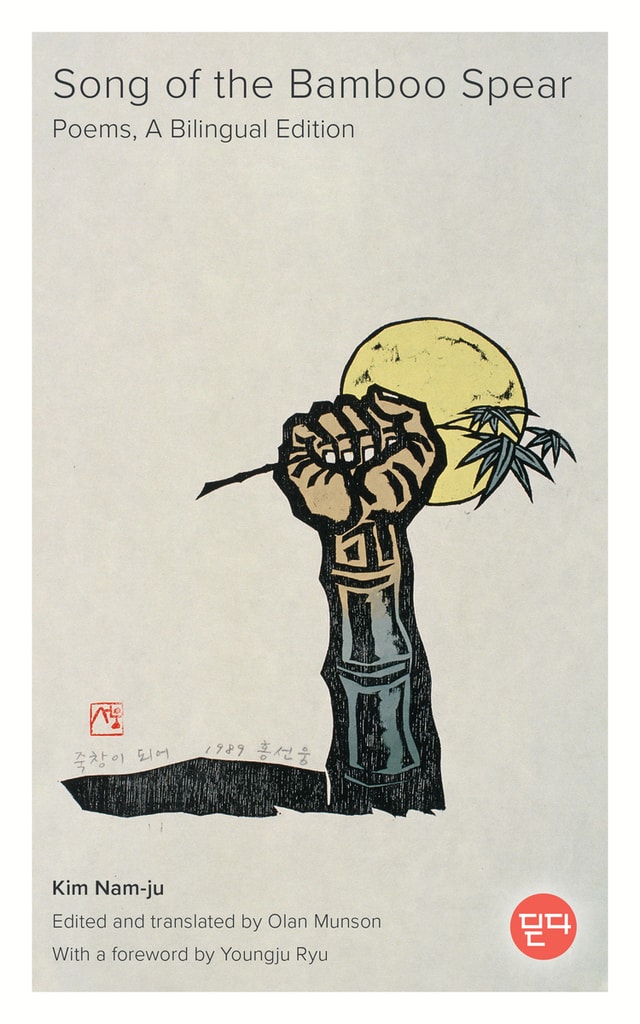
Song of the Bamboo Spear
Poems, A Bilingual EditionNam-ju Kim (1945–1994)
Rutgers University Press, 2027
This book debuts selected poetry by Kim Nam-ju (1946–1994) in English translation, along with the original Korean. Referred to as the “Che Guevara of South Korea,” and self-described a “warrior poet,” Kim Nam-ju remains, to this day, an enduring voice of the 1970s and 80s cultures of anti-authoritarian resistance in South Korea. Kim was arrested in 1979 for his involvement with the “South Josǒn” National Liberation Front, a leftist underground group organizing against the Yushin regime. Kim wrote prolifically while in prison (1979-1988), at times by etching his poems into scraps of foil, milk carton, or cigarette packages. The work he produced in prison alone totals around 360 poems. This bilingual volume selects 65 poems from Kim's oeuvre, sampling across many different chapters of the poet’s career. Readers will find autobiographical reflections on his childhood, love poems, missives from the prison cell, commemorations of the Kwangju Uprising, the poet’s calls to arms, and more.
이 책은 김남주 시인(1946~1994)의 시 65편을 한국어 원문과 함께 영문 번역으로 처음 선보인다. ‘한국의 체 게바라’로 불리며 스스로를 ‘전사 시인’이라 칭했던 김남주는 오늘날까지도 한국의 1970·80년대 반독재 저항운동을 대표하는 사라지지 않는 목소리로 남아 있다. 김남주는 유신정권에 맞서 결성된 좌파 지하조직 ‘남조선민족해방전선준비위원회’에 가담한 혐의로 1979년에 체포되었다. 1979년부터 1988년에 이르는 수감 기간에도 꾸준히 창작 활동을 이어갔으며, 때로는 은박지 조각이나 우유곽, 담뱃갑 등에 시를 새겨 집필하기도 하였다. 이 시기에 쓴 작품만 해도 360여 편에 이른다. 이 영역시집은 시인의 전체 작품 중에서 65편의 시를 엄선하여 시인의 생애와 창작 활동의 다양한 시기를 아우르는 시적 여정을 한눈에 보여준다. 독자들은 시인의 어린 시절에 대한 자전적인 회고, 사랑의 시, 옥중 서한, 5·18 광주항쟁을 추모하는 시, 민중의 투쟁을 촉구하는 시 등 다양한 작품을 만나볼 수 있을 것이다.
English-Korean Bilingual Edition
영-한 이중언어판
This book is published with the support of the Literature Translation Institute of Korea (LTI Korea)
South Koreans in the Debt Crisis
The Creation of a Neoliberal Welfare SocietyJesook Song
Duke University Press, 2009
Drawing on her experience during the crisis as an employee in a public works program in Seoul, Song provides an ethnographic assessment of the efforts of the state and civilians to regulate social insecurity, instability, and inequality through assistance programs. She focuses specifically on efforts to help two populations deemed worthy of state subsidies: the “IMF homeless,” people temporarily homeless but considered employable, and the “new intellectuals,” young adults who had become professionally redundant during the crisis but had the high-tech skills necessary to lead a transformed post-crisis South Korea.