108 books match the query 'Landscapes' and 6 start with s
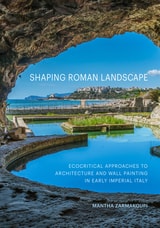
cover of Shaping Roman Landscape: Ecocritical Approaches to Architecture and Wall Painting in Early Imperial Italy

Shaping Roman Landscape

Ecocritical Approaches to Architecture and Wall Painting in Early Imperial Italy

Mantha Zarmakoupi

J. Paul Getty Trust, The, 0

A groundbreaking ecocritical study that examines how ideas about the natural and built environment informed architectural and decorative trends of the Roman Late Republican and Early Imperial periods.
 
Landscape emerged as a significant theme in the Roman Late Republican and Early Imperial periods. Writers described landscape in texts and treatises, its qualities were praised and sought out in everyday life, and contemporary perceptions of the natural and built environment, as well as ideas about nature and art, were intertwined with architectural and decorative trends.
 
This illustrated volume examines how representations of real and depicted landscapes, and the merging of both in visual space, contributed to the creation of novel languages of art and architecture. Drawing on a diverse body of archaeological, art historical, and literary evidence, this study applies an ecocritical lens that moves beyond the limits of traditional iconography. Chapters consider, for example, how garden designs and paintings appropriated the cultures and ecosystems brought under Roman control and the ways miniature landscape paintings chronicled the transformation of the Italian shoreline with colonnaded villas, pointing to the changing relationship of humans with nature. Making a timely and original contribution to current discourses on ecology and art and architectural history, Shaping Roman Landscape reveals how Roman ideas of landscape, and the decorative strategies at imperial domus and villa complexes that gave these ideas shape, were richly embedded with meanings of nature, culture, and labor.
[more]
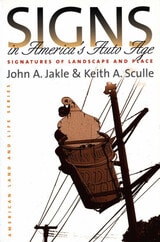
cover of Signs in America's Auto Age: Signatures of Landscape and Place

Signs in America's Auto Age

Signatures of Landscape and Place

John A. & Keith A. Jakle & Sculle

University of Iowa Press, 2004

Signs orient, inform, persuade, and regulate. They help give meaning to our natural and human-built environment, to landscape and place. In Signs in America’s Auto Age, cultural geographer John Jakle and historian Keith Sculle explore the ways in which we take meaning from outdoor signs and assign meaning to our surroundings—the ways we “read” landscape. With an emphasis on how the use of signs changed as the nation’s geography reorganized around the coming of the automobile, Jakle and Sculle consider the vast array of signs that have evolved since the beginning of the twentieth century.
[more]
cover of Silent City on a Hill: Landscapes of Memory and Boston’s Mount Auburn Cemetery

Silent City on a Hill

Landscapes of Memory and Boston’s Mount Auburn Cemetery

Blanche Linden-Ward

The Ohio State University Press, 1900
[more]
cover of Sowing Empire: Landscape And Colonization

Sowing Empire

Landscape And Colonization

Jill H. Casid

University of Minnesota Press, 2005
Planting and transplanting, seeding and reshaping—landscaping practices that emerged in the eighteenth century—are inextricable from the contested terrain of empire within which they operated. From the plantations of the “nabobs” to the island gardens of narrative fiction, from William Beckford’s estate at Fonthill to Marie Antoinette’s ornamented farm, Sowing Empire considers imperial relandscaping—its patriarchal organization, heterosexual reproduction, and slavery—and how it contributed to the construction of imperial power. At the same time, the book shows how these picturesque landscapes and sugar plantations contained within them the seeds of resistance—how, for instance, slave gardens and the Afro-Caribbean practice of Vodou threatened authority and created new possibilities for once again transforming the landscape.In an ambitious work of wide-ranging literary, visual, and historical allusion, Jill H. Casid examines how landscaping functioned in an imperial mode that defined and remade the “heartlands” of nations as well as the contact zones and colonial peripheries in the West and East Indies. Revealing the colonial landscape as far more than an agricultural system—as a means of regulating national, sexual, and gender identities—Casid also traces how the circulation of plants and hybridity influenced agriculture and landscaping on European soil and how colonial contacts materially shaped what we take as “European.”Utilizing a wide range of both visual and written sources—maps, literature, and travel writing—this book is interdisciplinary in its methodology and in its scope. Sowing Empire explores how postcolonial and queer studies can alter art history and visual studies and, in turn, what close attention to the visual may offer to both postcolonial theorizing and historically and materially based colonial cultural studies.Jill H. Casid is assistant professor of art history and part of the developing transdisciplinary program in visual culture studies at the University of Wisconsin, Madison.
[more]
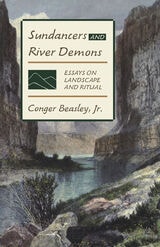
cover of Sundancers and River Demons: Essays on Landscape and Ritual

Sundancers and River Demons

Essays on Landscape and Ritual

Conger Beasley Jr.

University of Arkansas Press, 1990
[more]
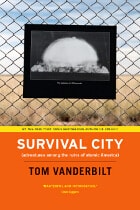
cover of Survival City: Adventures among the Ruins of Atomic America

Survival City

Adventures among the Ruins of Atomic America

Tom Vanderbilt

University of Chicago Press, 2002

On the road to Survival City, Tom Vanderbilt maps the visible and invisible legacies of the cold war, exhuming the blueprints for the apocalypse we once envisioned and chronicling a time when we all lived at ground zero. In this road trip among ruined missile silos, atomic storage bunkers, and secret test sites, a lost battleground emerges amid the architecture of the 1950s, accompanied by Walter Cotten’s stunning photographs. Survival City looks deep into the national soul, unearthing the dreams and fears that drove us during the latter half of the twentieth century.

“A crucial and dazzling book, masterful, and for me at least, intoxicating.”—Dave Eggers


“A genuinely engaging book, perhaps because [Vanderbilt] is skillful at conveying his own sense of engagement to the reader.”—Los Angeles Times


“A retracing of Dr. Strangelove as ordinary life.”—Greil Marcus, Bookforum

[more]