Results by title
622 books match the query 'Language Study' and 46 start with s
SLIFE
What Every Teacher Needs to KnowAndrea DeCapua
University of Michigan Press, 2019
SOFLA®
The Synchronous Online Flipped Learning ApproachHelaine W. Marshall and Ilka Kostka
University of Michigan Press, 2026

Sahidic Coptic
An Introductory TextbookBill Manley
University College London, 2026
An introduction to reading and analyzing texts in Sahidic Coptic, the primary literary language in Late Antique Egypt.
This concise textbook provides beginner students with the knowledge and skills required for reading primary sources and teaches the grammar of documents written in Sahidic Coptic. Learners are invited to study aspects of the language across twenty structured lessons and, from the beginning, apply their learning directly to reading authentic ancient texts written by men and women between 380 and 750 AD. The book introduces the language through engagement with ancient texts rather than artificial exercises, enabling students to explore the history and culture of Egyptian communities under Byzantine and early Islamic rule, as well as key topics such as the development of Christian orthodoxy, the lives of women, and the emergence of monasticism as a major cultural force.
Scribal Habits in Greek New Testament Manuscripts
Andrew W. Wilson
SBL Press, 2026
Scribal Worlds
Scholarship and Classification in Cuneiform CulturesEdited by Eduardo A. Escobar, Kiersten Neumann, and C. Jay Crisostomo
University College London, 2026
Revealing the scholarly worlds behind the world’s first writing system, this volume explores how cuneiform cultures classified, transmitted, and interpreted knowledge.
Cuneiform is the world’s first preserved writing system, yet cuneiform texts and the associated cultures and practices remain undervalued across several disciplines. Scribal Worlds: Scholarship and Classification in Cuneiform Cultures explores the history of the earliest writing cultures of the ancient Middle East. Case studies reconstruct the intellectual frameworks and the transmission of knowledge of scribal cultures to show how specific texts and objects can be interpreted within their cultural contexts.
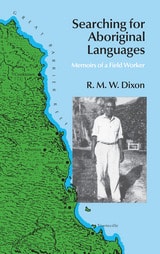
Searching for Aboriginal Languages
Memoirs of a Field WorkerR. M. W. Dixon
University of Chicago Press, 1989
As he made his way through northern Australia, Dixon was dependent on rumors of Aboriginal speakers, the unreliable advice of white Australians, and the faulty memories of many of the remaining speakers of the languages. Suggestions of informants led him on a circuitous trail through the bush, to speakers such as the singer Willie Kelly in Ravenshoe, who wanted his recordings sent to the south, "where white people would pay big money to hear a genuine Aborigine sing" and Chloe Grant in Murray Upper, who told tales in four dialects of digging wild yams, of the blue-tongue lizard Banggara, and of the arrival of Captain Cook. Dixon tells of obtaining the trust of possible informants, of learning the customs and terrain of the country, and of growing understanding of the culture and tradition of his subjects. And he explains his surprise at his most unexpected discovery: that the rich oral tradition of the "primitive" Aborigines could yield a history of a people, as told by that people, that dates to almost ten millenia before.
Second Language Acquisition Myths
Applying Second Language Research to Classroom TeachingSteven Brown and Jenifer Larson-Hall
University of Michigan Press, 2012
This volume was conceived as a first book in SLA for advanced undergraduate or introductory master’s courses that include education majors, foreign language education majors, and English majors. It’s also an excellent resource for practicing teachers.
Both the research and pedagogy in this book are based on the newest research in the field of second language acquisition. It is not the goal of this book to address every SLA theory or teach research methodology. It does however address the myths and questions that non-specialist teacher candidates have about language learning.
Steven Brown is the co-author of the introductory applied linguistics textbook Understanding Language Structure, Interaction, and Variation textbook (and workbook).
The myths challenged in this book are:
§ Children learn languages quickly and easily while adults are ineffective in comparison.
§ A true bilingual is someone who speaks two languages perfectly.
§ You can acquire a language simply through listening or reading.
§ Practice makes perfect.
§ Language students learn (and retain) what they are taught.
§ Language learners always benefit from correction.
§ Individual differences are a major, perhaps the major, factor in SLA.
§ Language acquisition is the individual acquisition of grammar.
Second Language Writing in Transitional Spaces
Teaching and Learning across Educational ContextsLubie Grujicic-Alatriste and Cathryn Crosby Grundleger
University of Michigan Press, 2020
The chapters examine the writing that English learners are producing because of the Common Core and the writing they are required to do once they reach the college or university, and then consider where the intersections exist—that is, what do educators think English learners ought to be writing across educational levels?
Each chapter describes the educational setting where the researchers were engaged, examines specific issues related to transitions, and offers—where relevant—recommendations for classroom practices, teaching strategies, and instructional materials that may be useful for practicing teachers and all others professionally engaged in educating writers across K–16.

Secret Germany
Myth in Twentieth-Century German CultureFurio Jesi
Seagull Books, 2021
In the decades before the rise of the Third Reich, “Secret Germany” was a phrase used by the circle of writers around the poet Stefan George to describe a collective political and poetic project: the introduction of the highest values of art into everyday life, the secularization of myth and the mythologization of history. In this book, Furio Jesi takes up the term in order to trace the contours of that political, artistic, and aesthetic thread as it runs through German literary and artistic culture in the period—which, in the 1930s, became absorbed by Nazism as part of its prophecy of a triumphant future. Drawing on thinkers like Carl Jung and writers such as Thomas Mann and Rainer Maria Rilke, Jesi reveals a literary genre that was transformed, tragically, into a potent political myth.
Seeing the Big Picture, Revised Edition
A Cinematic Approach to Understanding Cultures in AmericaEllen Summerfield and Sandra Lee
University of Michigan Press, 2006
In addition to increasing students' knowledge and understanding of cultural differences, Seeingthe Big Picture will help students develop strong critical-thinking and analytic abilities as they learn to recognize and question messages inherent in the films' portrayals of different populations. A unique feature of the text are the Points of View segments from directors, insiders, and students that appear throughout the text, provoking perspectives students might not otherwise encounter.
This text is the ideal coursebook for undergraduate diversity electives and other multicultural awareness courses.
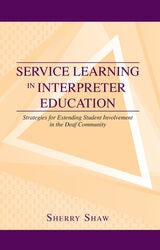
Service Learning in Interpreter Education
Strategies for Extending Student Involvement in the Deaf CommunitySherry Shaw
Gallaudet University Press, 2013
Institutions of higher learning around the nation have embraced the concept of student civic engagement as part of their curricula, a movement that has spurred administrators in various fields to initiate programs as part of their disciplines. In response, sign language interpreting educators are attempting to devise service-learning programs aimed at Deaf communities. Except for a smattering of journal articles, however, they have had no primary guide for fashioning these programs. Sherry Shaw remedies this in her new book Service Learning in Interpreter Education: Strategies for Extending Student Involvement in the Deaf Community.
Shaw begins by outlining how to extend student involvement beyond the field experience of an internship or practicum and suggests how to overcome student resistance to a course that seems atypical. She introduces the educational strategy behind service-learning, explaining it as a tool for re-centering the Deaf community in interpreter education. She then provides the framework for a service-learning course syllabus, including establishing Deaf community partnerships and how to conduct student assessments.
Service Learning in Interpreter Education concludes with first-person accounts from students and community members who recount their personal and professional experiences with service learning. With this thorough guide, interpreter education programs can develop stand-alone courses or modules within existing coursework.
Service-Learning
What Every ESL Teacher Needs to KnowTrisha Dowling and James M. Perren
University of Michigan Press, 2021
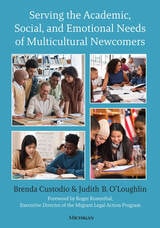
Serving the Academic, Social, and Emotional Needs of Multicultural Newcomers
Brenda Custodio and Judith B. O’Loughlin
University of Michigan Press, 2025
- Collaborate with school professionals to create a program specifically to meet the unique needs of new arrivals.
- Provide intensive literacy, numeracy, and content area support, especially for students with interrupted schooling.
- Develop the classroom supports necessary for students to achieve academic success.
- Provide supports that address the physical, social, and emotional challenges of newcomers.
- Work with families and communities to support students outside of a school environment.
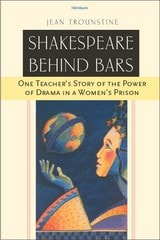
Shakespeare Behind Bars
One Teacher's Story of the Power of Drama in a Women's PrisonJean Trounstine
University of Michigan Press, 2004
Originally published in cloth in 2001, the paperback includes a new foreword that will inspire all teachers who work with students others have deemed unteachable. A new afterword updates readers on the prison art's program -- and the author herself -- since 2001.
Shorter Lexicon of the Greek New Testament
Edited by F. Wilbur Gingrich and Frederick William Danker
University of Chicago Press, 1983
"[The Shorter Lexicon] is by far superior to other New Testament 'dictionaries' of comparable size."—Robert Hoerber, Classical World
Sifrut al Ketzeh Halashon
Intermediate Hebrew TextbookEdna Genossar Grad
Northwestern University Press, 1992
Sifrut al Ketzeh Halashon
Intermediate Hebrew WorkbookEdna Genossar Grad
Northwestern University Press, 1992
Sign Language Archaeology
Understanding the Historical Roots of American Sign LanguageTed Supalla
Gallaudet University Press, 2014
By tracing the writings of selected individuals, this study reconstructs the historical context for early ASL grammar. It describes the language used in each century and how it changed, and focuses on the rediscovery of the literary legacy of the Deaf American voice. Sign Language Archaeology reveals the contrast between folk etymology and scientific etymology and allows readers to see ASL in terms of historical linguistics.
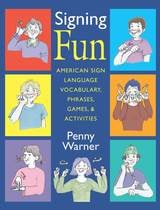
Signing Fun
American Sign Language Vocabulary, Phrases, Games, and ActivitiesPenny Warner
Gallaudet University Press, 2006
Here’s a great book for every young adult age 11 up, Signing Fun: American Sign Language Vocabulary, Phrases, Games, and Activities. Signing is visual, easy to learn, and fun to use. Author Penny Warner offers 441 useful signs on a variety of favorite topics: activities, animals, fashion, food, holidays, home, outdoors, parties, people, places, play, emotions, school, shopping, travel, plus extra fun signs for especially popular words. Each chapter includes practice sentences using everyday phrases to help new signers learn in a fun way.
Signing Fun provides dozens of entertaining games and activities, too, such as Alphabet Sign, Finger Fun Gesture Guess, Match Signs, Mime and Sign, Oppo-Sign, Picture Hand, Secret Sign, Sign-A-Gories, Signo Bingo, Snap and Sign, and Truth or Sign. It also features a list of tips on how to sign, including how to fingerspell, use numbers, and communicate with deaf people. Whimsical drawings clearly illustrate all of the signs, and a full index lists all of their English meanings for quick reference. Signing Fun is a terrific first book for learning sign while having a great time.
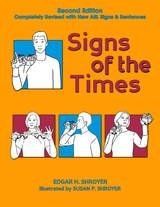
Signs of the Times
Edgar H. Shroyer
Gallaudet University Press, 2011
•Completely Revised with New Signs and Lessons
•Each Sign Illustration Features Sentences in English and ASL Order
•New Class Activities and New Student Activities for Homework or Quizzes
•New Facts about American Sign Language Grammar and Deaf Culture
Now, the bestselling American Sign Language textbook Signs of the Times has been completely revised and updated. The new, second edition is an excellent beginner’s American Sign Language textbook designed for use in the classroom or at home. Organized into 44 lessons, it presents more than 1,300 signs representing 3,500 English glosses. Each lesson contains clear illustrations of all signs, English equivalent words and synonyms, sample sentences to define vocabulary context, and practice sentences to display and reinforce ASL usage.
Signs of the Times is a complete text that includes new class activities for teachers, plus new student activities that can be done in class, as homework, or as quizzes. The new edition features the Contextual Sign/Word Appendix, which displays groups of sentences using the same English word to show different meanings along with the corresponding ASL signs. It also provides an expanded index, vocabulary lists, and a reading reference list. The new edition offers facts on ASL grammar and Deaf culture and includes mind ticklers that enliven the lessons with hints, tips, and mnemonic devices.
The new Signs of the Times expands the features that made it a standard, easy-to-use ASL textbook. Signs are repeated in sentences throughout the book to provide excellent practice for the students. The clear, easy-to-understand sign illustrations facilitates the learning process, enhancing students’ success while also making ASL fun.
Sin fronteras
Inclusive Spanish Grammar GuidebookLiana Stepanyan, María Mercedes Fages Agudo, Carolina Castillo Larrea, Goretti Prieto Botana
Amherst College Press, 2024
Sites of Translation
What Multilinguals Can Teach Us about Digital Writing and RhetoricLaura Gonzales
University of Michigan Press, 2018
Winner of the 2016 Sweetland Digital Rhetoric Collaborative Book Prize
Sites of Translation illustrates the intricate rhetorical work that multilingual communicators engage in as they translate information for their communities. Blending ethnographic and empirical methods from multiple disciplines, Laura Gonzales provides methodological examples of how linguistic diversity can be studied in practice, both in and outside the classroom, and provides insights into the rhetorical labor that is often unacknowledged and made invisible in multilingual communication. Sites of Translation is relevant to researchers and teachers of writing as well as technology designers interested in creating systems, pedagogies, and platforms that will be more accessible and useful to multilingual audiences. Gonzales presents multilingual communication as intellectual labor that should be further valued in both academic and professional spaces, and supported by multilingual technologies and pedagogies that center the expertise of linguistically diverse communicators.
Slavic in Head-Driven Phrase Structure Grammar
Edited by Robert D. Borsley and Adam Przepiórkowski
CSLI, 1999
Social-Emotional Learning in English Language Teaching
Luis Javier Pentón Herrera and Janine J. Darragh
University of Michigan Press, 2024
Sonora Yaqui Language Structures
John M. Dedrick and Eugene H. Casad
University of Arizona Press, 1999
The book includes useful sections on quantifiers and adverbial and deictic particles, often inadequately treated in reference grammars. A section on auxiliary verbs and well-documented information on voice, aspect, and other features of verbal inflection provide readers with useful data for particular lines of linguistic inquiry. Each grammatical point is illustrated by example sentences distinguished by their naturalness and cultural relevance. At the end of the book, a Yaqui text provides a sample of connected sentences in a natural context.
Sonora Yaqui Language Structures is a valuable source not only for research on this language family but also for anthropological studies of the Arizona-Sonora cultural region. In addition, it documents an indigenous language for future generations of Yaqui speakers.
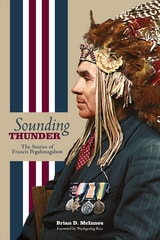
Sounding Thunder
The Stories of Francis PegahmagabowBrian D. McInnes
Michigan State University Press, 2016
Francis Pegahmagabow’s stories describe many parts of his life and are characterized by classic Ojibwe narrative. They reveal aspects of Francis’s Anishinaabe life and worldview. Interceding chapters by Brian McInnes provide valuable cultural, spiritual, linguistic, and historical insights that give a greater context and application for Francis’s words and world. Presented in their original Ojibwe as well as in English translation, the stories also reveal a rich and evocative relationship to the lands and waters of Georgian Bay.
In Sounding Thunder, Brian McInnes provides a new perspective on Pegahmagabow and his experience through a unique synthesis of Ojibwe oral history, historical record, and Pegahmagabow family stories.

Southwestern Medical Dictionary
Spanish-English, English-SpanishMargarita Artschwager Kay
University of Arizona Press, 2001
A staple of southwestern health care for more than twenty years, this dictionary can make a difference in patient care. Now available in a revised edition, it focuses on vocabulary used in health contexts by Spanish-speaking people in order to help patients tell their stories and medical practitioners to understand them. Unlike other bilingual dictionaries that emphasize scientific terms, this one focuses on standard Spanish terms as well as regional expressions peculiar to Mexican Spanish—language encountered in Chicago as easily as in Phoenix.
In the Spanish-to-English section, Spanish terms are followed by English translations and sample sentences to help health care practitioners understand how a patient might use them:
acedías, heartburn, pain in lower esophagus perceived as in the heart. Uno tiene la tendencia a sufrir de acedías después de comer chile. One has a tendency to suffer heartburn after eating chile. (syn: acidez, agruras del estómago)
In the English-to-Spanish section, English words are translated into simple Spanish terms along with English synonyms.
Now available in a revised edition, this handy reference features:
• more than 3,000 entries
• new entries that reflect current health problems and treatments
• inclusion of cognates
• Spanish definitions of English words
• anatomical drawings with bilingual labels
• more material on medicinal plants, including an appendix of poisonous and non-poisonous plants
• lists of food items and kinship terms
This book is an indispensable reference for all health care professionals who see patients of Mexican origin. Combining idiomatic precision with technical accuracy, it can help break down language barriers on either side of the border.
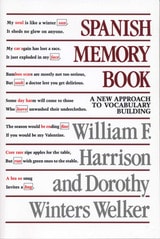
Spanish Memory Book
A New Approach to Vocabulary BuildingBy William F. Harrison and Dorothy Winters Welker
University of Texas Press, 1990
Using mnemonics is an age-old technique for remembering names, numbers, and many other things. In Spanish Memory Book, William Harrison and Dorothy Welker offer original mnemonic rimes that are by turns amusing, ironic, pathetic, sentimental, and sardonic to help students and independent learners acquire and remember Spanish vocabulary.
Included are mnemonic jingles for 700 of the 2,000 most commonly used Spanish words. Each jingle contains both the sound of the Spanish word and its English meaning. The authors have included a general pronunciation guide to Spanish vowels and consonants.
This innovative approach, which the authors have used successfully with their own students, is simple, effective, and entertaining. In the words of one student, "This book teaches me not only Spanish words but English words as well."
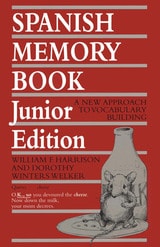
Spanish Memory Book
A New Approach to Vocabulary Building, Junior EditionBy William F. Harrison and Dorothy Winters Welker
University of Texas Press, 1990
Mnemonics is an age-old technique for remembering names, numbers, and many other things. In Spanish Memory Book, Junior Edition, William Harrison and Dorothy Welker offer onginal mnemonic rimes appropriate in subject matter and skill level for junior high and high school students to help them acquire and remember Spanish vocabulary.
Included are mnemonic jingles for several hundred of the 2,000 most commonly used Spanish words. Each jingle contains both the sound of the Spanish word and its English meaning. The authors have also included a general pronunciation guide to Spanish vowels and consonants.
This innovative approach, which the authors have used successfully with their own students, is simple, effective, and entertaining. In the words of one student, "This book teaches me not only Spanish words but English words as well."
Spanish Pronunciation in the Americas
D. Lincoln Canfield
University of Chicago Press, 1981
Spanish Verbs Made Simple(r)
By David Brodsky
University of Texas Press, 2005
It's time for a new approach to learning Spanish verbs. Unlike popular verb guides that require the rote memorization of hundreds of verb forms, this book clearly explains the rules that govern the conjugation of all classes of Spanish verbs—especially the irregular ones that give second-language learners the most trouble. These simple, easy-to-understand rules for conjugating Spanish verbs are effective learning tools for both beginning students and more advanced speakers who want to perfect their usage of Spanish verb forms.
Spanish Verbs Made Simple(r) has many helpful features that you won't find in any other verb guide:
- Clear explanations of all verb tenses and forms.
- The simple rules that govern the conjugation of all verbs—including the 90% of irregular verbs whose irregularities are entirely predictable.
- A detailed discussion of how each verb form is used, with numerous examples.
- A full explanation of the distinction between ser and estar—the single most confusing element in the Spanish verbal system.
- An extended treatment of the subjunctive that will help you understand why it is used in some situations but not others.
- Conjugations for 35 model Spanish verbs and a comprehensive listing of 4,800 verbs that indicates which of the models each verb follows.
Going well beyond any other guide in the clarity and detail of its explanations—as well as the innovative manner in which individual verbs are linked to model conjugations—Spanish Verbs Made Simple(r) is the only guide to Spanish verbs a learner needs.
Spanish Vocabulary
An Etymological ApproachBy David Brodsky
University of Texas Press, 2008
Unlike other vocabulary guides that require the rote memorization of literally thousands of words, this book starts from the premise that using the etymological connections between Spanish and English words—their common derivations from Latin, Greek, and other languages—is the most effective way to acquire and remember vocabulary. This approach is suitable for beginners as well as for advanced students. Teachers of the language will also find much material that can be used to help motivate their students to acquire, and retain, Spanish vocabulary.
Spanish Vocabulary is divided into four parts and four annexes:
- Part I provides background material on the origins of Spanish and begins the process of presenting Spanish vocabulary.
- Part II presents "classical" Spanish vocabulary—words whose form (in both Spanish and English) is nearly unchanged from Latin and Greek.
- Part III deals with "popular" Spanish vocabulary, which underwent significant changes in form (and often meaning) during the evolution from Latin to Spanish. A number of linguistic patterns are identified that will help learners recognize and remember new vocabulary.
- Part IV treats a wide range of themes, including words of Germanic and Arabic origin, numbers, time, food and animals, the family, the body, and politics.
- Annex A: Principal exceptions to the "Simplified Gender Rule"
- Annex B: 700 words whose relations, if any, to English words are not immediately obvious
- Annex C: -cer verbs and related words
- Annex D: 4,500 additional words, either individually or in groups, with English correspondences

Spatial Prepositions
A Case Study from FrenchClaude Vandeloise
University of Chicago Press, 1991
Most previous analyses of spatial prepositions have assumed that their semantic properties can be adequately explained by familiar logical and geometrical concepts. Thus, the standard view of the preposition "in" as it appears in the sentence "the ball is in the bag" postulates that it refers to the geometrical relation of inclusion. This paradigm, however, falters when faced with the contrast in acceptability between sentences such as "the bulb is in the socket" and "the bottle is in the cap." The force exerted by the "landmark" (a conceptually fixed object) on the "target" (a moveable object) is crucial in this difference: the functional notion of containment seems more operational in the use of the preposition "in" than inclusion. That is, what are taken to be the landmark and the target depend greatly on the functions these objects serve in the human scheme. This offers important clues to otherwise problematic linguistic quirks, such as why one sleeps in one's bed, while one is said to lie on one's deathbed.
While many of the examples apply in English as well as French, there are some noteworthy differences—in French one sits on a chair, but in a couch. Vandeloise convincingly argues that it is precisely this subjective element which makes a standard geometrical account unfeasible.
Speaking in Social Contexts
Communication for Life and Study in the U.S.Robyn Brinks Lockwood
University of Michigan Press, 2018
The text provides language to use for a variety of functions as they might related to life on a university campus: offering greetings and goodbyes, making introductions, giving opinions, agreeing and disagreeing, using the phone, offering assistance, asking for advice, accepting and declining invitations, giving and receiving compliments, complaining, giving congratulations, expressing condolences, and making small talk. Users are also taught to think beyond the words and to interpret intonation and stress (how things sound).
Each of the 10 units includes discussion prompts, language lessons, practice activities, get acquainted tasks (interacting with native speakers), and analysis opportunities (what did they discover and what can they apply?).
Speechcraft
Discourse Pronunciation for Academic CommunicationWayne B. Dickerson and Laura D. Hahn
University of Michigan Press, 2027
The second edition of Speechcraft: Discourse Pronunciation for Advanced Learners is designed to address the needs of advanced non-native speakers of English, specifically university-level students on North American campuses, who expect to interact with native speakers in academic and professional settings. These students need especially clear, intelligible speech to pursue their studies in their chosen discipline, to serve as international teaching assistants, and to interact well in their chosen professions.
A number of significant improvements make this edition better suited to meet the needs of this audience than even before. In particular, the model of English rhythm taught is now closer to that used by native speakers in their everyday interactions. Also, advances in linguistic research on English rhythm have been brought to bear on the lessons. An exploration of the pedagogical implications of these findings has led us to redirect the focus of Speechcraft, to reorganize lesson sequences, to clarify and simplify important regularities, and to develop new lessons to present important, missing content.
Step It Up
A Multilevel Reading-Writing Book for Learners of EnglishM. E. Sokolik
University of Michigan Press, 2005
Each chapter focuses on a different academic discipline (education, art, history, business, geology, ecology, nutrition, language and culture, and literature). Chapters include three readings at three fluency levels-called the First Step (intermediate), Second Step (high-intermediate to low-advanced), and Third Step (advanced). Corresponding vocabulary development exercises, comprehension questions, group discussion questions, and wrap-up activities encourage students to work at their own learning levels even as they are asked to interact with the group and share the expertise that they have gained from the material.
Step It Up can also address the needs of learners who don't fall into the traditional categories and who will benefit from activities at different levels to help fill in gaps of their knowledge of English.
Steps to a New Edition of the Hebrew Bible
Ronald Hendel
SBL Press, 2016
Understand the purpose and background of the new The Hebrew Bible: A Critical Edition project
Our understanding of the textual history of the Hebrew Bible has been transformed in the wake of the discovery of the Dead Sea Scrolls. Hendel explores and refines this new knowledge and formulates a rationale for a new edition of the Hebrew Bible. The chapters situate The Hebrew Bible; A Critical Edition project in a broad historical context, from the beginnings of textual criticism in late antiquity and the Renaissance to the controversies in contemporary theory and practice. This book combines close analysis with broad synthesis, yielding new perspectives on the text of the Hebrew Bible.
Features- Theory and practice of textual criticism
- Textual history of the Hebrew Bible
- History of text-critical scholarship
Strange Cocktail
Translation and the Making of Modern Hebrew PoetryAdriana X. Jacobs
University of Michigan Press, 2018
For centuries, poets have turned to translation for creative inspiration. Through and in translation, poets have introduced new poetic styles, languages, and forms into their own writing, sometimes changing the course of literary history in the process. Strange Cocktail is the first comprehensive study of this phenomenon in modern Hebrew literature of the late nineteenth century to the present day. Its chapters on Esther Raab, Leah Goldberg, Avot Yeshurun, and Harold Schimmel offer close readings that examine the distinct poetics of translation that emerge from reciprocal practices of writing and translating. Working in a minor literary vernacular, the translation strategies that these poets employed allowed them to create and participate in transnational and multilingual poetic networks. Strange Cocktail thereby advances a comparative and multilingual reframing of modern Hebrew literature that considers how canons change and are undone when translation occupies a central position—how lines of influence and affiliation are redrawn and literary historiographies are revised when the work of translation occupies the same status as an original text, when translating and writing go hand in hand.

Strategies for Legal Case Reading and Vocabulary Development
Susan M. Reinhart
University of Michigan Press, 2007
Strategies for Legal Case Reading and Vocabulary Development begins with an overview of the American legal system and relevant research and guidelines relating to case reading. The book is divided into sections on common law, statutory law, and constitutional law. Approximately twenty cases (some abridged) and eight readings are included in the text. Questions for Discussion follow each case to help students prepare to actively participate in class case discussions. Additional features include hypotheticals (often posed by law professors), vocabulary tasks, and short writing assignments.

Structure, Alignment and Optimality in Swedish
Peter Sells
CSLI, 2001
Student Workbook for Discover Romanian
An Introduction to the Language and CultureRodica Bo?oman
The Ohio State University Press, 1995
Student Workbook for Discover Romanian: An Introduction to the Language and Culture by Rodica Bot?oman

Studies in Austronesian Linguistics
Mis Sea#76Richard Mcginn
Ohio University Press, 1986
Studies in the History of the Greek Text of the Apocalypse
The Ancient StemsJosef Schmid
SBL Press, 2018
Now available in English
Josef Schmid's landmark publication, Studien zur Geschichte des Griechischen Apokalypse-Textes, has been the standard work for understanding Revelation's Greek manuscript tradition and textual history for more than sixty years. Despite the fact that most major studies on the book are based on Schmid's work, the work itself has long been out of print, making it difficult for the broader scholarly community to reassess Schmid's conclusions in light of recent manuscript discoveries and technological advances. This new translation of the work makes Schmid's detailed review of the history of textual scholarship; his comprehensive examination of the origin, history, and development of the Greek manuscripts of the book of Revelation; and his assessment of John's peculiar linguistic writing style accessible to a new generation of scholars.
Features
- A critical introduction that places Schmid's work in its historical and theoretical context
- Definitions and explanations of Schmid's text-critical terms and categories used in his construction of Revelation's Greek manuscript tradition
- The latest available information used to correct, update, and supplement Schmid's Greek manuscript data and historical and text-critical conclusions
Supplement to Introduction to Classical and New Testament Greek
Michael Boler
Catholic University of America Press, 2024
Supporting the Journey of English Learners after Trauma
Judith B. O'Loughlin and Brenda K. Custodio
University of Michigan Press, 2021
This book is designed to provide a practical resource to help educators better understand the possible traumatic backgrounds of their students and how that could be affecting their academic, social, and emotional lives. It also focuses on how school personnel can create a safe environment in schools and classrooms to help students recognize, nurture, and expand the internal resilience that has enabled them to weather past situations and that will allow them to continue the healing process.
One chapter is devoted to the topic of self-care for educators who are working so hard to help students be resilient. An appendix features a list of recommended books on the topics of personal migration and resilience.
Swahili Origins
Swahili Culture and The Shungwaya PhenomenonJames de Vere Allen
Ohio University Press, 1993
Kiswahili has become the lingua franca of eastern Africa. Yet there can be few historic peoples whose identity is as elusive as that of the Swahili. Some have described themselves as Arabs, as Persians or even, in one place, as Portuguese. It is doubtful whether, even today, most of the people about whom this book is written would unhesitatingly and in all contexts accept the name Swahili.
This book was central to the thought and lifework of the late James de Vere Allen. It is his major study of the origin of the Swahili and of their cultural identity. He focuses on how the African element in their cultural patrimony was first modified by Islam and later changed until many Swahili themselves lost sight of it.
They share a language and they share a culture. Their territory stretches from the coast of southern Somalia to the Lamu archipelago in Kenya, to the Rovuma River in modern Mozambique and out into the islands of the Indian Ocean. But they lack a shared historical experience.
James de Vere Allen, in this study of contentious originality, set out to give modern Swahili evidence of their shared history during a period of eight centuries.