Results by title
128 books match the query 'Language and languages' and 11 start with s

Show of Hands
A Natural History of Sign LanguageDavid F. Armstrong
Gallaudet University Press, 2011
Most scholarly speculation on the origin of human language has centered around speech. However, the growing understanding of sign languages on human development has transformed the debate on language evolution. David F. Armstrong’s new book Show of Hands: A Natural History of Sign Language casts a wide net in history and geography to explain how these visible languages have enriched human culture in general and how their study has expanded knowledge of the human condition.
Armstrong addresses the major theories of language evolution, including Noam Chomsky’s thesis of an innate human “organ” for language and Steven Pinker’s contention that there is language and not-language without any gradations between gesture and language. This engrossing survey proceeds with William C. Stokoe’s revival of the early anthropological cognitive-linguistic model of gradual development through the iconicity of sign languages. Armstrong ranges far to reveal the nature of sign languages, from the anatomy of early human ancestors to telling passages by Shakespeare, Dickens, and Pound, to the astute observations of Socrates, Lucretius, and Abbé de l’Epée on sign communication among deaf people. Show of Hands illustrates the remarkable development of sign languages in isolated Bedouin communities and among Australian indigenous peoples. It also explores the ubiquitous benefits of “Deaf Gain” and visual communication as they dovetail with the Internet and its mushrooming potential for the future.

Silence and the Rest
Verbal Skepticism in Russian PoetrySofya Khagi
Northwestern University Press, 2013
Scholars have long noted the deeply rooted veneration of the power of the word—both the expressive and communicative capacities of language—in Russian literature and culture. In her ambitious book Silence and the Rest, Sofya Khagi illuminates a consistent counternarrative, showing how, throughout its entire history, Russian poetry can be read as an argument for what she calls “verbal skepticism.” Although she deals with many poets from a two-century tradition, Khagi gives special emphasis to Osip Mandelstam, Joseph Brodsky, and Timur Kibirov, offering readings that add new layers of meaning to their work. She posits a long-running dialogue between the poets and the philosophers and theorists who have also been central to the antiverbal strain of Russian culture. Unlike its Western counterpart, the Russian philosophical and theological doubt of the efficacy of the word still grants the author, and literature itself, an ethical force—the inadequacies of language notwithstanding.
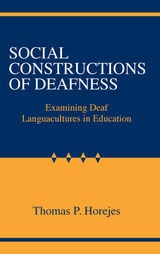
Social Constructions of Deafness
Examining Deaf Languacultures in EducationThomas P. Horejes
Gallaudet University Press, 2012
Thomas P. Horejes’s new book focuses on revealing critical knowledge that addresses certain social justice issues, including deafness, language, culture, and deaf education. He conveys this information through discourses about his own experiences being deaf and through his research in which he “stresses the contingency of the social” in educational institutions.
In Social Constructions of Deafness: Examining Deaf Languacultures in Education, Horejes contends that schools as social institutions play powerful and exacting roles in the creation and maintenance of social constructions such as language and culture for deaf children. He subscribes to Michael Agar’s concept of “languaculture,” defined as the inextricable relationship between language and culture in which a specific language will shape and influence culture. His approach employs other anthropological terminology as he connects his personal experience as a deaf student (emic) to academic research on deafness (etic) to bring understanding to the multidimensional aspects of his own negotiated identities.
Horejes extends his inquiry through his analysis of two kindergarten classes for deaf students, one orally oriented and the other conducted using sing language. His findings are sobering evidence of the myriad challenges educators face in defining appropriate academic, linguistic, and cultural pedagogy for deaf children in schools and other social institutions.

Social Science as Civic Discourse
Essays on the Invention, Legitimation, and Uses of Social TheoryRichard Harvey Brown
University of Chicago Press, 1989
Sociolinguistic Variation
Data, Theory, and AnalysisEdited by Jennifer Arnold, Renee Blake, and Brad Davidson
CSLI, 1996
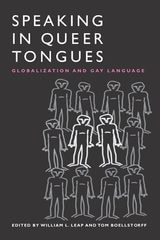
Speaking in Queer Tongues
GLOBALIZATION AND GAY LANGUAGEEdited by William L. Leap and Tom Boellstorff
University of Illinois Press, 2003
Western constructions of gay culture are now circulating widely beyond the boundaries of Western nations due to influences as diverse as Internet communication, global dissemination of entertainment and other media, increased travel and tourism, migration, displacement, and transnational citizenship. The authority claimed by these constructions, and by the linguistic codes embedded in them, is causing them to have a profound impact on public and private expressions of homosexuality in locations as diverse as sub-Saharan Africa, New Zealand, Indonesia and Israel.
Examining a wide range of global cultures, Speaking in Queer Tongues presents essays on topics that include old versus new sexual vocabularies, the rhetoric of gay-oriented magazines and news media, verbal and nonverbalized sexual imagery in poetry and popular culture, and the linguistic consequences of the globalized gay rights movement.

Spurs
Nietzsche's Styles/Eperons: Les Styles de NietzscheJacques Derrida
University of Chicago Press, 1981
Spurs, then, is aptly titled, for Derrida's "deconstructions" of Nietzsche's meanings will surely act as spurs to further thought and controversy. This dual-language edition offers the English-speaking reader who has some knowledge of French an opportunity to examine the stylistic virtuosity of Derrida's writing—of particular significance for his analysis of "the question of style."
Statement and Referent
An Inquiry into the Foundations of our Conceptual OrderDavid Shwayder
CSLI, 2008
Plato’s Parmenides and Aristotle’s Metaphysics initiated the discussion of the “First Philosophy” in the Western canon. Here, David Shwayder continues this debate by considering statements as the fundamental bearers of truth-values. Systematically moving from action to utterance, Shwayder argues that the category of “bodies” is fundamental to the human scheme of conceptualization and that if we had no capacity to refer to bodies then we would be unable to address referents from other categories.

States of Terror
History, Theory, LiteratureDavid Simpson
University of Chicago Press, 2019
Introducing the concept of the “fear-terror cluster,” Simpson is able to capture the wide range of terms that we have used to express extreme emotional states over the centuries—from anxiety, awe, and concern to dread, fear, and horror. He shows that the choices we make among such words to describe shades of feeling have seriously shaped the attribution of motives, causes, and effects of the word “terror” today, particularly when violence is deployed by or against the state. At a time when terror-talk is widely and damagingly exploited by politicians and the media, this book unpacks the slippery rhetoric of terror and will prove a vital resource across humanistic and social sciences disciplines.

Studies in General Linguistics and Language Structure
N.S. Trubetzkoy
Duke University Press, 2001
Translated by Marvin Taylor and Anatoly Liberman
N. S. Trubetzkoy (1890–1939) is generally celebrated today as the creator of the science of phonology. While his monumental Grundzüge der Phonologie was published posthumously and contains a summary of Trubetzkoy’s late views on the linguistic function of speech sounds, there has, until now, been no practical way to trace the development of his thought or to clarify the conclusions appearing in that later work. With the publication of Studies in General Linguistics and Language Structure, not only will linguists have that opportunity, but a collection of Trubetzkoy’s work will appear in English for the first time.
Translated from the French, German, and Russian originals, these articles and letters present Trubetzkoy’s work in general and on Indo-European linguistics. The correspondence reprinted here, also for the first time in English, is between Trubetzkoy and Roman Jakobson. The resulting collection offers a view of the evolution of Trubetzkoy’s ideas on phonology, the logic in laws of linguistic geography and relative chronology, and the breadth of his involvement with Caucasian phonology and the Finno-Ugric languages.
A valuable resource, this volume will make Trubetzkoy’s work available to a larger audience as it sheds light on problems that remain at the center of contemporary linguistics.

Studies in Language and Information
John Perry
CSLI, 2019