Results by title
154 books match the query 'Lesbian Studies' and 13 start with s

Safe Space
Gay Neighborhood History and the Politics of ViolenceChristina B. Hanhardt
Duke University Press, 2013
Since the 1970s, a key goal of lesbian and gay activists has been protection against street violence, especially in gay neighborhoods. During the same time, policymakers and private developers declared the containment of urban violence to be a top priority. In this important book, Christina B. Hanhardt examines how LGBT calls for "safe space" have been shaped by broader public safety initiatives that have sought solutions in policing and privatization and have had devastating effects along race and class lines.
Drawing on extensive archival and ethnographic research in New York City and San Francisco, Hanhardt traces the entwined histories of LGBT activism, urban development, and U.S. policy in relation to poverty and crime over the past fifty years. She highlights the formation of a mainstream LGBT movement, as well as the very different trajectories followed by radical LGBT and queer grassroots organizations. Placing LGBT activism in the context of shifting liberal and neoliberal policies, Safe Space is a groundbreaking exploration of the contradictory legacies of the LGBT struggle for safety in the city.
Sapphic Slashers
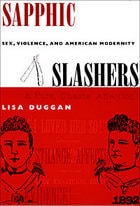
Sex, Violence, and American ModernityLisa Duggan
Duke University Press, 2000
Situating this story alongside simultaneously circulating lynching narratives (and its resistant versions, such as those of Memphis antilynching activist Ida B. Wells) Duggan reveals how stories of sex and violence were crucial to the development of American modernity. While careful to point out the differences between the public reigns of terror that led to many lynchings and the rarer instances of the murder of one woman by another privately motivated woman, Duggan asserts that dominant versions of both sets of stories contributed to the marginalization of African Americans and women while solidifying a distinctly white, male, heterosexual form of American citizenship. Having explored the role of turn-of-the-century print media—and in particular their tendency toward sensationalism—Duggan moves next to a review of sexology literature and to novels, most notably Radclyffe Hall’s The Well of Loneliness. Sapphic Slashers concludes with two appendices, one of which presents a detailed summary of Ward’s murder, the trial, and Mitchell’s eventual institutionalization. The other presents transcriptions of letters exchanged between the two women prior to the crime.
Combining cultural history, feminist and queer theory, narrative analysis, and compelling storytelling, Sapphic Slashers provides the first history of the emergence of the lesbian in twentieth-century mass culture.

Scenes from la Cuenca de Los Angeles y otros Natural Disasters
Susana Chávez-Silverman
University of Wisconsin Press, 2010

Sex Talks to Girls
A MemoirMaureen Seaton
University of Wisconsin Press, 2008
Sisters in the Life
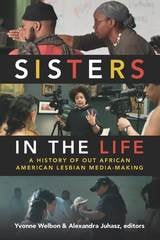
A History of Out African American Lesbian Media-MakingYvonne Welbon and Alexandra Juhasz, editors
Duke University Press, 2018
Contributors. Jennifer DeVere Brody, Jennifer DeClue, Raul Ferrera-Balanquet, Alexis Pauline Gumbs, Thomas Allen Harris, Devorah Heitner, Pamela L. Jennings, Alexandra Juhasz, Kara Keeling, Candace Moore, Marlon Moore, Michelle Parkerson, Roya Rastegar, L. H. Stallings, Yvonne Welbon, Patricia White, Karin D. Wimbley
Songs in Black and Lavender
Race, Sexual Politics, and Women's MusicEileen M. Hayes, Foreword by Linda Tillery
University of Illinois Press, 2010
Sounding Like a No-No
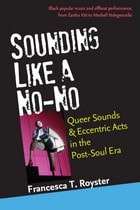
Queer Sounds and Eccentric Acts in the Post-Soul EraFrancesca T. Royster
University of Michigan Press, 2012
Sounding Like a No-No traces a rebellious spirit in post–civil rights black music by focusing on a range of offbeat, eccentric, queer, or slippery performances by leading musicians influenced by the cultural changes brought about by the civil rights, black nationalist, feminist, and LGBTQ movements, who through reinvention created a repertoire of performances that have left a lasting mark on popular music. The book's innovative readings of performers including Michael Jackson, Grace Jones, Stevie Wonder, Eartha Kitt, and Meshell Ndegeocello demonstrate how embodied sound and performance became a means for creativity, transgression, and social critique, a way to reclaim imaginative and corporeal freedom from the social death of slavery and its legacy of racism, to engender new sexualities and desires, to escape the sometimes constrictive codes of respectability and uplift from within the black community, and to make space for new futures for their listeners. The book's perspective on music as a form of black corporeality and identity, creativity, and political engagement will appeal to those in African American studies, popular music studies, queer theory, and black performance studies; general readers will welcome its engaging, accessible, and sometimes playful writing style, including elements of memoir.

Sounding Like a No-No
Queer Sounds and Eccentric Acts in the Post-Soul EraFrancesca T. Royster
University of Michigan Press, 2013
Sounding Like a No-No traces a rebellious spirit in post–civil rights black music by focusing on a range of offbeat, eccentric, queer, or slippery performances by leading musicians influenced by the cultural changes brought about by the civil rights, black nationalist, feminist, and LGBTQ movements, who through reinvention created a repertoire of performances that have left a lasting mark on popular music. The book's innovative readings of performers including Michael Jackson, Grace Jones, Stevie Wonder, Eartha Kitt, and Meshell Ndegeocello demonstrate how embodied sound and performance became a means for creativity, transgression, and social critique, a way to reclaim imaginative and corporeal freedom from the social death of slavery and its legacy of racism, to engender new sexualities and desires, to escape the sometimes constrictive codes of respectability and uplift from within the black community, and to make space for new futures for their listeners. The book's perspective on music as a form of black corporeality and identity, creativity, and political engagement will appeal to those in African American studies, popular music studies, queer theory, and black performance studies; general readers will welcome its engaging, accessible, and sometimes playful writing style, including elements of memoir.
Split Britches
Fifty Years OnPeggy Shaw and Lois Weaver, Edited by Benjamin Gillespie
University of Michigan Press, 2027
What does it mean to sustain a creative life over fifty years? Split Britches: Fifty Years On offers an intimate look at the enduring collaboration of Peggy Shaw and Lois Weaver, the artists behind the groundbreaking performance troupe Split Britches. The collection highlights Split Britches’ enduring queer and feminist legacies, tracing how their distinctive butch/femme lesbian aesthetic and collaborative performance practice have evolved over five decades and nearly thirty original productions. It foregrounds their shift toward increasingly autobiographical and introspective work, while also situating their later performances within key theatrical, historical, and critical frameworks–paying particular attention to issues of embodiment, aging, the archive, and queer temporality. Bringing together performance scripts, candid interviews, production photos, accessible essays, and video documentation, Split Britches: Fifty Years On demonstrates how Shaw and Weaver pull from the past in order to critique the present. For scholars, artists, and students, the volume's unique combination of primary texts, critical essays, and multimedia resources makes it an essential volume that considers theatre scholarship and practice, queer and feminist discourses, and the evolution of creativity with age and time.
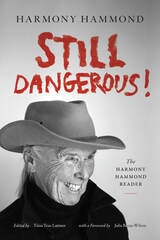
Still Dangerous!
The Harmony Hammond ReaderHarmony Hammond. Edited by Tirza True Latimer.
Duke University Press, 2026
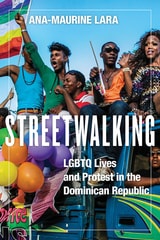
Streetwalking
LGBTQ Lives and Protest in the Dominican RepublicAna-Maurine Lara
Rutgers University Press, 2021
Streetwalking: LGBTQ Lives and Protest in the Dominican Republic is an exploration of the ways that lesbian, gay, bisexual, trans and queer persons exercise power in a Catholic Hispanic heteropatriarchal nation-state, namely the Dominican Republic. Lara presents the specific strategies employed by LGBTQ community leaders in the Dominican Republic in their struggle for subjectivity, recognition, and rights. Drawing on ethnographic encounters, film and video, and interviews, LGBTQ community leaders teach readers about streetwalking, confrontación, flipping the script, cuentos, and the use of strategic universalisms in the exercise of power and agency. Rooted in Maria Lugones's theorization of streetwalker strategies and Audre Lorde's theorization of silence and action, this text re-imagines the exercise and locus of power in examples provided by the living, thriving LGBTQ community of the Dominican Republic.
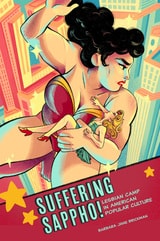
Suffering Sappho!
Lesbian Camp in American Popular CultureBarbara Jane Brickman
Rutgers University Press, 2024
Offering the first major consideration of lesbian camp in American popular culture, Suffering Sappho! traces a larger-than-life lesbian menace across midcentury media forms to propose five prototypical queer icons—the sicko, the monster, the spinster, the Amazon, and the rebel. On the pages of comics and sensational pulp fiction and the dramas of television and drive-in movies, Barbara Jane Brickman discovers evidence not just of campy sexual deviants but of troubling female performers, whose failures could be epic but whose subversive potential could inspire.
Supplemental images of interest related to this title: George and Lomas; Connie Minerva; Cat On Hot Tin; and Beulah and Oriole.


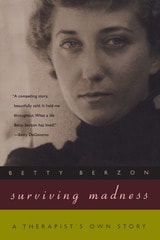
Surviving Madness
A Therapist's Own StoryBetty Berzon
University of Wisconsin Press, 2002
Betty Berzon, renowned psychotherapist and author of the bestselling book Permanent Partners, tells her own incredible story here. Berzon’s journey from psychiatric patient on suicide watch—her wrists tethered to the bed rails in a locked hospital ward—to her present role as a groundbreaking therapist and gay pioneer makes for purely compelling reading.
Berzon is recognized today as a trailblazing co-founder of a number of important lesbian and gay organizations and one of the first therapists to focus on means of developing healthy gay relationships and overcoming homophobia. Her sometimes bumpy road to success never fails to fascinate. Along the way she encounters such luminaries as Anaïs Nin, Eleanor Roosevelt, the Sitwells, Evelyn Hooker, and Paul Monette. Her recollections here provide a collective portrait of her fellow pioneers and a stirring lesson in twentieth-century history.
It is, however, the intimate story of Berzon’s own private passage toward self-discovery—from mental breakdown and suicide attempts, through hospitalization, eventual triumphant recovery, and her own coming out as an open lesbian at the age of forty—that makes this memoir an urgent, insightful, and deeply emotional testament to human survival.