151 books match the query 'Liberalism' and 3 start with s

cover of Selling Free Enterprise: The Business Assault on Labor and Liberalism, 1945-60

Selling Free Enterprise

The Business Assault on Labor and Liberalism, 1945-60

Elizabeth A. Fones-Wolf

University of Illinois Press, 1994

The post-World War II years in the United States were marked by the business community's efforts to discredit New Deal liberalism and undermine the power and legitimacy of organized labor. In Selling Free Enterprise, Elizabeth Fones-Wolf describes how conservative business leaders strove to reorient workers away from their loyalties to organized labor and government, teaching that prosperity could be achieved through reliance on individual initiative, increased productivity, and the protection of personal liberty. 

Based on research in a wide variety of business and labor sources, this detailed account shows how business permeated every aspect of American life, including factories, schools, churches, and community institutions.
[more]
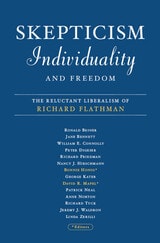
cover of Skepticism, Individuality, and Freedom: The Reluctant Liberalism Of Richard Flathman

Skepticism, Individuality, and Freedom

The Reluctant Liberalism Of Richard Flathman

Bonnie Honig

University of Minnesota Press, 2002

Major thinkers grapple with the challenge of this renowned liberal thinker.

As one of liberal theory’s most important gadflies, Richard Flathman has during the past four decades produced a significant body of work that is iconoclastic, idiosyncratic, and increasingly influential. Flathman criticizes liberal theory’s role in justifying a politics of governance that has drifted substantially from liberalism’s central commitments to individuality and freedom. It is this challenge, and its implications for the future of liberal theory, that brings together the diverse and distinguished authors of this volume. Topics include the relationships between theory and practice, skepticism and knowledge, individuality and egoism, negative and positive freedom, Hobbes and liberalism, as well as the uneasy connections among liberalism, feminism, and democratic politics.

Contributors: Ronald Beiner, U of Toronto; Jane Bennett, Goucher; William E. Connolly, Johns Hopkins; Peter Digeser, U of California, Santa Barbara; Richard Friedman, SUNY, Buffalo; Nancy J. Hirschmann, Cornell; George Kateb, Princeton; Patrick Neal, U of Vermont; Anne Norton, U of Pennsylvania; Richard Tuck, Harvard; Jeremy J. Waldron, Columbia; Linda Zerilli, Northwestern.

[more]
cover of Social Science for What?: Philanthropy and the Social Question in a World Turned Rightside Up

Social Science for What?

Philanthropy and the Social Question in a World Turned Rightside Up

Alice O'Connor

Russell Sage Foundation, 2007

Much like today, the early twentieth century was a period of rising economic inequality and political polarization in America. But it was also an era of progressive reform—a time when the Russell Sage Foundation and other philanthropic organizations were established to promote social science as a way to solve the crises of industrial capitalism. In Social Science for What? Alice O'Connor relates the history of philanthropic social science, exploring its successes and challenges over the years, and asking how these foundations might continue to promote progressive social change in our own politically divided era. The philanthropic foundations established in the early 1900s focused on research which, while intended to be objective, was also politically engaged. In addition to funding social science research, in its early years the Russell Sage Foundation also supported social work and advocated reforms on issues from child welfare to predatory lending. This reformist agenda shaped the foundation's research priorities and methods. The Foundation's landmark Pittsburgh Survey of wage labor, conducted in 1907-1908, involved not only social scientists but leaders of charities, social workers, and progressive activists, and was designed not simply to answer empirical questions, but to reframe the public discourse about industrial labor. After World War II, many philanthropic foundations disengaged from political struggles and shifted their funding toward more value-neutral, academic social inquiry, in the belief that disinterested research would yield more effective public policies. Consequently, these foundations were caught off guard in the 1970s and 1980s by the emergence of a network of right-wing foundations, which was successful in promoting an openly ideological agenda. In order to counter the political in-roads made by conservative organizations, O'Connor argues that progressive philanthropic research foundations should look to the example of their founders. While continuing to support the social science research that has contributed so much to American society over the past 100 years, they should be more direct about the values that motivate their research.  In this way, they will help foster a more democratic dialogue on important social issues by using empirical knowledge to engage fundamentally ethical concerns about rising inequality. O'Connor's message is timely: public-interest social science faces unprecedented challenges in this era of cultural warfare, as both liberalism and science itself have come under assault. Social Science for What? is a thought-provoking critique of the role of social science in improving society and an indispensable guide to how progressives can reassert their voice in the national political debate. A Volume in the Russell Sage Foundation's Centennial Series
[more]