Results by title
101 books match the query 'Liberty' and 3 start with s
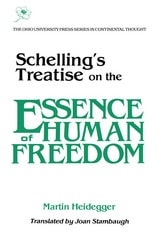
Schelling’s Treatise on the Essence of Human Freedom
On Essence Human FreedomMartin Heidegger
Ohio University Press, 1985
Heidegger’s lectures delivered at the University of Freiburg in 1936 on Schelling’s Treatise On Human Freedom came at a crucial turning point in Heidegger’s development. He had just begun his study to work out the term “Ereignis.” Heidegger’s interpretation of Schelling’s work reveals a dimension of his thinking which has never been previously published in English.
While Schelling’s philosophy is less known than that of the other major German Idealists, Fichte and Hegel, he is one of the thinker with whom Heidegger has the most affinity, making this study fruitful for an understanding of both philosophers. Heidegger’s interpretation of On Human Freedom is the most straightforward of the studies to have appeared in English on the Treatise, and is the only work that is devoted to Schelling in Heidegger’s corpus. The basic problems at stake in Schelling’s Treatise lie at the very heart of the idealist tradition: the question of the compatibility of the system and individual freedom, the questions of pantheism and the justification of evil. Schelling was the first thinker in the rationalist-idealist tradition to grapple seriously with the problem of evil.
These are the great questions of the philosophical tradition. They lead Schelling and, with him, Heidegger, to possibilities that come very close to the boundaries of the idealist tradition. For example, Schelling’s concept of the “groundless”—what reason can no longer ground and explain—points back to Jacob Boehme and indirectly forward to the direction of Heidegger’s own inquiry into “Being.” Heidegger’s reading of Schelling, especially of the topics of evil and freedom, clearly shows Schelling’s influence on Heidegger’s views.
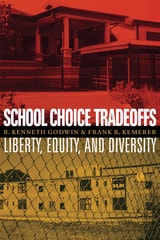
School Choice Tradeoffs
Liberty, Equity, and DiversityBy R. Kenneth Godwin and Frank R. Kemerer
University of Texas Press, 2002
Educational policy in a democracy goes beyond teaching literacy and numeracy. It also supports teaching moral reasoning, political tolerance, respect for diversity, and citizenship. Education policy should encourage liberty and equality of opportunity, hold educational institutions accountable, and be efficient. School Choice Tradeoffs examines the tradeoffs among these goals when government affords parents the means to select the schools their children attend.
Godwin and Kemerer compare current policy that uses family residence to assign students to schools with alternative policies that range from expanding public choice options to school vouchers. They identify the benefits and costs of each policy approach through a review of past empirical literature, the presentation of new empirical work, and legal and philosophic analysis.
The authors offer a balanced perspective that goes beyond rhetoric and ideology to offer policymakers and the public insight into the complex tradeoffs that are inherent in the design and implementation of school choice policies. While all policies create winners and losers, the key questions concern who these individuals are and how much they gain or lose. By placing school choice within a broader context, this book will stimulate reflective thought in all readers.
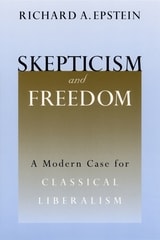
Skepticism and Freedom
A Modern Case for Classical LiberalismRichard A. Epstein
University of Chicago Press, 2003
He begins by laying out his own vision of the key principles of classical liberalism: respect for the autonomy of the individual, a strong system of private property rights, the voluntary exchange of labor and possessions, and prohibitions against force or fraud. Nonetheless, he not only recognizes but insists that state coercion is crucial to safeguarding these principles of private ordering and supplying the social infrastructure on which they depend. Within this framework, Epstein then shows why limited government is much to be preferred over the modern interventionist welfare state.
Many of the modern attacks on the classical liberal system seek to undermine the moral, conceptual, cognitive, and psychological foundations on which it rests. Epstein rises to this challenge by carefully rebutting each of these objections in turn. For instance, Epstein demonstrates how our inability to judge the preferences of others means we should respect their liberty of choice regarding their own lives. And he points out the flaws in behavioral economic arguments which, overlooking strong evolutionary pressures, claim that individual preferences are unstable and that people are unable to adopt rational means to achieve their own ends. Freedom, Epstein ultimately shows, depends upon a skepticism that rightly shuns making judgments about what is best for individuals, but that also avoids the relativistic trap that all judgments about our political institutions have equal worth.
A brilliant defense of classical liberalism, Skepticism and Freedom will rightly be seen as an intellectual landmark.