Results by title
78 books match the query 'Light' and 3 start with s
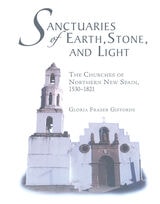
Sanctuaries of Earth, Stone, and Light
The Churches of Northern New Spain, 1530-1821Gloria Fraser Giffords
University of Arizona Press, 2007
Over nearly three centuries, Jesuit, Franciscan, and Dominican missionaries built a network of churches throughout the “new world” of New Spain. Since the early twentieth century, scholars have studied the colonial architecture of southern New Spain, but they have largely ignored the architecture of the north. However, as this book clearly demonstrates, the colonial architecture of Northern New Spain—an area that encompasses most of the southwestern United States and much of northern Mexico—is strikingly beautiful and rich with meaning. After more than two decades of research, both in the field and in archives around the world, Gloria Fraser Giffords has authored the definitive book on this architecture.
Giffords has a remarkable eye for detail and for images both grand and diminutive. Because so many of the buildings she examines have been destroyed, she sleuthed through historical records in several countries, and she discovered that the architecture and material culture of northern New Spain reveal the influences of five continents. As she examines objects as large as churches or as small as ornamental ceramic tile she illuminates the sometimes subtle, sometimes striking influences of the religious, social, and artistic traditions of Europe (from the beginning of the Christian era through the nineteenth century), of the Muslim countries ringing the Mediterranean (from the seventh through the fifteenth centuries), and of Northern New Spain’s indigenous peoples (whose art influenced the designs of occupying Europeans).
Sanctuaries of Earth, Stone, and Light is a pathbreaking book, featuring 200 stunning photographs and over 300 illustrations ranging from ceremonial garments to detailed floor plans of the churches.
[more]
Seeing the Light
The Social Logic of Personal DiscoveryThomas DeGloma
University of Chicago Press, 2014
The chorus of the Christian hymn “Amazing Grace” reads, “I once was lost, but now am found, / Was blind but now I see.” Composed by a minister who formerly worked as a slave trader, the song expresses his experience of divine intervention that ultimately caused him to see the error of his ways. This theme of personal awakening is a feature of countless stories throughout history, where the “lost” and the “blind” are saved from darkness and despair by suddenly seeing the light.
In Seeing the Light, Thomas DeGloma explores such accounts of personal awakening, in stories that range from the discovery of a religious truth to remembering a childhood trauma to embracing a new sexual orientation. He reveals a common social pattern: When people discover a life-changing truth, they typically ally with a new community. Individuals then use these autobiographical stories to shape their stances on highly controversial issues such as childhood abuse, war and patriotism, political ideology, human sexuality, and religion. Thus, while such stories are seemingly very personal, they also have a distinctly social nature. Tracing a wide variety of narratives through nearly three thousand years of history, Seeing the Light uncovers the common threads of such stories and reveals the crucial, little-recognized social logic of personal discovery.
In Seeing the Light, Thomas DeGloma explores such accounts of personal awakening, in stories that range from the discovery of a religious truth to remembering a childhood trauma to embracing a new sexual orientation. He reveals a common social pattern: When people discover a life-changing truth, they typically ally with a new community. Individuals then use these autobiographical stories to shape their stances on highly controversial issues such as childhood abuse, war and patriotism, political ideology, human sexuality, and religion. Thus, while such stories are seemingly very personal, they also have a distinctly social nature. Tracing a wide variety of narratives through nearly three thousand years of history, Seeing the Light uncovers the common threads of such stories and reveals the crucial, little-recognized social logic of personal discovery.
[more]
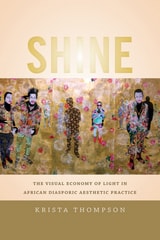
Shine
The Visual Economy of Light in African Diasporic Aesthetic PracticeKrista Thompson
Duke University Press, 2015
In Jamaican dancehalls competition for the video camera's light is stiff, so much so that dancers sometimes bleach their skin to enhance their visibility. In the Bahamas, tuxedoed students roll into prom in tricked-out sedans, staging grand red-carpet entrances that are designed to ensure they are seen being photographed. Throughout the United States and Jamaica friends pose in front of hand-painted backgrounds of Tupac, flashy cars, or brand-name products popularized in hip-hop culture in countless makeshift roadside photography studios. And visual artists such as Kehinde Wiley remix the aesthetic of Western artists with hip-hop culture in their portraiture. In Shine, Krista Thompson examines these and other photographic practices in the Caribbean and United States, arguing that performing for the camera is more important than the final image itself. For the members of these African diasporic communities, seeking out the camera's light—whether from a cell phone, Polaroid, or video camera—provides a means with which to represent themselves in the public sphere. The resulting images, Thompson argues, become their own forms of memory, modernity, value, and social status that allow for cultural formation within and between African diasporic communities.
[more]