Results by title
50 books match the query 'Literature, Medieval' and 3 start with s
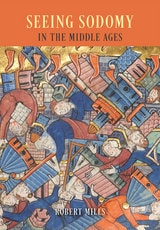
Seeing Sodomy in the Middle Ages
Robert Mills
University of Chicago Press, 2015
In Seeing Sodomy in the Middle Ages, Robert Mills explores the relationship between sodomy and motifs of vision and visibility in medieval culture, on the one hand, and those categories we today call gender and sexuality, on the other. Challenging the view that ideas about sexual and gender dissidence were too confused to congeal into a coherent form in the Middle Ages, Mills demonstrates that sodomy had a rich, multimedia presence in the period—and that a flexible approach to questions of terminology sheds new light on the many forms this presence took. Among the topics that Mills covers are depictions of the practices of sodomites in illuminated Bibles; motifs of gender transformation and sex change as envisioned by medieval artists and commentators on Ovid; sexual relations in religious houses and other enclosed spaces; and the applicability of modern categories such as “transgender,” “butch” and “femme,” or “sexual orientation” to medieval culture.
Taking in a multitude of images, texts, and methodologies, this book will be of interest to all scholars, regardless of discipline, who engage with gender and sexuality in their work.
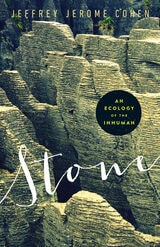
Stone
An Ecology of the InhumanJeffrey Jerome Cohen
University of Minnesota Press, 2015
Stone maps the force, vivacity, and stories within our most mundane matter, stone. For too long stone has served as an unexamined metaphor for the “really real”: blunt factuality, nature’s curt rebuke. Yet, medieval writers knew that stones drop with fire from the sky, emerge through the subterranean lovemaking of the elements, tumble along riverbeds from Eden, partner with the masons who build worlds with them. Such motion suggests an ecological enmeshment and an almost creaturely mineral life.
Although geological time can leave us reeling, Jeffrey Jerome Cohen argues that stone’s endurance is also an invitation to apprehend the world in other than human terms. Never truly inert, stone poses a profound challenge to modernity’s disenchantments. Its agency undermines the human desire to be separate from the environment, a bifurcation that renders nature “out there,” a mere resource for recreation, consumption, and exploitation.
Written with great verve and elegance, this pioneering work is notable not only for interweaving the medieval and the modern but also as a major contribution to ecotheory. Comprising chapters organized by concept —“Geophilia,” “Time,” “Force,” and “Soul”—Cohen seamlessly brings together a wide range of topics including stone’s potential to transport humans into nonanthropocentric scales of place and time, the “petrification” of certain cultures, the messages fossils bear, the architecture of Bordeaux and Montparnasse, Yucca Mountain and nuclear waste disposal, the ability of stone to communicate across millennia in structures like Stonehenge, and debates over whether stones reproduce and have souls.
Showing that what is often assumed to be the most lifeless of substances is, in its own time, restless and forever in motion, Stone fittingly concludes by taking us to Iceland⎯a land that, writes the author, “reminds us that stone like water is alive, that stone like water is transient.”
Strong Voices, Weak History
Early Women Writers and Canons in England, France, and ItalyPamela J Benson and Victoria Kirkham, Editors
University of Michigan Press, 2005