Results by title
328 books match the query 'Literature and society' and 26 start with s
Satire or Evasion?
Black Perspectives on Huckleberry FinnJames S. Leonard, Thomas A. Tenney and Thadious M. Davis, eds.
Duke University Press, 1992
Ranging from the laudatory to the openly hostile, these essays include personal impressions of Huckleberry Finn, descriptions of classroom experience with the book, evaluations of its ironic and allegorical aspects, explorations of its nineteenth-century context, and appraisal of its effects on twentieth-century African American writers. Among the issues the authors contend with are Twain’s pervasive use of the word “nigger,” his portrayal of the slave Jim according to the conventions of the minstrel show “darky,” and the thematic chaos created by the “evasion” depicted in the novel’s final chapters.
Sure to provoke thought and stir debate, Satire or Evasion? provides a variety of new perspectives on one of this country’s most troubling classics.
Contributors. Richard K. Barksdale, Bernard W. Bell, Mary Kemp Davis, Peaches M. Henry, Betty Harris Jones, Rhett S. Jones, Julius Lester, Donnarae MacCann, Charles H. Nichols, Charles H. Nilon, Arnold Rampersad, David L. Smith, Carmen Dubryan, John H. Wallace, Kenny Jackson Williams, Fredrick Woodard
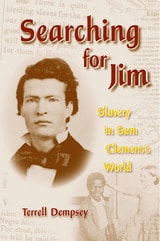
Searching for Jim
Slavery in Sam Clemens's WorldTerrell Dempsey
University of Missouri Press, 2005
During Sam’s earliest years, his father, John Marshall Clemens, had significant interaction with slaves. Newly discovered court records show the senior Clemens in his role as justice of the peace in Hannibal enforcing the slave ordinances. With the death of his father, young Sam was apprenticed to learn the printing and newspaper trade. It was in the newspaper that slaves were bought and sold, masters sought runaways, and life insurance was sold on slaves. Stories the young apprentice typeset helped Clemens learn to write in black dialect, a skill he would use throughout his writing, most notably in Huckleberry Finn.
Missourians at that time feared abolitionists across the border in Illinois and Iowa. Slave owners suspected every traveling salesman, itinerant preacher, or immigrant of being an abolition agent sent to steal slaves. This was the world in which Sam Clemens grew up. Dempsey also discusses the stories of Hannibal’s slaves: their treatment, condition, and escapes. He uncovers new information about the Underground Railroad, particularly about the role free blacks played in northeast Missouri.
Carefully reconstructed from letters, newspaper articles, sermons, speeches, books, and court records, Searching for Jim offers a new perspective on Clemens’s writings, especially regarding his use of race in the portrayal of individual characters, their attitudes, and worldviews. This fascinating volume will be valuable to anyone trying to measure the extent to which Clemens transcended the slave culture he lived in during his formative years and the struggles he later faced in dealing with race and guilt. It will forever alter the way we view Sam Clemens, Hannibal, and Mark Twain.
Separate Spheres No More
Gender Convergence in American Literature, 1830-1930Monika Elbert
University of Alabama Press, 2000
Examines the intersection of male and female spheres in American literature
Although they wrote in the same historical milieu as their male counterparts, women writers of the 19th- and early 20th-centuries have generally been "ghettoized" by critics into a separate canonical sphere. These original essays argue in favor of reconciling male and female writers, both historically and in the context of classroom teaching.
While some of the essays pair up female and male authors who write in a similar style or with similar concerns, others address social issues shared by both men and women, including class tensions, economic problems, and the Civil War experience. Rather than privileging particular genres or certain well-known writers, the contributors examine writings ranging from novels and poetry to autobiography, utopian fiction, and essays. And they consider familiar figures like Harriet Beecher Stowe, Emily Dickinson, and Ralph Waldo Emerson alongside such lesser-known writers as Melusina Fay Peirce, Susie King Taylor, and Mary Gove Nichols.
Each essay revises the binary notions that have been ascribed to males and females, such as public and private, rational and intuitive, political and domestic, violent and passive. Although they do not deny the existence of separate spheres, the contributors show the boundary between them to be much more blurred than has been assumed until now.
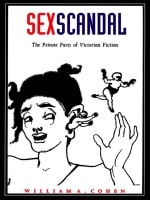
Sex Scandal
The Private Parts of Victorian FictionWilliam A. Cohen
Duke University Press, 1996
Scandal, then as now, makes public the secret indiscretions of prominent people, engrossing its audience in salacious details that violate the very code of propriety it aims to enforce. In narratives ranging from Great Expectations to the Boulton and Park sodomy scandal of 1870–71, from Eliot’s and Trollope’s novels about scandalous women to Oscar Wilde’s writing and his trials for homosexuality, Cohen shows how, in each instance, sexuality appears couched in coded terms. He identifies an assortment of cunning narrative techniques used to insinuate sex into Victorian writing, demonstrating that even as such narratives air the scandalous subject, they emphasize its unspeakable nature.
Written with an eye toward the sex scandals that still whet the appetites of consumers of news and novels, this work is suggestive about our own modes of imagining sexuality today and how we arrived at them. Sex Scandal will appeal to scholars and general readers interested in Victorian literature, the history of sexuality, gender studies, nineteenth-century Britain, and gay, lesbian, and queer studies.
Sexual Textualities
Essays on Queer/ing Latin American WritingBy David William Foster
University of Texas Press, 1997
Since the 1991 publication of his groundbreaking book Gay and Lesbian Themes in Latin American Writing, David William Foster has proposed a series of theoretical and critical principles for the analysis of Latin American culture from the perspectives of the queer. This book continues that project with a queer reading of literary and cultural aspects of Latin American texts.
Moving beyond its predecessor, which provided an initial inventory of Latin American gay and lesbian writing, Sexual Textualities analyzes questions of gender representation in Latin American cultural productions to establish the interrelationships, tensions, and irresolvable conflicts between heterosexism and homoeroticism. The topics that Foster addresses include Eva Peron as a cultural/sexual icon, feminine pornography, Luis Humberto Hermosillo's classic gay film Doña Herlinda y su hijo, homoerotic writing and Chicano authors, Matias Montes Huidobro's Exilio and the representation of gay identity, representation of the body in Alejandra Pizarnik's poetry, and the crisis of masculinity in Argentine fiction from 1940 to 1960.
Shakespeare from the Margins
Language, Culture, ContextPatricia Parker
University of Chicago Press, 1996
Combining feminist and historical approaches with attention to the "matter" of language as well as of race and gender, Parker's brilliant "edification from the margins" illuminates much that has been overlooked, both in Shakespeare and in early modern culture. This book, a reexamination of popular and less familiar texts, will be indispensable to all students of Shakespeare and the early modern period.
Shipwreck Modernity
Ecologies of Globalization, 1550–1719Steve Mentz
University of Minnesota Press, 2015
Shipwreck Modernity engages early modern representations of maritime disaster in order to describe the global experience of ecological crisis. In the wet chaos of catastrophe, sailors sought temporary security as their worlds were turned upside down. Similarly, writers, poets, and other thinkers searched for stability amid the cultural shifts that resulted from global expansion. The ancient master plot of shipwreck provided a literary language for their dislocation and uncertainty.
Steve Mentz identifies three paradigms that expose the cultural meanings of shipwreck in historical and imaginative texts from the mid-sixteenth through the early eighteenth centuries: wet globalization, blue ecology, and shipwreck modernity. The years during which the English nation and its emerging colonies began to define themselves through oceangoing expansion were also a time when maritime disaster occupied sailors, poets, playwrights, sermon makers, and many others. Through coming to terms with shipwreck, these figures adapted to disruptive change.
Traces of shipwreck ecology appear in canonical literature from Shakespeare to Donne to Defoe and also in sermons, tales of survival, amateur poetry, and the diaries of seventeenth-century English sailors. The isolated islands of Bermuda and the perils of divine anger hold central places. Modern sailor-poets including Herman Melville serve as valuable touchstones in the effort to parse the reality and understandings of global shipwreck.
Offering the first ecocritical account of early modern shipwreck narratives, Shipwreck Modernity reveals the surprisingly modern truths to be found in these early stories of ecological collapse.
Sightlines
Race, Gender, and Nation in Contemporary Australian TheatreHelen Gilbert
University of Michigan Press, 1998
Signifying God
Social Relation and Symbolic Act in the York Corpus Christi PlaysSarah Beckwith
University of Chicago Press, 2001
Introducing a radical new understanding of these plays as "sacramental theater," Beckwith shows how organizing the plays served as a political mechanism for regulating labor, and how theater and sacrament combined in them to do important theological work. She argues, for instance, that the theology of Corpus Christi in the resurrection plays can only be understood as a theatrical exploration of eucharistic absence and presence. Beckwith frames her study with discussions of twentieth-century manifestations of sacramental theater in Barry Unsworth's novel Morality Play and Denys Arcand's film Jesus of Montreal, and the connections between contemporary revivals of the York Corpus Christi plays and England's heritage culture.
Sin and Salvation in Early Modern France
Three Women’s StoriesMarguerite d'Auge, Renée Burlamacchi, and Jeanne du Laurens
Iter Press, 2017
The texts available here in English for the first time open a window into the lives of three early modern Frenchwomen as they explore the common themes of family, memory, sin, and salvation. The Regrets of Marguerite d’Auge (1600), the Memoirs of Renée Burlamacchi (1623), and the Genealogy of Jeanne du Laurens (1631), taken from different genres of historical writings, raise important questions: Why and how did female authorship find its way into the historical record? How did these voices escape the censorship and prejudice against female publication? In a time of extreme religious conflict, how did these women convey their views on controversial issues such as primacy of grace, indulgences, and salvation without disrupting the gender expectations of the era?
Slavery and Sentiment
The Politics of Feeling in Black Atlantic Antislavery Writing, 1770-1850Christine Levecq
University of New Hampshire Press, 2008
Levecq examines liberalism and republicanism, the main Anglo-American political ideologies of the period, in the antislavery texts of a range of African-American and Afro-British authors. Disclosing the political content hitherto unexamined in this kind of writing, she shows that while the overall story is one of increased liberalization of ideology on both sides of the Atlantic, the republican ideal persisted, particularly among black authors with transatlantic connections.
Demonstrating that such writers as Phillis Wheatley, Ignatius Sancho, Olaudah Equiano, Frederick Douglass, and Mary Prince were men and women of their times, Levecq provides valuable new insight into the ideological world of black Atlantic writers and puts them, for the first time, on modernity’s political map.
Slumming in New York
From the Waterfront to Mythic HarlemRobert M. Dowling
University of Illinois Press, 2006
Using the methods of ethnicity theory, black studies, regional studies, literary studies, and popular culture, Robert M. Dowling reveals the way in which "outsider" authors helped alleviate New York's mounting social anxieties by popularizing "insider" voices from neighborhoods as distinctive as the East Side waterfront, the Bowery, the Tenderloin's "black Bohemia," the Jewish Lower East Side, and mythic Harlem.
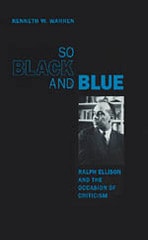
So Black and Blue
Ralph Ellison and the Occasion of CriticismKenneth W. Warren
University of Chicago Press, 2003
What would it mean to read Invisible Man as a document of Jim Crow America? Using Ralph Ellison's classic novel and many of his essays as starting points, Kenneth W. Warren illuminates the peculiar interrelation of politics, culture, and social scientific inquiry that arose during the post-Reconstruction era and persisted through the Civil Rights movement. Warren argues that Ellison's novel expresses the problem of who or what could represent and speak for the Negro in an age of limited political representation.
So Black and Blue shows that Ellison's successful transformation of these limits into possibilities has also, paradoxically, cast a shadow on the postsegregation world. What can be the direction of African American culture once the limits that have shaped it are stricken down? Here Warren takes up the recent, ongoing, and often contradictory veneration of Ellison's artistry by black writers and intellectuals to reveal the impoverished terms often used in discussions about the political and cultural future of African Americans. Ultimately, by showing what it would mean to take seriously the idea of American novels as creatures of their moment, Warren questions whether there can be anything that deserves the label of classic American literature.
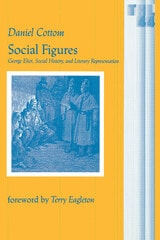
Social Figures
George Eliot, Social History, and Literary RepresentationDaniel Cottom
University of Minnesota Press, 1987
Centers on the discourse of the liberal intellectual as exemplified in the novels of George Eliot, whose awareness of her aesthetic and social task was keener than that of most Victorian writers.
“…Daniel Cottom has produced a readable, well-researched, and thoroughly referenced work that speaks to a broad scholarly audience composed of philosophers, psychologists, sociolinguists, literary critics, historians, sociologists, and anthropologists, to name but a few.” Anthropology and Humanism Quarterly
Society as Text
Essays on Rhetoric, Reason, and RealityRichard Harvey Brown
University of Chicago Press, 1987
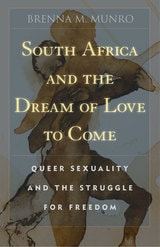
South Africa and the Dream of Love to Come
Queer Sexuality and the Struggle for FreedomBrenna M. Munro
University of Minnesota Press, 2012
After apartheid, South Africa established a celebrated new political order that imagined the postcolonial nation as belonging equally to the descendants of indigenous people, colonizing settlers, transported slaves, indentured laborers, and immigrants. Its constitution, adopted in 1996, was the first in the world to include gays and lesbians as full citizens. Brenna M. Munro examines the stories that were told about sexuality, race, and nation throughout the struggle against apartheid in order to uncover how these narratives ultimately enabled gay people to become imaginable as fellow citizens. She also traces how the gay, lesbian, or bisexual person appeared as a stock character in the pageant of nationhood during the transition to democracy. In the process, she offers an alternative cultural history of South Africa.
Munro asserts that the inclusion of gay people made South Africans feel “modern”—at least for a while. Being gay or being lesbian was reimagined in the 1990s as distinctly South African, but the “newness” that made these sexualities apt symbols for a transformed nation can also be understood as foreign and un-African. Indeed, a Western-style gay identity is often interpreted through the formula “gay equals modernity equals capitalism.” As South Africa’s reentrance into the global economy has failed to bring prosperity to the majority of its citizens, homophobic violence has been on the rise.
Employing a wide array of texts—including prison memoirs, poetry, plays, television shows, photography, political speeches, and the postapartheid writings of Nobel Laureates Nadine Gordimer and J. M. Coetzee—Munro reports on how contemporary queer activists and artists are declining to remain ambassadors for the “rainbow nation” and refusing to become scapegoats for the perceived failures of liberation and liberalism.
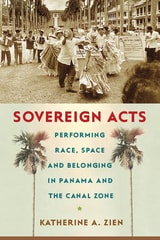
Sovereign Acts
Performing Race, Space, and Belonging in Panama and the Canal ZoneZien, Katherine A.
Rutgers University Press, 2017
Winner of the 2017 Annual Book Prize from the Canadian Association of Latin American and Caribbean Studies (CALACS)
Sovereign Acts explores how artists, activists, and audiences performed and interpreted sovereignty struggles in the Panama Canal Zone, from the Canal Zone’s inception in 1903 to its dissolution in 1999. In popular entertainments and patriotic pageants, opera concerts and national theatre, white U.S. citizens, West Indian laborers, and Panamanian artists and activists used performance as a way to assert their right to the Canal Zone and challenge the Zone’s sovereignty, laying claim to the Zone’s physical space and imagined terrain.
By demonstrating the place of performance in the U.S. Empire’s legal landscape, Katherine A. Zien transforms our understanding of U.S. imperialism and its aftermath in the Panama Canal Zone and the larger U.S.-Caribbean world.

Sovereign Fictions
Poetics and Politics in the Age of Russian RealismIlya Kliger
University of Chicago Press, 2024
The nineteenth-century novel is generally assumed to owe its basic social imaginaries to the ideologies, institutions, and practices of modern civil society. In Sovereign Fictions, Ilya Kliger asks what happens to the novel when its fundamental sociohistorical orientation is, as in the case of Russian realism, toward the state. Kliger explores Russian realism’s distinctive construals of sociality through a broad range of texts from the 1830s to the 1870s, including major works by Tolstoy, Dostoevsky, Gogol, Pushkin, Lermontov, Goncharov, and Turgenev, and several lesser-known but influential books of the period, including Alexander Druzhinin’s Polinka Saks (1847), Aleksei Pisemsky’s One Thousand Souls (1858), and Vasily Sleptsov’s Hard Times (1865). Challenging much current scholarly consensus about the social dynamics of nineteenth-century realist fiction, Sovereign Fictions offers an important intervention in socially inflected theories of the novel and in current thinking on representations of power and historical poetics.

Spanish American Poetry at the End of the Twentieth Century
Textual DisruptionsBy Jill Kuhnheim
University of Texas Press, 2005
Has poetry lost its relevance in the postmodern age, unable to keep pace with other forms of cultural production such as film, mass media, and the Internet? Quite the contrary, argues Jill Kuhnheim in this pathfinding book, which explores how recent Spanish American poetry participates in the fundamental cultural debates of its time.
Using a variety of interdisciplinary approaches, Kuhnheim engages in close readings of numerous poetic works to show how contemporary Spanish American poetry struggles with the divisions between politics and aesthetics and between visual and written images; grapples with issues of ethnic, national, sexual, and urban identities; and incorporates rather than rejects technological innovations and elements from the mass media. Her analysis illuminates the ways in which contemporary issues such as indigenismo and Latin America's postcolonial legacy, modernization, immigration, globalization, economic shifts toward neoliberalism and informal economies, urbanization, and the technological revolution have been expressed in—and even changed the very form of—Spanish American poetry since the 1970s.
Spanish American Women's Use of the Word
Colonial through Contemporary NarrativesStacey Schlau
University of Arizona Press, 2001
Spanish Women Writers and the Essay
Gender, Politics, and the SelfKathleen M. Glenn and Mercedes Mazquirán de Rodríguez
University of Missouri Press, 1998
Never before has a book examined Spanish women and their mastery of the essay. In the groundbreaking collection Spanish Women Writers and the Essay, Kathleen M. Glenn and Mercedes Mazquiarán de Rodríguez help to rediscover the neglected genre, which has long been considered a "masculine" form. Taking a feminist perspective, the editors examine why Spanish women have been so drawn to the essay through the decades, from Concepción Arenal's nineteenth-century writings to the modern works of Rosa Montero.
Spanish women, historically denied a public voice, have discovered an outlet for their expression via the essay. As essayists, they are granted the authority to address subjects they personally deem important, discuss historical and sociopolitical issues, and denounce female subordination. This genre, which attracts a different audience than does the novel or poem, allows Spanish women writers to engage in a direct dialogue with their readers.
Featuring twelve critical investigations of influential female essayists, Spanish Women Writers and the Essay illustrates Spanish women writers' command of the genre, their incorporation of both the ideological and the aesthetic into one concise form, and their skillful use of various strategies for influencing their readers. This fascinating study, which provides English translations for all quotations, will appeal to anyone interested in nineteenth- and twentieth-century Spanish literature, comparative literature, feminist criticism, or women's studies.
Spreading the Word
Poetry and the Survival of Community in AmericaRoss Talarico
Duke University Press, 1995
Drawing on his workshops in Rochester, Talarico describes a unique approach for eliciting poetry from people of many ages and backgrounds—particularly underpriviledged urban kids and the elderly. The process—from dialogue to self-expression to publication to public event—illuminates the urgency and meaning of releasing the spirit captured in each man and woman and child’s experience. "Some people say that Ross Talarico has done the impossible," the Today Show remarked of his success in Rochester; and with this book Talarico offers the same opportunity to others. Teachers, community leaders, parents, and children will be able to follow his practical, hands-on approach to encouraging self-expression in diverse, even unlikely, settings. They will see here how poetry is indeed relevant, ever more crucial to our identity as the culture evolves—how it is, finally, the place where the inarticulate can come to speak for themselves.
Staged Readings
Contesting Class in Popular American Theater and Literature, 1835-75Michael D’Alessandro
University of Michigan Press, 2022
Based in the historical archive, Staged Readings presents a panoramic display of mid-century leisure and entertainment. It examines best-selling novels, such as Harriet Beecher Stowe’s Uncle Tom’s Cabin and George Lippard’s The Quaker City. But it also analyzes a series of sensational melodramas, parlor theatricals, doomsday speeches, tableaux vivant displays, curiosity museum exhibits, and fake volcano explosions. These oft-overlooked spectacles capitalized on consumers’ previous cultural encounters and directed their social identifications. The book will be particularly appealing to those interested in histories of popular theater, literature and reading, social class, and mass culture.
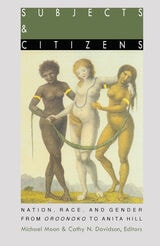
Subjects and Citizens
Nation, Race, and Gender from Oroonoko to Anita HillMichael Moon and Cathy N. Davidson, eds.
Duke University Press, 1995
Defining the landscape of the New American literary history, these essays are united by three interrelated concerns: ideas of origin (where does "American literature" begin?), ideas of nation (what does "American literature" mean?), and ideas of race and gender (what does "American literature" include and exclude and how?). Work by writers as diverse as Aphra Behn, James Fenimore Cooper, Edgar Allan Poe, Frances Harper, Harriet Beecher Stowe, Herman Melville, William Faulkner, Harriet Jacobs, Frederick Douglass, Abraham Lincoln, Bharati Mukherjee, Booker T. Washington, Mark Twain, Kate Chopin, Américo Paredes, and Toni Morrison are discussed from several theoretical perspectives, using a variety of methodologies. Issues of the "frontier" and the "border" as well as those of coloniality and postcoloniality are explored. In each case, these essays emphasize the ideological nature of national identity and, more specifically, the centrality of race and gender to our concept of nationhood.
Collected from recent issues of American Literature, with three new essays added, Subjects and Citizens charts the new directions being taken in American literary studies.
Contributors. Daniel Cooper Alarcón, Lori Askeland, Stephanie Athey, Nancy Bentley, Lauren Berlant, Michele A. Birnbaum, Kristin Carter-Sanborn, Russ Castronovo, Joan Dayan, Julie Ellison, Sander L. Gilman, Karla F. C. Holloway, Annette Kolodny, Barbara Ladd, Lora Romero, Ramón Saldívar, Maggie Sale, Siobhan Senier, Timothy Sweet, Maurice Wallace, Elizabeth Young
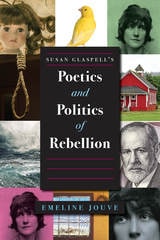
Susan Glaspell's Poetics and Politics of Rebellion
Emeline Jouve
University of Iowa Press, 2017
Analyzing plays from the early Trifles (1916) through Springs Eternal (1943) and the undated, incomplete Wings, author Emeline Jouve illustrates the way that Glaspell’s dramas addressed issues of sexism, the impact of World War I on American values, and the relationship between individuals and their communities, among other concerns. Jouve argues that Glaspell turns the playhouse into a courthouse, putting the hypocrisy of American democracy on trial. In staging rebels fighting for their rights in fictional worlds that reflect her audience’s extradiegetic reality, she explores the strategies available to individuals to free themselves from oppression. Her works envisage a better future for both her fictive insurgents and her spectators, whom she encourages to consider which modes of revolt are appropriate and effective for improving the society they live in. The playwright defines social reform in terms of collaboration, which she views as an alternative to the dominant, alienating social and political structures. Not simply accusing but proposing solutions in her plays, she wrote dramas that enacted a positive revolt.
A must for students of Glaspell and her contemporaries, as well as scholars of American theatre and literature of the first half of the twentieth century.
Swahili Beyond the Boundaries
Literature, Language, and IdentityAlamin Mazrui
Ohio University Press, 2007
Swahili literature is a hybrid that is being reconfigured by a conjuncture of global and local forces. As the interweaving of elements of the colonizer and the colonized, this hybrid formation provides a representation of cultural difference that is said to constitute a “third space,” blurring existing boundaries and calling into question established identitarian categorizations. This cultural dialectic is clearly evident in the Swahili literary experience as it has evolved in the crucible of the politics of African cultural production.
However, Swahili Beyond the Boundaries demonstrates that, from the point of view of Swahili literature, while hybridity evokes endless openness on questions of home and identity, it can simultaneously put closure on specific forms of subjectivity. In the process of this contestation, a new synthesis may be emerging that is poised to subject Swahili literature to new kinds of challenges in the politics of identity, compounded by the dynamics and counterdynamics of post–Cold War globalization.