Results by title
99 books match the query 'Local' and 3 start with s

San Francisco Year Zero
Political Upheaval, Punk Rock and a Third-Place Baseball TeamLincoln A. Mitchell
Rutgers University Press, 2019
San Francisco is a city of contradictions. It is one of the most socially liberal cities in America, but it also has some of the nation’s worst income inequality. It is a playground for tech millionaires, with an outrageously high cost of living, yet it also supports vibrant alternative and avant-garde scenes. So how did the city get this way?
In San Francisco Year Zero, San Francisco native Lincoln Mitchell traces the roots of the current situation back to 1978, when three key events occurred: the assassination of George Moscone and Harvey Milk occurring fewer than two weeks after the massacre of Peoples Temple members in Jonestown, Guyana, the explosion of the city’s punk rock scene, and a breakthrough season for the San Francisco Giants. Through these three strands, Mitchell explores the rifts between the city’s pro-business and progressive-left politicians, the emergence of Dianne Feinstein as a political powerhouse, the increasing prominence of the city’s LGBT community, punk’s reinvigoration of the Bay Area’s radical cultural politics, and the ways that the Giants helped unify one of the most ethnically and culturally diverse cities in the nation.
Written from a unique insider’s perspective, San Francisco Year Zero deftly weaves together the personal and the political, putting a human face on the social upheavals that transformed a city.
[more]
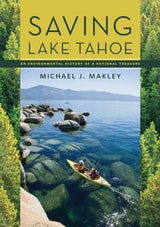
Saving Lake Tahoe
An Environmental History of a National TreasureMichael J. Makley
University of Nevada Press, 2014
The history of Lake Tahoe begins with the Washoe Indians who resided on its shores for thousands of years, with minimal impact on the landscape. The relatively brief American history at Lake Tahoe began in the mid-nineteenth century. Though awestruck by its beauty, the new arrivals were also intent on harvesting its abundant resources. In a mere half century, the basin’s forests and fisheries were destroyed, the lake’s pristine clarity dramatically reduced.
Left alone, nature healed itself, and by the 1960s mature forests once again surrounded the lake and its water clarity improved, with visibility more than one hundred feet deep. However, Tahoe’s wonders brought a new kind of threat: millions of annual visitors and incessant development, including ski resorts and casinos. Saving Lake Tahoe looks at the interaction through the years between human activities and Tahoe’s natural ecosystems. It is a dramatic story of ecological disasters and near misses, political successes and failures. Utilizing primary sources and interviews with key figures, Makley provides a meticulously researched account of the battles surrounding the management of the Tahoe basin.
Makley takes the story up to the present, describing the formation and evolution of a new type of governing body, the bistate Tahoe Regional Planning Agency, and groundbreaking efforts to utilize science in establishing policy. He depicts the passionate fights between those who seek to preserve the environment and advocates of individual property rights. Although Tahoe remains unique in its splendor, readers will understand why, with continued pressure for development, reversing environmental deterioration and improving the lake water’s clarity remain elusive goals.
[more]
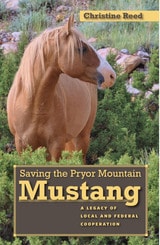
Saving the Pryor Mountain Mustang
A Legacy of Local and Federal CooperationChrstine Reed
University of Nevada Press, 2015
In 1968 the residents of Lovell, Wyoming, began the work of saving the Pryor Mountain Mustang, a breed of horse with a genetic link dating back to the sixteenth-century Spanish conquistadores’ horses. In this moving case study, Christine Reed shows how, through a grassroots campaign, these residents championed the creation of the first federal public wild horse range. Crucial to this provocative analysis of local-federal cooperation is the relationship that grew between the Lovell advocates, the Bureau of Land Management, and the National Park Service. Long before there were federal laws passed to protect wild horse herds across the western states, the Pryor Mountain Mustang was preserved through the cooperative efforts of local residents and federal officials.
Saving the Pryor Mountain Mustang explores the unique and ongoing relationship between locals and the federal government, highlighting the Lovell citizens’ philosophy of cooperation instead of the typical mistrust that exists between wild horse advocates and federal agencies. The book provides a rich analysis of how a determined group of people saved an endangered wild horse herd. The book will have wide appeal to wild horse activists, scholars of local and federal governance, and western history enthusiasts.
Saving the Pryor Mountain Mustang explores the unique and ongoing relationship between locals and the federal government, highlighting the Lovell citizens’ philosophy of cooperation instead of the typical mistrust that exists between wild horse advocates and federal agencies. The book provides a rich analysis of how a determined group of people saved an endangered wild horse herd. The book will have wide appeal to wild horse activists, scholars of local and federal governance, and western history enthusiasts.
[more]