Results by title
97 books match the query 'Louisiana' and 6 start with s

Showdown in Desire
The Black Panthers Take a Stand in New OrleansOrissa Arend
University of Arkansas Press, 2009
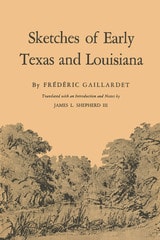
Sketches of Early Texas and Louisiana
By Frédéric Gaillardet
University of Texas Press, 1966
A lively report of travels in early nineteenth-century Texas and Louisiana and a fascinating account of the discovery, exploration, and settlement of those areas is presented in the work of this ebullient young French dramatist and journalist who traveled to Louisiana in 1837 and to Texas in 1839.
Frédéric Gaillardet, an alert and talented writer of the romantic school, was lured away for a decade from a successful career in Paris to satisfy his wanderlust and to seek inspiration on the American frontier. During that time he visited the American Southwest, and he talked with many personages there—men like Sam Houston, Mirabeau B. Lamar, and Achille Murat. His character sketches of these men add zest to the book, as do the facets of Gaillardet's own personality and life displayed in these pages.
Gaillardet's reports of his travels were published in various French-language newspapers of the time; a few were incorporated into the author's posthumous memoirs. His opinions, as recorded in his writings, exerted undeniable influence in the French decision to recognize Texas; one of his theses was that the Republic of Texas might become a curb, rather than a stepping stone, to an expanding United States. Despite Gaillardet's historical importance, however, none of these chapters has ever appeared before in English translation.
This collection was gathered from several sources: the Journal des Débats, the Constitutionnel, the Courrier des États-Unis, and Gaillardet's memoirs, entitled L'Aristocratie en Amérique.
The latter chapters concentrate on the career of a prominent Louisiana lawyer, politician, and diplomat, Pierre Soulé, whose much maligned name Gaillardet repeatedly and stoutly defended. A less favorable treatment of Soulé, contained in Fanny Calderón de la Barca's Attaché in Madrid, is reprinted in the appendix to aid the reader in judging the accuracy of Gaillardet's analysis of this arresting figure.
Copious footnotes to clarify the text have been added by the translator. His introduction presents a biographical sketch of Gaillardet, together with a careful analysis of the book, which has been translated lucidly and vividly.
Sodomy's Solicitations
A Right to QueernessJoseph J. Fischel
Temple University Press, 2025
The political stories narrated in Sodomy’s Solicitations are undoubtedly stories of racism, sexism, homophobia, and transphobia, but they are also stories of other political problems—and political possibilities. Fischel indicts U.S. sex offender regulatory regimes as state-sponsored sexual violence; offers a qualified defense for sexual expression in public; and argues that animal sexual abuse laws, with their exemptions for industrial agricultural practices, authorize the suffering they were enacted to deter. He also makes the case that laws criminalizing the exchange of sex for money are unconstitutional, and proposes that the best way to protect trans and queer children might just be to enfranchise them.
Sodomy’s Solicitations champions a right to queerness across rather than within identity formations—a right to relatively unpoliced gender, sexual, and intimate pluralism.
In the series Sexuality Studies
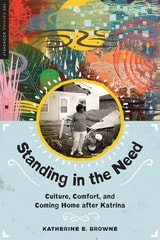
Standing in the Need
Culture, Comfort, and Coming Home After KatrinaBy Katherine E. Browne
University of Texas Press, 2015
Standing in the Need presents an intimate account of an African American family’s ordeal after Hurricane Katrina. Before the storm struck, this family of one hundred fifty members lived in the bayou communities of St. Bernard Parish just outside New Orleans. Rooted there like the wild red iris of the coastal wetlands, the family had gathered for generations to cook and share homemade seafood meals, savor conversation, and refresh their interconnected lives.
In this lively narrative, Katherine Browne weaves together voices and experiences from eight years of post-Katrina research. Her story documents the heartbreaking struggles to remake life after everyone in the family faced ruin. Cast against a recovery landscape managed by outsiders, the efforts of family members to help themselves could get no traction; outsiders undermined any sense of their control over the process. In the end, the insights of the story offer hope. Written for a broad audience and supported by an array of photographs and graphics, Standing in the Need offers readers an inside view of life at its most vulnerable.
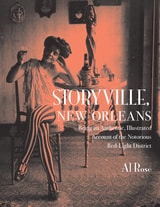
Storyville, New Orleans
Being an Authentic, Illustrated Account of the Notorious Red-Light DistrictAl Rose
University of Alabama Press, 1978
A true-to-life impression of Storyville, the only legally established red light district in the US
At the turn of the twentieth-century, there were hundreds of red-light districts in the United States, ranging in size from a discreet “house” or two in or near small towns and cities to block after bawdy block of brothels in larger cities such as Chicago and San Francisco. Storyville, New Orleans: Being an Authentic, Illustrated Account of the Notorious Red Light District seeks to offer the reader a reasonably true-to-life impression of Storyville, the most famous of the large districts and the only such district in the United States that was legally established.
Storyville was an area, carefully defined by law, outside of which prostitutes or women “notoriously abandoned to lewdness” were not permitted to live or work. Prostitutes working within the District were considered to be engaged in legal enterprises so long as they confined themselves to prostitution and other related activities such as dispensing food and drink to their customers.
From the early days of the French colony of Louisiana, a great number of prostitutes, women from correctional centers, and those with so-called “loose morals” were transported to the New World, resulting in a large proportion of the earliest female residents in New Orleans engaging in prostitution. During the course of Storyville’s legal existence from January 1, 1898 to November 12, 1917—it is evident that in establishing this district the New Orleans city council acted out of a sense of frustration after decades of attempting to deal rationally with a serious social problem. As the author says in the preface, “You may see this as a disorderly book about disorderly houses—and so it may be. But I doubt you will find it dull.”
Subversive Sounds
Race and the Birth of Jazz in New OrleansCharles B. Hersch
University of Chicago Press, 2008
Subversive Sounds probes New Orleans’s history, uncovering a web of racial interconnections and animosities that was instrumental to the creation of a vital American art form—jazz. Drawing on oral histories, police reports, newspaper accounts, and vintage recordings, Charles Hersch brings to vivid life the neighborhoods and nightspots where jazz was born.
This volume shows how musicians such as Jelly Roll Morton, Nick La Rocca, and Louis Armstrong negotiated New Orleans’s complex racial rules to pursue their craft and how, in order to widen their audiences, they became fluent in a variety of musical traditions from diverse ethnic sources. These encounters with other music and races subverted their own racial identities and changed the way they played—a musical miscegenation that, in the shadow of Jim Crow, undermined the pursuit of racial purity and indelibly transformed American culture.
“More than timely . . . Hersch orchestrates voices of musicians on both sides of the racial divide in underscoring how porous the music made the boundaries of race and class.”—New Orleans Times-Picayune