Results by title
58 books match the query 'Margins' and 7 start with s
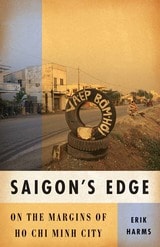
Saigon’s Edge
On the Margins of Ho Chi Minh CityErik Harms
University of Minnesota Press, 2010
Unlike the idealized Vietnamese model of urban space, Hóc Môn is between worlds, neither outside nor inside but always uncomfortably both. With particular attention to everyday social realities, Harms demonstrates how living on the margin can be both alienating and empowering, as forces that exclude its denizens from power and privilege in the inner city are used to thwart the status quo on the rural edges.
More than a local case study of urban change, Harms’s work also opens a window on Vietnam’s larger turn toward market socialism and the celebration of urbanization—transformations instructively linked to trends around the globe.

Shakespeare from the Margins
Language, Culture, ContextPatricia Parker
University of Chicago Press, 1996
Combining feminist and historical approaches with attention to the "matter" of language as well as of race and gender, Parker's brilliant "edification from the margins" illuminates much that has been overlooked, both in Shakespeare and in early modern culture. This book, a reexamination of popular and less familiar texts, will be indispensable to all students of Shakespeare and the early modern period.

Sleaze Artists
Cinema at the Margins of Taste, Style, and PoliticsJeffrey Sconce, ed.
Duke University Press, 2007
Writing about horror, exploitation, and sexploitation films, the contributors delve into topics ranging from the place of the “Aztec horror film” in debates about Mexican national identity to a cycle of 1960s films exploring homosexual desire in the military. One contributor charts the distribution saga of Mario Bava’s 1972 film Lisa and the Devil through the highs and lows of art cinema, fringe television, grindhouse circuits, and connoisseur DVD markets. Another offers a new perspective on the work of Doris Wishman, the New York housewife turned sexploitation director of the 1960s who has become a cult figure in bad-cinema circles over the past decade. Other contributors analyze the relation between image and sound in sexploitation films and Italian horror movies, the advertising strategies adopted by sexploitation producers during the early 1960s, the relationship between art and trash in Todd Haynes’s oeuvre, and the ways that the Friday the 13th series complicates the distinction between “trash” and “legitimate” cinema. The volume closes with an essay on why cinephiles love to hate the movies.
Contributors. Harry M. Benshoff, Kay Dickinson, Chris Fujiwara, Colin Gunckel, Joan Hawkins, Kevin Heffernan, Matt Hills, Chuck Kleinhans, Tania Modleski, Eric Schaefer, Jeffrey Sconce, Greg Taylor
Social Media Tribes
Jordan's Bedouin and the Margins of the StateGeoffrey F. Hughes
University of Texas Press, 2026
An examination of the uses of social media in Jordan through the experiences of Bedouin tribespeople.
It has become something of a cliché to say that social media is making us tribal. But what do self-styled tribespeople themselves think about social media, and how might they help us better understand the role of the internet in our current political moment? Drawing on in-depth ethnographic fieldwork among Bedouin in Jordan, Social Media Tribes underscores the varied but broadly intelligible ways in which distinctive groups domesticate social media to suit their needs.
Organized around key concepts in Bedouin life (including tribalism, envy, and mercy), Social Media Tribes moves between Facebook-mediated tribal truces, upstart online media platforms, palatial urban villas where self-appointed sheikhs dispense justice, and street clashes organized over WhatsApp in rural communities ignored by state development projects. A meticulous researcher and insightful participant-observer, Geoffrey Hughes reframes social media as part of a global renegotiation of the state-society divide that both preceded the emergence of social media platforms and, in turn, feeds off of them. In this telling, the internet represents a new frontier that, like older frontiers, heralds both novel freedoms and novel forms of social control.

Speech and Song at the Margins of Global Health
Zulu Tradition, HIV Stigma, and AIDS Activism in South AfricaSteven P. Black
Rutgers University Press, 2019
Squee from the Margins
Fandom and RaceRukmini Pande
University of Iowa Press, 2018
Rukmini Pande’s examination of race in fan studies is sure to make an immediate contribution to the growing field. Until now, virtually no sustained examination of race and racism in transnational fan cultures has taken place, a lack that is especially concerning given that current fan spaces have never been more vocal about debating issues of privilege and discrimination.
Pande’s study challenges dominant ideas of who fans are and how these complex transnational and cultural spaces function, expanding the scope of the field significantly. Along with interviewing thirty-nine fans from nine different countries about their fan practices, she also positions media fandom as a postcolonial cyberspace, enabling scholars to take a more inclusive view of fan identity. With analysis that spans from historical to contemporary, Pande builds a case for the ways in which non-white fans have always been present in such spaces, though consistently ignored.
State Crime on the Margins of Empire
Rio Tinto, the War on Bougainville and Resistance to MiningKristian Lasslett
Pluto Press, 2014
This book offers a pioneering window into the elusive workings of state-corporate crime within the mining industry. It follows a campaign of resistance organised by indigenous activists on the island of Bougainville, who struggled to close a Rio Tinto owned copper mine, and investigates the subsequent state-corporate response, which led to the shocking loss of some 10,000 lives.
Drawing on internal records and interviews with senior officials, Kristian Lasslett examines how an articulation of capitalist growth mediated through patrimonial politics, imperial state-power, large-scale mining, and clan-based, rural society, prompted an ostensibly ‘responsible’ corporate citizen, and liberal state actors, to organise a counterinsurgency campaign punctuated with gross human rights abuses.
State Crime on the Margins of Empire represents a unique intervention rooted in a classical Marxist tradition that challenges positivist streams of criminological scholarship, in order to illuminate with greater detail the historical forces faced by communities in the global south caught in the increasingly violent dynamics of the extractive industries.