Results by title
120 books match the query 'Marketing' and 8 start with s

Say It with Data
A Concise Guide to Making Your Case and Getting ResultsPriscille Dando
American Library Association, 2014
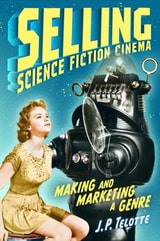
Selling Science Fiction Cinema
Making and Marketing a GenreJ. P. Telotte
University of Texas Press, 2023
How science fiction films in the 1950s were marketed and helped create the broader genre itself.
For Hollywood, the golden age of science fiction was also an age of anxiety. Amid rising competition, fluid audience habits, and increasing government regulation, studios of the 1950s struggled to make and sell the kinds of films that once were surefire winners. These conditions, the leading media scholar J. P. Telotte argues, catalyzed the incredible rise of science fiction.
Though science fiction films had existed since the earliest days of cinema, the SF genre as a whole continued to resist easy definition through the 1950s. In grappling with this developing genre, the industry began to consider new marketing approaches that viewed films as fluid texts and audiences as ever-changing. Drawing on trade reports, film reviews, pressbooks, trailers, and other archival materials, Selling Science Fiction Cinema reconstructs studio efforts to market a promising new genre and, in the process, shows how salesmanship influenced what that genre would become. Telotte uses such films as The Thing from Another World, Forbidden Planet, and The Blob, as well as the influx of Japanese monster movies, to explore the shifting ways in which the industry reframed the SF genre to market to no-longer static audience expectations. Science fiction transformed the way Hollywood does business, just as Hollywood transformed the meaning of science fiction.

Shoveling Smoke
Advertising and Globalization in Contemporary IndiaWilliam Mazzarella
Duke University Press, 2003
An examination of the complex cultural politics of mass consumerism in a globalized marketplace, Shoveling Smoke is a pathbreaking and detailed ethnography of the contemporary Indian advertising industry. It is also a critical and innovative intervention into current theoretical debates on the intersection of consumerist globalization, aesthetic politics, and visual culture. William Mazzarella traces the rise in India during the 1980s of mass consumption as a self-consciously sensuous challenge to the austerities of state-led developmentalism. He shows how the decisive opening of Indian markets to foreign brands in the 1990s refigured established models of the relationship between the local and the global and, ironically, turned advertising professionals into custodians of cultural integrity.

Soda Science
Making the World Safe for Coca-ColaSusan Greenhalgh
University of Chicago Press, 2024
The 1990s were tough times for the soda industry. In the United States, obesity rates were exploding. Public health critics pointed to sugary soda as a main culprit and advocated for soda taxes that might decrease the consumption of sweetened beverages—and threaten the revenues of the giant soda companies.
Soda Science tells the story of how industry leader Coca-Cola mobilized allies in academia to create a soda-defense science that would protect profits by advocating exercise, not dietary restraint, as the priority solution to obesity, a view few experts accept. Anthropologist and science studies specialist Susan Greenhalgh discovers a hidden world of science-making—with distinctive organizations, social networks, knowledge-making practices, and ethical claims—dedicated to creating industry-friendly science and keeping it under wraps. By tracing the birth, maturation, death, and afterlife of the science they made, Greenhalgh shows how corporate science has managed to gain such a hold over our lives.
Spanning twenty years, her investigation takes her from the US, where the science was made, to China, a key market for sugary soda. In the US, soda science was a critical force in the making of today’s society of step-counting, fitness-tracking, weight-obsessed citizens. In China, this distorted science has left its mark not just on national obesity policies but on the apparatus for managing chronic disease generally. By following the scientists and their ambitious schemes to make the world safe for Coke, Greenhalgh offers an account that is more global—and yet more human—than the story that dominates public understanding today.
Coke’s research isn’t fake science, Greenhalgh argues; it was real science, conducted by real and eminent scientists, but distorted by its aim. Her gripping book raises crucial questions about conflicts of interest in scientific research, the funding behind familiar messages about health, and the cunning ways giant corporations come to shape our diets, lifestyles, and health to their own needs.

Sponsored Identities
Cultural Politics in Puerto RicoArlene Davila
Temple University Press, 1997
Author Arlene Davila focuses on the Institute for Puerto Rican Culture, the government institution charged with defining authenticated views of national identity since the 1950s, and on popular festival organizers to illuminate contestations over appropriate representations of culture in the increasingly mass-mediated context of contemporary Puerto Rico. She examines the creation of an essentialist view of nationhood based on a peasant culture and a "unifying" Hispanic heritage, and the ways in which grassroots organizations challenge and reconfigure definitions of national identity through their own activities and representations.
Davila pays particular attention to the increasing prominence of corporate sponsorship in determining what is distinguished as authentic "Puerto Rican culture" and discusses the politicization of culture as a discourse to debate and legitimize conflicting claims from selling commercial product to advocating divergent status options for the island. In so doing, Davila illuminates the prospects for cultural identities in an increasingly transnational context by showing the growth of cultural nationalism to be intrinsically connected to forms of political action directed to the realm of culture and cultural politics. This in-depth examination also makes clear that despite contemporary concerns with "authenticity," commercialism is an inescapable aspect of all cultural expression on the island.

Stagestruck
Theater, AIDS, and the Marketing of Gay AmericaSarah Schulman
Duke University Press, 1998
Closely recounting her discovery of the ways in which Rent took materials from her own novel, Schulman takes us on her riveting and infuriating journey through the power structures of New York theater and media, a journey she pursued to seek legal restitution and make her voice heard. Then, to provide a cultural context for the emergence of Rent—which Schulman experienced first-hand as a weekly theater critic for the New York Press at the time of Rent’s premiere—she reveals in rich detail the off- and off-off-Broadway theater scene of the time. She argues that these often neglected works and performances provide more nuanced and accurate depictions of the lives of gay men, Latinos, blacks, lesbians and people with AIDS than popular works seen in full houses on Broadway stages. Schulman brings her discussion full circle with an incisive look at how gay and lesbian culture has become rapidly commodified, not only by mainstream theater productions such as Rent but also by its reduction into a mere demographic made palatable for niche marketing. Ultimately, Schulman argues, American art and culture has made acceptable a representation of “the homosexual” that undermines, if not completely erases, the actual experiences of people who continue to suffer from discrimination or disease. Stagestruck’s message is sure to incite discussion and raise the level of debate about cultural politics in America today.
Start a Revolution
Stop Acting Like a LibraryBen Bizzle
American Library Association, 2014

Strategic Advertising Mechanisms
From Copy Strategy to Iconic BrandsJorge David Fernández Gómez
Intellect Books, 2021
This book takes an in-depth look at the most important and transcendent strategic advertising mechanisms to emerge in the twentieth century. Charting trends in classic advertising methodologies, the author explores key concepts from Rosser Reeves’s unique selling proposition and Procter & Gamble’s copy strategy to influential modern approaches including Kevin Roberts’s Lovemarks and Douglas Holt’s iconic brand framework. It also considers European mechanisms, including Jacques Séguéla’s star strategy and Henri Joannis’ psychological axis theory. Practitioners, researchers, scholars, and students will find much to gain from this rich exploration of the strategies that shaped modern advertising and the figures behind them.