58 books match the query 'Mass media and culture' and 3 start with s
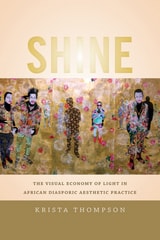
cover of Shine: The Visual Economy of Light in African Diasporic Aesthetic Practice

Shine

The Visual Economy of Light in African Diasporic Aesthetic Practice

Krista Thompson

Duke University Press, 2015
In Jamaican dancehalls competition for the video camera's light is stiff, so much so that dancers sometimes bleach their skin to enhance their visibility. In the Bahamas, tuxedoed students roll into prom in tricked-out sedans, staging grand red-carpet entrances that are designed to ensure they are seen being photographed. Throughout the United States and Jamaica friends pose in front of hand-painted backgrounds of Tupac, flashy cars, or brand-name products popularized in hip-hop culture in countless makeshift roadside photography studios. And visual artists such as Kehinde Wiley remix the aesthetic of Western artists with hip-hop culture in their portraiture. In Shine, Krista Thompson examines these and other photographic practices in the Caribbean and United States, arguing that performing for the camera is more important than the final image itself. For the members of these African diasporic communities, seeking out the camera's light—whether from a cell phone, Polaroid, or video camera—provides a means with which to represent themselves in the public sphere. The resulting images, Thompson argues, become their own forms of memory, modernity, value, and social status that allow for cultural formation within and between African diasporic communities.
 
[more]
cover of Shooting a Revolution: Visual Media and Warfare in Syria

Shooting a Revolution

Visual Media and Warfare in Syria

Donatella Della Ratta

Pluto Press, 2018

From ISIS propaganda videos to popular regime-backed soap operas and digital activism, the Syrian conflict has been profoundly affected by visual media. But what are the aesthetic, political, and material implications of this disturbing collusion between war and digital culture?
            Drawing on a decade of ethnographic research conducted in Syria and neighboring countries, Donatella Della Ratta examines here how the networked age shapes contemporary warfare, from conflict on the ground to the performance of violence on the screen. Her findings present a stark parallel to the digital democracy offered by techno-utopians, delving into the dark side of web 2.0 practices, where visual regimes of representation and media production are put in service of modes of destruction.
            A vivid account of the politics of Syria’s visual media, from commercial television to citizen journalism and Daesh propaganda, Shooting a Revolution offers fascinating insight into the media’s role in transforming conflict zones in the digital age. 
 
[more]
cover of Signal and Noise: Media, Infrastructure, and Urban Culture in Nigeria

Signal and Noise

Media, Infrastructure, and Urban Culture in Nigeria

Brian Larkin

Duke University Press, 2008

Mainstream media and film theory are based on the ways that media technologies operate in Europe and the United States. In this groundbreaking work, Brian Larkin provides a history and ethnography of media in Nigeria, asking what media theory looks like when Nigeria rather than a European nation or the United States is taken as the starting point. Concentrating on the Muslim city of Kano in the north of Nigeria, Larkin charts how the material qualities of technologies and the cultural ambitions they represent feed into the everyday experiences of urban Nigeria.

Media technologies were introduced to Nigeria by colonial regimes as part of an attempt to shape political subjects and create modern, urban Africans. Larkin considers the introduction of media along with electric plants and railroads as part of the wider infrastructural project of colonial and postcolonial urbanism. Focusing on radio networks, mobile cinema units, and the building of cinema theaters, he argues that what media come to be in Kano is the outcome of technology’s encounter with the social formations of northern Nigeria and with norms shaped by colonialism, postcolonial nationalism, and Islam. Larkin examines how media technologies produce the modes of leisure and cultural forms of urban Africa by analyzing the circulation of Hindi films to Muslim Nigeria, the leisure practices of Hausa cinemagoers in Kano, and the dynamic emergence of Nigerian video films. His analysis highlights the diverse, unexpected media forms and practices that thrive in urban Africa. Signal and Noise brings anthropology and media together in an original analysis of media’s place in urban life.

[more]