Results by title
308 books match the query 'Memory' and 19 start with s
Salt in the Sand
Memory, Violence, and the Nation-State in Chile, 1890 to the PresentLessie Jo Frazier
Duke University Press, 2007
Analyzing multiple memories of state violence, Frazier innovatively shapes social and cultural theory to interpret a range of sources, including local and national government archives, personal papers, popular literature and music, interviews, architectural and ceremonial commemorations, and her ethnographic observations of civic associations, women's and environmental groups, and human rights organizations. A masterful integration of extensive empirical research with sophisticated theoretical analysis, Salt in the Sand is a significant contribution to interdisciplinary scholarship on human rights, democratization, state formation, and national trauma and reconciliation.
Scarred Landscapes
Place, Trauma, and Memory in Caribbean Latinx ArtStephanie Lewthwaite
University of Arizona Press, 2025
The book combines formal analysis with artist testimony, exhibition histories, and theoretical frameworks from trauma, memory, and archipelagic studies, to offer a multifaceted examination of Caribbean Latinx art. Lewthwaite explores how these artists practice “archipelagic memory,” a generative, decolonial, and coalitional form of memory work that envisions alternative modes of belonging in difference and solidarity with others. By connecting different people, pasts, and places, Caribbean Latinx artists expose the reverberations of trauma while imagining other worlds beyond it.
This work puts Caribbean Latinx artists at the center of debates about the exclusions of dominant memory narratives and contemporary art worlds, highlighting their contributions to a wider decolonial project of remembrance. By revealing the interconnectedness of traumatic histories and the potential for art to foster empathy and justice, Lewthwaite’s work underscores the importance of relational and decolonial thought for imagining a better society.
Selective Remembrances
Archaeology in the Construction, Commemoration, and Consecration of National PastsEdited by Philip L. Kohl, Mara Kozelsky, and Nachman Ben-Yehuda
University of Chicago Press, 2008
Examining such relatively new or reconfigured nation-states as Iran, Iraq, Turkey, Israel, Russia, Ukraine, India, and Thailand, Selective Remembrances shows how states invoke the remote past to extol the glories of specific peoples or prove claims to ancestral homelands. Religion has long played a key role in such efforts, and the contributors take care to demonstrate the tendency of many people, including archaeologists themselves, to view the world through a religious lens—which can be exploited by new regimes to suppress objective study of the past and justify contemporary political actions.
The wide geographic and intellectual range of the essays in Selective Remembrances will make it a seminal text for archaeologists and historians.
Selenidad
Selena, Latinos, and the Performance of MemoryDeborah Paredez
Duke University Press, 2009
Paredez argues that Selena’s death galvanized Latina/o efforts to publicly mourn collective tragedies (such as the murders of young women along the U.S.-Mexico border) and to envision a brighter future. At the same time, reactions to the star’s death catalyzed political jockeying for the Latino vote and corporate attempts to corner the Latino market. Foregrounding the role of performance in the politics of remembering, Paredez unravels the cultural, political, and economic dynamics at work in specific commemorations of Selena. She analyzes Selena’s final concert, the controversy surrounding the memorial erected in the star’s hometown of Corpus Christi, and the political climate that served as the backdrop to the touring musicals Selena Forever and Selena: A Musical Celebration of Life. Paredez considers what “becoming” Selena meant to the young Latinas who auditioned for the biopic Selena, released in 1997, and she surveys a range of Latina/o queer engagements with Selena, including Latina lesbian readings of the star’s death scene and queer Selena drag. Selenidad is a provocative exploration of how commemorations of Selena reflected and changed Latinidad.

Sense of History
The Place of the Past in American LifeDavid Glassberg
University of Massachusetts Press, 2001
As Americans enter the new century, their interest in the past has never been greater. In record numbers they visit museums and historic sites, attend commemorative ceremonies and festivals, watch historically based films, and reconstruct family genealogies. The question is, Why? What are Americans looking for when they engage with the past? And how is it different from what scholars call “history?”
In this book, David Glassberg surveys the shifting boundaries between the personal, public, and professional uses of the past and explores their place in the broader cultural landscape. Each chapter investigates a specific encounter between Americans and their history: the building of a pacifist war memorial in a rural Massachusetts town; the politics behind the creation of a new historical festival in San Francisco; the letters Ken Burns received in response to his film series on the Civil War; the differing perceptions among black and white residents as to what makes an urban neighborhood historic; and the efforts to identify certain places in California as worthy of commemoration. Along the way, Glassberg reflects not only on how Americans understand and use the past, but on the role of professional historians in that enterprise. Combining the latest research on American memory with insights gained from Glassberg's more than twenty years of personal experience in a variety of public history projects, Sense of History offers stimulating reading for all who care about the future of history in America.
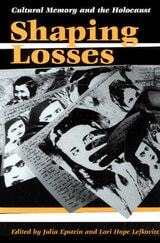
Shaping Losses
CULTURAL MEMORY AND THE HOLOCAUSTEdited by Julia Epstein and Lori Hope Lefkovitz
University of Illinois Press, 2001
This eloquent volume examines how memoirs, films, photographs, art, and literature, as well as family conversations and personal remembrances, embody the impulse to preserve what is destroyed. The contributors -- all distinguished women scholars, most of them survivors or daughters of survivors--examine classic memorializations such as Claude Lanzmann's film Shoah and Roman Vishniac's photographs of prewar Jews as well as several less-well-known works. They also address ways in which children of survivors of the Holocaust--and of other catastrophic traumas--struggle with inherited or vicarious memory, striving to come to terms with losses that centrally define them although they experience them only indirectly.
Shaping Losses considers the limitations of Holocaust representations and testimonies that capture shards of the experience but are necessarily selective and reductive. Contributors discuss artistic efforts to "preserve the rawness" of memory, to resist redemptive closure in Holocaust narratives and public memorials, and to prevent the Holocaust from being sealed in "the cold storage of history." The authors probe the nature of memory and of trauma, studying the use of language within and outside a traumatic context such as Auschwitz and pinpointing the qualities that make traumatic memory ineffable, untransmittable, and perhaps unreliable. Within the "haunted terrain of traumatized memory" that all Holocaust testimonies inhabit, the impulse to give form to emptiness--to shape loss--emerges as a necessary betrayal, a vital effort to bridge the gap between history and memory.
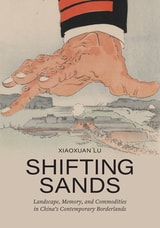
Shifting Sands
Landscape, Memory, and Commodities in China's Contemporary BorderlandsXiaoxuan Lu
University of Texas Press, 2023
How China’s borderlands transformed politically and culturally throughout the twentieth and twenty-first centuries.
China’s land borders, shared with fourteen other nations, are the world’s longest. Like all borders, they are not just lines on a map but also spaces whose histories and futures are defined by their frontier status. An ambitious appraisal of China’s borderlands, Shifting Sands addresses the full scope and importance of these regions, illustrating their transformation from imperial backwaters to hotbeds of resource exploitation and human development in the age of neoliberal globalization.
Xiaoxuan Lu brings to bear an original combination of archival research, fieldwork, cartography, and landscape analysis, broadening our understanding of the political economy and cultural changes in China’s borderlands in the twentieth and twenty-first centuries. While conventional wisdom looks to the era of Deng Xiaoping for China’s “opening,” Lu shows the integration of China’s borderlands into national and international networks from Sun Yat-sen onward. Yet, while the state has left a firm imprint on the borderlands, they were hardly created by China alone. As the Chinese case demonstrates, all borderlands are transnational, their physical and socioeconomic landscapes shaped by multidirectional flows of materials, ideas, and people.
Shuva
The Future of the Jewish PastYehuda Kurtzer
Brandeis University Press, 2012

Silent City on a Hill
Landscapes of Memory and Boston’s Mount Auburn CemeteryBlanche Linden-Ward
The Ohio State University Press, 1900
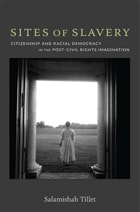
Sites of Slavery
Citizenship and Racial Democracy in the Post–Civil Rights ImaginationSalamishah Tillet
Duke University Press, 2012
Slips of the Mind
Poetry as ForgettingJennifer Soong
University of Chicago Press, 2025
In Slips of the Mind, poet and critic Jennifer Soong turns away from forgetting’s long-standing associations with suppression, privation, and error to argue that the absence or failure of memory has often functioned as a generative creative principle. Exploring forgetting not as the mere rejection of a literary past or a form of negative poetics, Soong puts to the test its very aesthetic meaning. What new structures, forms of desires, styles, and long and short feelings do lapses in time allow? What is oblivion’s relationship to composition? And how does the twentieth-century poet come to figure as the quintessential embodiment of such questions?
Soong uncovers forgetting’s influence on Gertrude Stein, Lyn Hejinian, Tan Lin, Harryette Mullen, Lissa Wolsak, and New York School poets John Ashbery, James Schuyler, Bernadette Mayer, and Ted Berrigan, among others. She reveals that forgetting’s shapeshifting produces differences in poetic genre, interest, and degrees of intentionality—and that such malleability is part of forgetting’s nature. Most provocatively, Soong shows how losing track of things, leaving them behind, or finding them already gone resists overdetermination and causality in the name of surprise, as poets leverage forgetting in order to replace identity with style. Slips of the Mind is the kind of literary criticism that will reward all readers of modern and contemporary poetry.
Social Memory in Athenian Public Discourse
Uses and Meanings of the PastBernd Steinbock
University of Michigan Press, 2013
Integrating literary, epigraphic, and archaeological evidence with recent scholarship on memory, identity, rhetoric, and international relations, Social Memory in Athenian Public Discourse: Uses and Meanings of the Past enhances our understanding of both the function of memory in Athenian public discourse and the history of Athenian-Theban relations. It should be of interest not only to students of Greek history and oratory but to everybody interested in memory studies, Athenian democracy, and political decision making.
Southern Heritage on Display
Public Ritual and Ethnic Diversity within Southern RegionalismEdited by Celeste Ray
University of Alabama Press, 2002
W. J. Cash's 1941 observation that “there are many Souths and many cultural traditions among them” is certainly validated by this book. Although the Civil War and its “lost cause” tradition continues to serve as a cultural root paradigm in celebrations, both uniting and dividing loyalties, southerners also embrace a panoply of public rituals—parades, cook-offs, kinship homecomings, church assemblies, music spectacles, and material culture exhibitions—that affirm other identities. From the Appalachian uplands to the Mississippi Delta, from Kentucky bluegrass to Carolina piedmont, southerners celebrate in festivals that showcase their diverse cultural backgrounds and their mythic beliefs about themselves.
The ten essays of this cohesive, interdisciplinary collection present event-centered research from various fields of study—anthropology, geography, history, and literature—to establish a rich, complex picture of the stereotypically “Solid South.” Topics include the Mardi Gras Indian song cycle as a means of expressing African-American identity in New Orleans; powwow performances and Native American traditions in southeast North Carolina; religious healings in southern Appalachian communities; Mexican Independence Day festivals in central Florida; and, in eastern Tennessee, bonding ceremonies of melungeons who share Indian, Scots Irish, Mediterranean, and African ancestry. Seen together, these public heritage displays reveal a rich “creole” of cultures that have always been a part of southern life and that continue to affirm a flourishing regionalism.
This book will be valuable to students and scholars of cultural anthropology, American studies, and southern history; academic and public libraries; and general readers interested in the American South. It contributes a vibrant, colorful layer of understanding to the continuously emerging picture of complexity in this region historically depicted by simple stereotypes.
Southern Stages
Space and Memory in US PerformanceHopkins, Chandra
University of Iowa Press, 2025
Through the eyes of actors and everyday people, Southern Stages offers an engaging new model for interrogating the performance of southernness, as well as how memory and imagination intersect in spaces that have shaped hundreds of years of American history. Chandra Owenby Hopkins employs cultural memory and lived realities of Black and white communities to examine the earliest and most enduring southern stages: the playhouse and the public square.
Sown in Earth
Essays of Memory and BelongingFred Arroyo
University of Arizona Press, 2020
In Sown in Earth, Arroyo often roots his thoughts and feelings in place, expressing a deep connection to the small homes he inhabited in his childhood, his warm and hazy memories of his grandmother’s kitchen in Puerto Rico, the rivers and creeks he fished, and the small cafés in Madrid that inspired writing and reflection in his adult years. Swirling in romantic moments and a refined love for literature, Arroyo creates a sense of belonging and appreciation for his life despite setbacks and complex anxieties along the way.
By crafting a written journey through childhood traumas, poverty, and the impact of alcoholism on families, Fred Arroyo clearly outlines how his lived experiences led him to become a writer. Sown in Earth is a shocking yet warm collage of memories that serves as more than a memoir or an autobiography. Rather, Arroyo recounts his youth through lyrical prose to humanize and immortalize the hushed lives of men like his father, honoring their struggle and claiming their impact on the writers and artists they raised.
State Repression and the Labors of Memory
Elizabeth Jelin
University of Minnesota Press, 2003
A timely exploration of the nature of memory and its political uses
Hearing the news from South America at the turn of the millennium can be like traveling in time: here are the trials of Pinochet, the searches for “the disappeared” in Argentina, the investigation of the death of former president Goulart in Brazil, the Peace Commission in Uruguay, the Archive of Terror in Paraguay, a Truth Commission in Peru. As societies struggle to come to terms with the past and with the vexing questions posed by ineradicable memories, this wise book offers guidance.
Combining a concrete sense of present urgency and a theoretical understanding of social, political, and historical realities, State Repression and the Labors of Memory fashions tools for thinking about and analyzing the presences, silences, and meanings of the past. With unflappable good judgment and fairness, Elizabeth Jelin clarifies the often muddled debates about the nature of memory, the politics of struggles over memories of historical injustice, the relation of historiography to memory, the issue of truth in testimony and traumatic remembrance, the role of women in Latin American attempts to cope with the legacies of military dictatorships, and problems of second-generation memory and its transmission and appropriation. Jelin’s work engages European and North American theory in its exploration of the various ways in which conflicts over memory shape individual and collective identities, as well as social and political cleavages. In doing so, her book exposes the enduring consequences of repression for social processes in Latin America, and at the same time enriches our general understanding of the fundamentally conflicted and contingent nature of memory.
States of Memory
Continuities, Conflicts, and Transformations in National RetrospectionJeffrey K. Olick, ed.
Duke University Press, 2003
The contributors—including historians and social scientists—describe societies’ struggles to produce and then use ideas of what a “normal” past should look like. They examine claims about the genuineness of revolution (in fascist Italy and communist Russia), of inclusiveness (in the United States and Australia), of innocence (in Germany), and of inevitability (in Israel). Essayists explore the reputation of Confucius among Maoist leaders during China’s Cultural Revolution; commemorations of Martin Luther King Jr. in the United States Congress; the “end” of the postwar era in Japan; and how national calendars—in signifying what to remember, celebrate, and mourn—structure national identification. Above all, these essays reveal that memory is never unitary, no matter how hard various powers strive to make it so.
States of Memory will appeal to those scholars—in sociology, history, political science, cultural studies, anthropology, and art history-who are interested in collective memory, commemoration, nationalism, and state formation.
Contributors. Paloma Aguilar, Frederick C. Corney, Carol Gluck, Matt K. Matsuda, Jeffrey K. Olick, Francesca Polletta, Uri Ram, Barry Schwartz, Lyn Spillman, Charles Tilly, Simonetta Falasca Zamponi, Eviatar Zerubavel, Tong Zhang
Stories of Our Lives
Memory, History, NarrativeFrank de Caro
Utah State University Press, 2013
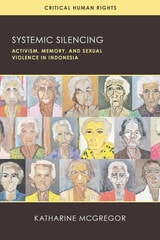
Systemic Silencing
Activism, Memory, and Sexual Violence in IndonesiaKatharine E. McGregor
University of Wisconsin Press, 2023